 Back
Change of Phase: Physics with Calculus Study Notes
Study Guide - Smart Notes
 Tailored notes based on your materials, expanded with key definitions, examples, and context.
Change of Phase
Phases of Matter
The four common phases of matter are solid, liquid, gas, and plasma. The phase of a material depends on its temperature and pressure, and changes of phase require the transfer of internal energy.
Solid phase: Molecules are tightly bound in a fixed structure (e.g., ice).
Liquid phase: Molecules are less tightly bound and can move past each other (e.g., water).
Gas phase: Molecules move freely and are far apart (e.g., water vapor).
Plasma phase: At very high energy, atoms disintegrate into ions and electrons.
Energy must be added to move from solid to liquid to gas to plasma, causing molecules to move more rapidly.
Evaporation
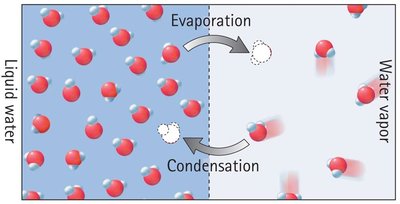
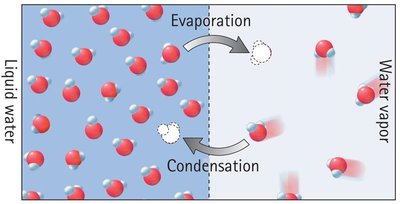
Evaporation is the change of phase from liquid to gas. It occurs when energetic molecules at the surface of a liquid escape into the gas phase.
Molecules in a liquid move randomly at various speeds, colliding and exchanging kinetic energy.
Some molecules gain enough energy to escape the liquid, becoming vapor.
The average kinetic energy of the remaining liquid molecules decreases, resulting in cooling.
Evaporation is important for cooling our bodies, as sweat absorbs heat and evaporates.
Sublimation: Direct phase change from solid to gas (e.g., dry ice, mothballs).
Condensation
Condensation is the opposite of evaporation: gas molecules near a liquid surface are attracted to the liquid, strike the surface, and become part of the liquid. This process increases the liquid's temperature and is a warming process.
Kinetic energy is absorbed by the liquid, raising its temperature.
Examples: Steam releases energy when it condenses, causing burns; moist shower stalls feel warmer due to condensation.
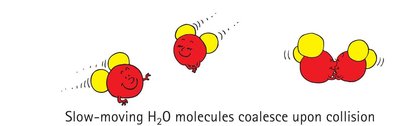
Atmospheric condensation occurs when slow-moving water molecules stick together, forming fog and clouds.
Boiling
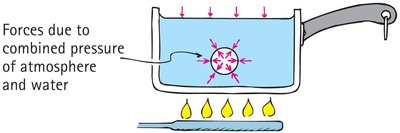
Boiling is rapid evaporation from beneath the surface of a liquid, forming vapor bubbles that rise to the surface. Boiling occurs when the vapor pressure equals or exceeds atmospheric pressure.
Bubbles collapse if vapor pressure is less than surrounding pressure.
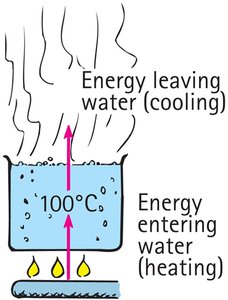
Boiling water at 100°C is in thermal equilibrium: cooling and heating occur at equal rates.
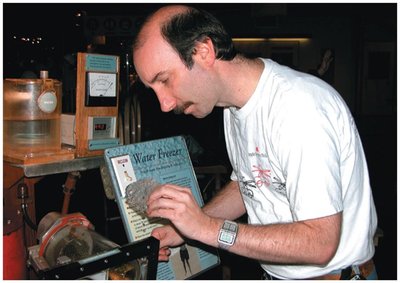
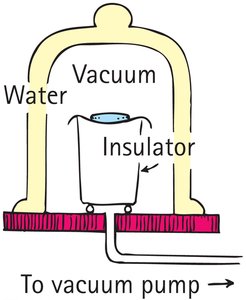
Boiling point depends on atmospheric pressure; lower pressure lowers boiling point (e.g., water boils at 95°C in Denver).
Melting and Freezing
Melting is the phase change from solid to liquid, while freezing is the change from liquid to solid. Both processes involve the transfer of energy.
Melting occurs when heat supplied to a solid increases molecular vibration, breaking the structure.
Freezing occurs when energy is removed from a liquid, decreasing molecular motion until molecules bind together.
Energy and Change of Phase
Energy must be added to change a substance from solid to liquid to gas, and removed to change from gas to liquid to solid. The direction of energy transfer determines whether energy is absorbed or released.
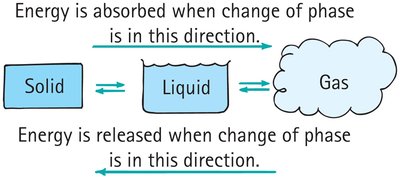
Heat of fusion: Energy needed to change a substance from solid to liquid (e.g., water: 334 J/g).
Heat of vaporization: Energy needed to change a substance from liquid to gas (e.g., water: 2256 J/g).
Condensing 1 gram of steam releases more energy than melting or cooling a similar mass of water or ice.
Melting ice in a cooler absorbs more heat from beverages than simply warming the ice.
Key Formulas
Heat of fusion:
Heat of vaporization:
Specific heat:
Example Table: Energy Required for Phase Changes
Process | Energy (calories per gram) |
|---|---|
Condensing 1g steam to water | 540 |
Freezing 1g water | 80 |
Cooling 1g ice from 0°C to -273°C | 136.5 |
Melting 1g ice | 80 |
Vaporizing 1g water | 540 |
Summary: Changes of phase are fundamental to understanding energy transfer in physics. Each phase change involves specific energy requirements, and the direction of change determines whether energy is absorbed or released.
