 Back
Change of Phase: Physics with Calculus Study Notes
Study Guide - Smart Notes
 Tailored notes based on your materials, expanded with key definitions, examples, and context.
Change of Phase
Phases of Matter
The four common phases of matter are solid, liquid, gas, and plasma. The phase of a material depends on its temperature and pressure, and transitions between phases require the transfer of internal energy.
Solid: Molecules are tightly bound in a fixed structure (e.g., ice).
Liquid: Molecules are less tightly bound and can move past each other (e.g., water).
Gas: Molecules move freely and are far apart (e.g., water vapor).
Plasma: At very high energy, molecules disintegrate into ions and electrons.
Energy must be added to move from solid → liquid → gas → plasma, causing molecules to move more rapidly.
Evaporation
Evaporation is the change of phase from liquid to gas. It occurs when energetic molecules at the surface of a liquid escape into the gas phase. This process cools the remaining liquid because the average kinetic energy decreases.
Evaporation is important for cooling, such as perspiration cooling the human body.
Evaporation is a cooling process because the most energetic molecules leave the liquid.
Sublimation: Direct phase change from solid to gas (e.g., dry ice).
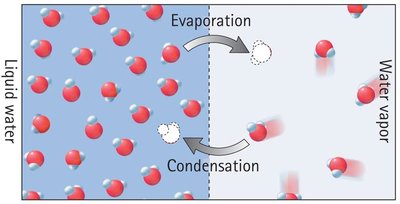
Example: Sweat evaporates from skin, absorbing body heat and cooling the body.
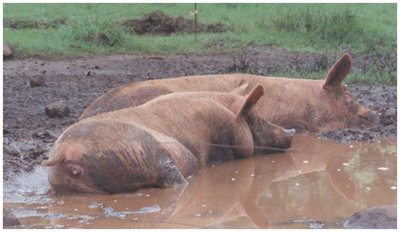
Additional info: Evaporation is used in industrial cooling and in natural processes such as the water cycle.
Condensation
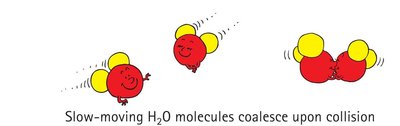
Condensation is the opposite of evaporation: gas molecules near a liquid surface are attracted to the liquid, strike the surface, and become part of the liquid. This process increases the liquid's temperature and is a warming process.
Condensation occurs when gas molecules lose kinetic energy and join the liquid phase.
Condensation releases energy to the liquid, warming it.
Examples: Steam burns are more damaging than boiling water burns due to energy released during condensation.
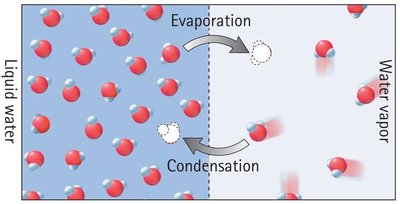
Example: In humid environments, condensation on skin makes you feel warmer; in dry environments, evaporation dominates and you feel cooler.
Condensation in the atmosphere leads to fog and clouds when air rises and cools.
Boiling
Boiling is rapid evaporation from beneath the surface of a liquid, forming vapor bubbles that rise to the surface. Boiling occurs when the vapor pressure inside bubbles equals or exceeds the surrounding pressure.
Boiling is a cooling process; boiling water is cooled as fast as it is warmed.
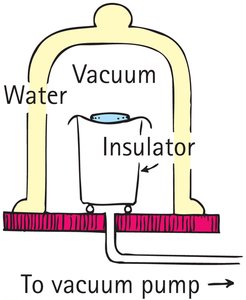
Boiling point depends on atmospheric pressure: lower pressure lowers boiling point.
Pressure cookers increase boiling point by increasing pressure.
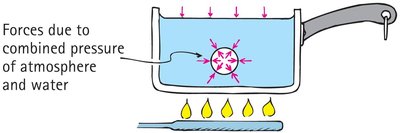
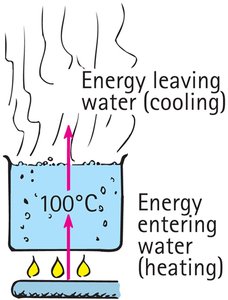
Example: Water boils at 95°C in Denver (high altitude) compared to 100°C at sea level.
Melting and Freezing
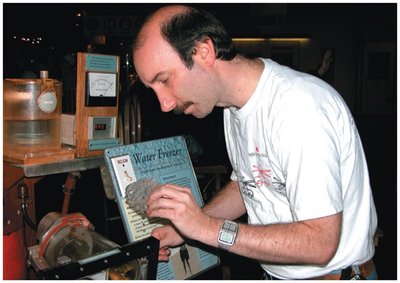
Melting is the phase change from solid to liquid, occurring when heat breaks the molecular structure. Freezing is the reverse, where energy is removed and molecules bind together to form a solid.
Melting: Heat increases molecular vibration, breaking bonds.
Freezing: Removal of energy decreases motion, allowing attraction forces to bind molecules.
Energy and Change of Phase
Phase changes require energy transfer. Energy is absorbed when moving from solid to liquid to gas, and released when moving from gas to liquid to solid.
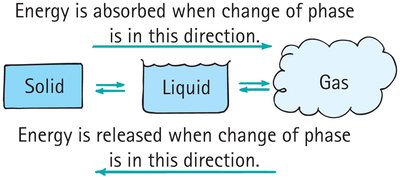
Heat of fusion: Energy needed to change a substance from solid to liquid (e.g., water: 334 J/g).
Heat of vaporization: Energy needed to change a substance from liquid to gas (e.g., water: 2256 J/g).
Example: Refrigerators and air conditioners use vaporization and condensation cycles to transfer heat.
Additional info: The energy released or absorbed during phase changes is crucial in meteorology, engineering, and biology.
Key Formulas
Heat of fusion:
Heat of vaporization:
Specific heat:
Where Q is heat energy, m is mass, L_f is latent heat of fusion, L_v is latent heat of vaporization, c is specific heat, and \Delta T is temperature change.
Summary Table: Phase Changes and Energy
Phase Change | Direction | Energy | Example |
|---|---|---|---|
Melting | Solid → Liquid | Absorbed | Ice melting to water |
Freezing | Liquid → Solid | Released | Water freezing to ice |
Evaporation | Liquid → Gas | Absorbed | Water evaporating |
Condensation | Gas → Liquid | Released | Steam condensing |
Sublimation | Solid → Gas | Absorbed | Dry ice sublimating |
Deposition | Gas → Solid | Released | Frost forming |
