 Back
Chapter 1: Concepts of Motion – Physics with Calculus Study Notes
Study Guide - Smart Notes
 Tailored notes based on your materials, expanded with key definitions, examples, and context.
Concepts of Motion
Introduction to Physics and Motion
Physics is the study of the natural world, focusing on discovering and understanding the laws that govern physical phenomena. Motion is a fundamental concept in physics, describing how objects change position over time. Understanding motion is essential for analyzing everything from everyday activities to cosmic events.
Physics Principles: These are discovered through observation and experiment, not invented, and are tested by repeated experimentation.
Laws of Nature: Universal rules that describe how objects behave in the universe.



Describing Motion
Motion Diagrams and the Particle Model
To analyze motion, physicists use models and diagrams that simplify real-world objects and their movements. The particle model treats objects as if all their mass is concentrated at a single point, making analysis more manageable.
Motion Diagram: A sequence of images showing an object's position at equal time intervals.
Particle: An object represented as a mass at a single point in space.
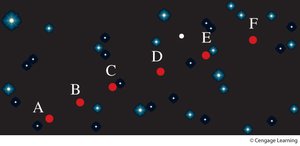
Position, Displacement, and Coordinate Systems
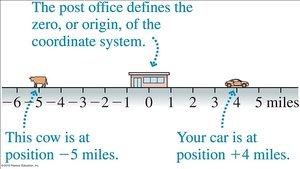
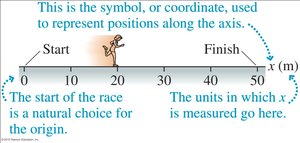
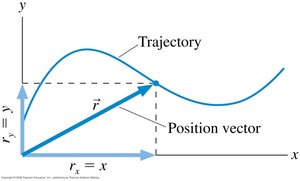
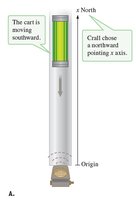
To specify an object's location, a coordinate system is established with a reference point called the origin. The position vector points from the origin to the object's location.
Position (x): The location of an object relative to the origin.
Displacement (Δx): The change in position, calculated as the final position minus the initial position.
Vectors in Motion
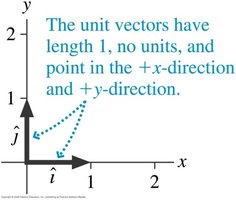
Many physical quantities, such as displacement and velocity, have both magnitude and direction. These are called vectors. Scalars, in contrast, have only magnitude.
Vector: Quantity with both magnitude and direction (e.g., velocity, displacement).
Scalar: Quantity with only magnitude (e.g., speed, distance).
Vector Addition and Subtraction
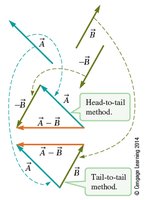
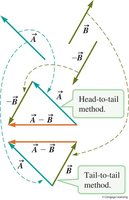
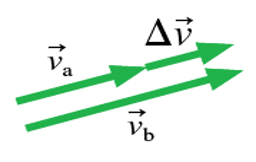
Vectors can be added graphically using the head-to-tail method or subtracted by adding the negative of a vector. This is essential for determining resultant displacement or velocity.
Graphical Addition: Place the tail of one vector at the head of another.
Subtraction: Add the negative (opposite) of the vector to be subtracted.
Time, Velocity, and Acceleration
Time Interval and Average Velocity
The time interval (Δt) is the difference between two time readings. Average velocity is defined as the displacement divided by the time interval:
Average Velocity:
Average Speed: Total distance traveled divided by total time; always positive.
Instantaneous Velocity and Acceleration
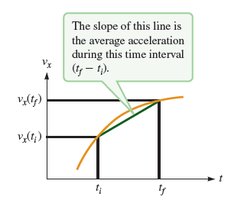
Instantaneous velocity is the velocity at a specific moment, while acceleration describes how velocity changes over time. Average acceleration is given by:
Average Acceleration:
Interpreting Motion Diagrams
Motion diagrams with velocity and acceleration vectors help visualize how an object's speed and direction change. When velocity and acceleration point in the same direction, the object speeds up; when they point in opposite directions, the object slows down.
Position-versus-Time Graphs
Graphical Representation of Motion
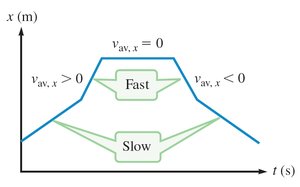
Position-versus-time graphs provide a visual way to analyze motion. The slope of the graph at any point gives the instantaneous velocity. A straight line indicates constant velocity, while a curved line indicates changing velocity (acceleration).
Slope of x vs. t graph:
Units, Significant Figures, and Measurement
SI Units and Prefixes
Physics uses the International System of Units (SI) for consistency. The basic SI units are the meter (m) for length, kilogram (kg) for mass, and second (s) for time. Prefixes denote powers of ten for convenience.
Power of 10 | Prefix | Abbreviation |
|---|---|---|
10-12 | pico | p |
10-9 | nano | n |
10-6 | micro | μ |
10-3 | milli | m |
10-2 | centi | c |
103 | kilo | k |
106 | mega | M |
109 | giga | G |
1012 | tera | T |
Unit Conversions
Converting between units is essential for solving physics problems. Use conversion factors to change from one unit to another.
Conversion | Value |
|---|---|
1 in = | 2.54 cm |
1 mi = | 1.609 km |
1 mph = | 0.447 m/s |
1 m = | 39.37 in |
1 km = | 0.621 mi |
1 m/s = | 2.24 mph |

Significant Figures and Measurement Precision
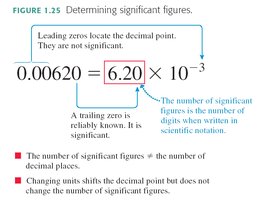
Significant figures reflect the precision of a measurement. The rules for identifying significant figures ensure that calculations do not imply greater accuracy than the measurements allow.
Nonzero digits are always significant.
Zeros between significant digits are significant.
Trailing zeros are significant only if there is a decimal point.
Leading zeros are not significant.
Calculations with Significant Figures
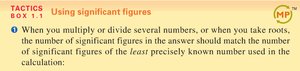
When performing calculations, the result should have no more significant figures than the least precise measurement used in the calculation. This is known as the "weakest link" rule.
Dimensional Analysis
Checking Equations for Consistency
Dimensional analysis involves checking that both sides of an equation have the same dimensions. This is a powerful tool for verifying the correctness of equations and for deriving relationships between physical quantities.
Dimensions of length: L
Dimensions of time: T
Dimensions of mass: M
For example, in the equation , the dimension of A must be distance/time4 for the equation to be dimensionally consistent.
Order-of-Magnitude Estimates
Estimating Physical Quantities
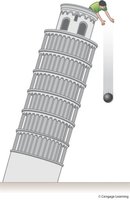
Order-of-magnitude estimates provide approximate values based on powers of ten. These are useful for quickly checking the plausibility of answers and for making rough calculations when only limited information is available.
Symbol "~" indicates an order-of-magnitude estimate.
Example: The speed of a rock falling off a cliff might be estimated as mph.
Problem-Solving Strategies in Physics
General Approach
Solving physics problems involves several steps:
Model: Simplify the situation by making reasonable assumptions.
Visualize: Draw diagrams and graphs to represent the problem.
Solve: Use mathematical equations to find the answer.
Review: Check units, significant figures, and the plausibility of the result.
Summary Table: Key Concepts
Concept | Definition |
|---|---|
Position | Location relative to origin |
Displacement | Change in position |
Velocity | Rate of change of position |
Acceleration | Rate of change of velocity |
Vector | Quantity with magnitude and direction |
Scalar | Quantity with magnitude only |
Additional info: This guide covers the foundational concepts of motion, vectors, units, significant figures, and problem-solving strategies, as introduced in Chapter 1 of a calculus-based physics course. These principles are essential for all subsequent topics in physics.
