 Back
Chapter 1: Concepts of Motion – Physics with Calculus Study Notes
Study Guide - Smart Notes
 Tailored notes based on your materials, expanded with key definitions, examples, and context.
Concepts of Motion
Introduction to Physics
Physics is a physical science that seeks to understand the laws governing natural phenomena, from the smallest particles to the largest galaxies. The principles of physics are discovered through experimentation and observation, not invented, and are continually tested for validity.
Laws of Nature: Fundamental rules that describe the behavior of the physical world.
Experimentation: Essential for testing and validating physical principles.

Additional info: Physics covers phenomena at all scales, from atomic to cosmic.
Describing Motion
Motion is a central theme in physics, and understanding it requires precise descriptions using diagrams, graphs, and mathematical representations. Key concepts include position, velocity, and acceleration.
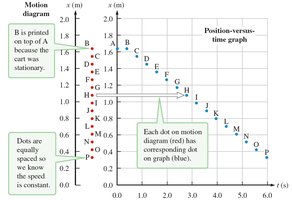
Motion Diagrams: Visual representations showing an object's position at successive times.
Graphs: Used to plot position, velocity, or acceleration versus time.
Pictures: Help visualize the physical situation.
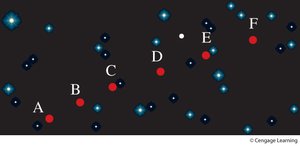
The Particle Model
For many types of motion, objects can be modeled as particles, concentrating all mass at a single point. This simplifies analysis and is especially useful in motion diagrams.
Particle: An object represented as a mass at a single point in space.
Motion Diagram: Each frame shows the particle as a dot.

Position and Coordinate Systems
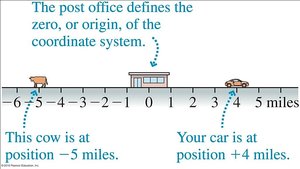
To describe motion quantitatively, a coordinate system is established with a reference point called the origin. Position is measured relative to this origin.
Position: Location of an object relative to the origin.
Coordinate System: Grid used to measure position and direction.
Vectors and Direction
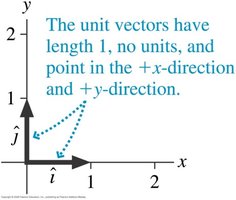
Many physical quantities, such as velocity and acceleration, have both magnitude and direction. These are called vectors. Unit vectors indicate direction in coordinate systems.
Vector: Quantity with both magnitude and direction.
Unit Vector: Vector of length 1, used to specify direction.
Position Vector and Displacement
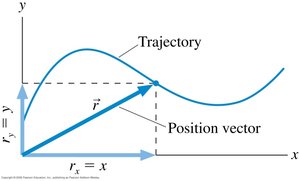
The position vector is an arrow from the origin to the object's location. Displacement is the change in position, represented as a vector.
Position Vector: points from origin to object.
Displacement:
Vector Addition and Subtraction
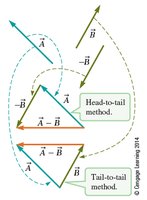
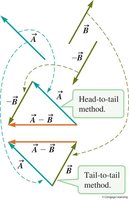
Vectors are added graphically using the head-to-tail method. Subtraction involves adding the negative of a vector.
Head-to-Tail Method: Place the tail of one vector at the head of another.
Negative Vector: Same magnitude, opposite direction.
Time, Velocity, and Speed
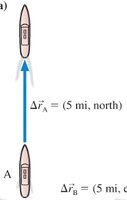
Time intervals are measured with stopwatches. Average velocity is displacement divided by time, while average speed is total distance divided by time.
Average Velocity:
Average Speed:
Acceleration
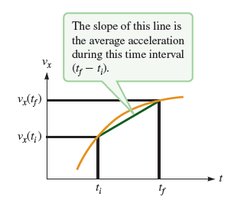
Acceleration is the rate of change of velocity. It is a vector quantity and can be determined from motion diagrams or velocity-time graphs.
Average Acceleration:
SI Unit: m/s2
Position-versus-Time Graphs
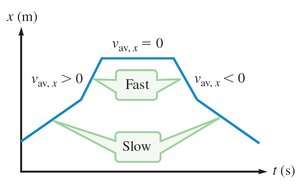
Position-time graphs provide a visual representation of motion. The slope of the graph at any point gives the velocity.
Average Velocity: Slope of position-time graph.
Constant Speed: Straight line on position-time graph.
Problem-Solving in Physics
Solving physics problems involves modeling, visualizing, and translating verbal statements into mathematical equations. Multiple representations (pictorial, graphical, mathematical) are used.
Model: Simplify the situation to essential features.
Visualize: Draw diagrams and graphs.
Solve: Use equations to find numerical answers.
Review: Check units and significant figures.
Units and SI System
Physics uses the SI system for measurements. The basic units are meter (m), kilogram (kg), and second (s). Prefixes denote powers of ten for convenience.
SI Units: Standard units for length, mass, and time.
Prefixes: Used for multiples and submultiples (e.g., kilo-, milli-).
Power of 10 | Prefix | Abbreviation |
|---|---|---|
10-12 | pico | p |
10-9 | nano | n |
10-6 | micro | μ |
10-3 | milli | m |
10-2 | centi | c |
103 | kilo | K |
106 | mega | M |
109 | giga | G |
1012 | tera | T |
Unit Conversion and Dimensional Analysis
Unit conversion is essential for comparing and calculating physical quantities. Dimensional analysis checks the consistency of equations.
Unit Conversion: Use conversion factors to change units.
Dimensional Analysis: Ensures equations are dimensionally correct.
Precision, Accuracy, and Significant Figures
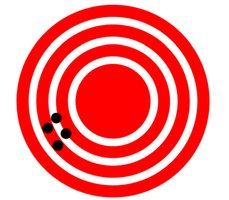
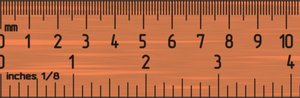
Measurements in physics must be reported with appropriate precision and significant figures. Accuracy refers to closeness to the true value, while precision refers to repeatability.
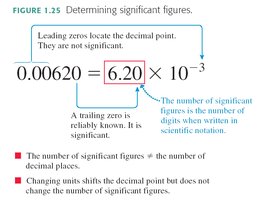
Significant Figures: Digits that convey meaningful information about precision.
Reporting: Use scientific notation to avoid ambiguity.
Calculations with Significant Figures
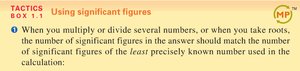
When performing calculations, the number of significant figures in the result should match that of the least precise measurement.
Multiplication/Division: Result has the same number of significant figures as the least precise input.
Addition/Subtraction: Result has the same number of decimal places as the least precise input.
Order-of-Magnitude Estimates
Order-of-magnitude estimates are rough calculations based on powers of ten, useful for quick checks and approximations.
Symbol: "~" denotes order-of-magnitude.
Application: Used when only approximate values are known.
Summary of Key Concepts
Particle Model: Simplifies analysis by concentrating mass at a point.
Position, Displacement, Velocity, Acceleration: Fundamental quantities for describing motion.
SI Units and Significant Figures: Ensure clarity and precision in communication.
Problem-Solving Strategy: Model, visualize, solve, and review.
