 Back
BackChapter 1: Introduction, Measurement, and Estimating
Study Guide - Smart Notes
 Tailored notes based on your materials, expanded with key definitions, examples, and context.
Chapter 1: Introduction, Measurement, and Estimating
1-1 The Nature of Science
Physics is a science that seeks to understand the fundamental laws of nature through observation, theory, and experimentation. The scientific method involves a continuous cycle of observation, theory development, prediction, and further observation.
Observation: The initial step in scientific inquiry, requiring careful attention and imagination to identify significant phenomena.
Theories: Explanatory frameworks developed to account for observations. Theories must make predictions that can be tested by further experiments.
Acceptance of New Theories: A new theory is accepted if its predictions agree better with experimental data and if it explains a broader range of phenomena than previous theories.
1-2 Physics and Its Relation to Other Fields
Physics is foundational to many other disciplines, including engineering, architecture, and the life sciences. Effective communication between professionals in these fields is essential to prevent errors and ensure safety.
Applications: Physics principles are crucial in designing structures (architecture, engineering) and understanding biological systems (physiology, zoology).
Interdisciplinary Importance: Collaboration between architects and engineers is vital to avoid structural failures.


1-3 Models, Theories, and Laws
Scientific understanding is built on models, theories, laws, and principles, each serving a distinct role in describing and predicting natural phenomena.
Model: A simplified representation or analogy used to visualize and understand complex phenomena. Models have limitations and should not be taken as literal descriptions.
Theory: A comprehensive explanation that provides testable predictions and is supported by a significant body of evidence.
Law: A concise statement describing how nature behaves under certain conditions, often expressed mathematically.
Principle: Similar to a law but applies to a narrower range of phenomena.
1-4 Measurement and Uncertainty; Significant Figures
All measurements in physics are subject to uncertainty due to limitations in instruments and human error. Understanding and expressing this uncertainty is essential for scientific accuracy.
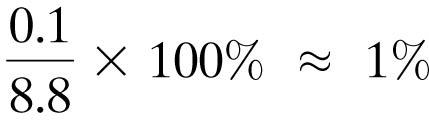
Uncertainty: No measurement is exact; uncertainty is indicated using the ± symbol (e.g., 8.8 ± 0.1 cm).
Percent Uncertainty: The ratio of the uncertainty to the measured value, multiplied by 100%.

Formula for Percent Uncertainty:
Significant Figures: The number of reliably known digits in a measurement. The way a number is written indicates its significant figures (e.g., 23.21 cm has 4 significant figures; 0.062 cm has 2 significant figures).
Rules for Calculations:
Multiplication/Division: The result should have as many significant figures as the value with the fewest significant figures.
Addition/Subtraction: The result should have the same number of decimal places as the least precise value.
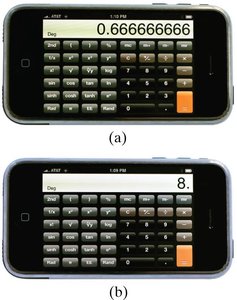
Calculator Limitations: Calculators may display too many or too few significant figures; it is the user's responsibility to round appropriately.
1-5 Units, Standards, and the SI System
Physics relies on standardized units for clear communication and reproducibility. The International System of Units (SI) is the most widely used system in science.
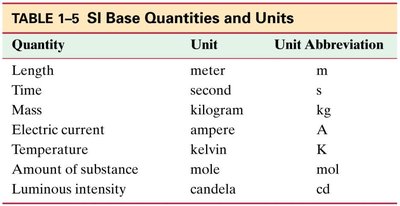
Base Quantities and Units: The SI system defines seven base quantities, each with a standard unit.
Quantity | Unit | Unit Abbreviation |
|---|---|---|
Length | meter | m |
Time | second | s |
Mass | kilogram | kg |
Electric current | ampere | A |
Temperature | kelvin | K |
Amount of substance | mole | mol |
Luminous intensity | candela | cd |
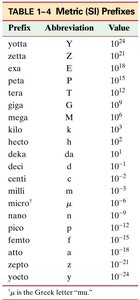
SI Prefixes: Prefixes are used to indicate powers of ten for units, making it easier to express very large or small quantities.
Prefix | Abbreviation | Value |
|---|---|---|
yotta | Y | 1024 |
zetta | Z | 1021 |
exa | E | 1018 |
peta | P | 1015 |
tera | T | 1012 |
giga | G | 109 |
mega | M | 106 |
kilo | k | 103 |
hecto | h | 102 |
deka | da | 101 |
deci | d | 10-1 |
centi | c | 10-2 |
milli | m | 10-3 |
micro | μ | 10-6 |
nano | n | 10-9 |
pico | p | 10-12 |
femto | f | 10-15 |
atto | a | 10-18 |
zepto | z | 10-21 |
yocto | y | 10-24 |
Other Systems: The cgs system (centimeter, gram, second) and the British engineering system (foot, pound, second) are also used, but SI is preferred in science.
1-6 Converting Units
Unit conversion is a fundamental skill in physics, especially when working with different measurement systems. Converting within the metric system is straightforward due to the use of powers of ten, while converting to and from British units requires more effort.
Example: 1 meter = 3.28084 feet. To convert the height of a mountain from meters to feet, multiply by this conversion factor.

1-7 Order of Magnitude: Rapid Estimating
Order-of-magnitude estimation is a technique for quickly approximating values by rounding to the nearest power of ten. This method is useful for checking the plausibility of results and making rapid calculations.
Method: Round all numbers to one significant figure and perform the calculation. The result should be correct within a factor of ten.
Application: Useful for making quick decisions and for sanity-checking detailed calculations.
Summary of Chapter 1
Theories are developed to explain observations and are tested by their predictions.
Models provide analogies for understanding, but are not literal representations.
Theories are well-developed explanations; laws are concise, widely applicable statements.
All measurements have uncertainty, which must be expressed and managed using significant figures.
The SI system provides standardized units and prefixes for scientific measurement.
Unit conversion and order-of-magnitude estimation are essential skills in physics.
