Back
Chapter 1: Motion in One Dimension – Structured Study Notes
Study Guide - Smart Notes
 Tailored notes based on your materials, expanded with key definitions, examples, and context.
Motion in One Dimension
Types of Motion
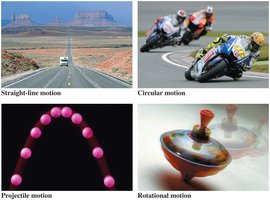
Motion describes the change of an object’s position or orientation with time. The path along which an object moves is called its trajectory. There are several fundamental types of motion:
Straight-line motion: Movement along a single direction.
Circular motion: Movement along a circular path.
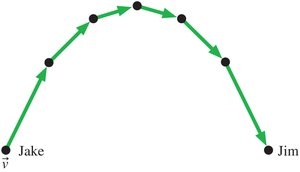
Projectile motion: Movement under the influence of gravity, typically following a parabolic trajectory.
Rotational motion: Movement around a fixed axis.
Making a Motion Diagram
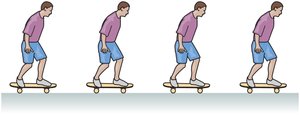
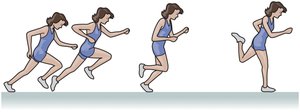
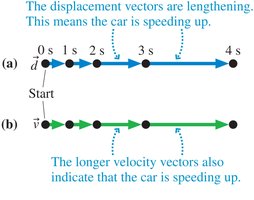
A motion diagram is a sequence of images showing an object’s position at equal time intervals. It helps visualize the type of motion:
Constant speed: Equal spacing between positions.
Speeding up: Increasing spacing between positions.
Slowing down: Decreasing spacing between positions.

Position and Coordinate Systems
To specify an object’s position, a coordinate system is used, consisting of an origin, an axis, and directions. The position is given as a coordinate value relative to the origin.
Reference point (origin): The zero point of the coordinate system.
Distance and direction: Position is specified by how far and in which direction from the origin.
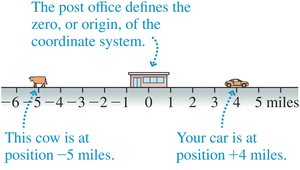
Change in Time
Quantifying motion requires measuring time intervals, which are always positive and represent the elapsed time between two events:
Initial time (ti): When the motion starts.
Final time (tf): When the motion ends.
Time interval:
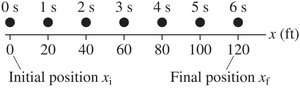
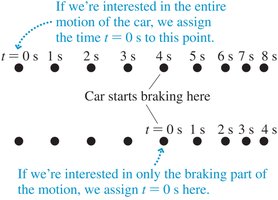
Time in Motion Diagrams
Each frame in a motion diagram is labeled with its corresponding time, allowing for analysis of the object’s movement over time.
Displacement
A displacement is the change in position of an object, defined as the difference between the final and initial positions:
Displacement formula:
Displacement is a vector quantity, having both magnitude and direction.
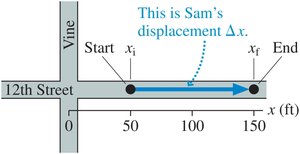
Distance vs. Displacement
Distance is the total length of the path traveled, while displacement is the straight-line change in position. Distance is always positive; displacement can be positive or negative.
Example: An ant zig-zags on a table. Its distance traveled may be greater than its displacement.
Velocity and Speed
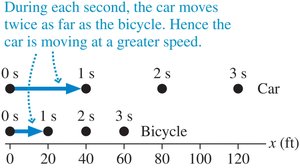
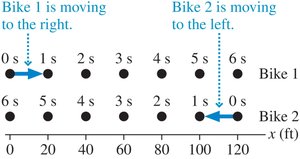
Speed measures how fast an object moves, while velocity includes both speed and direction. Uniform motion is movement at constant speed in a straight line.
Average velocity:
Speed:
Scalars and Vectors
Physical quantities are classified as scalars (having only magnitude) or vectors (having both magnitude and direction). The magnitude of a vector is its length.
Scalar example: Mass, temperature.
Vector example: Displacement, velocity.

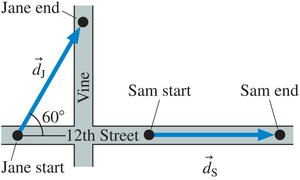
Displacement Vectors
The displacement vector shows the distance and direction from the initial to the final position, regardless of the path taken.
Adding Vectors
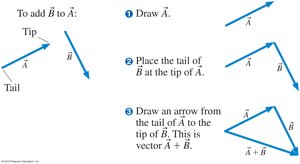
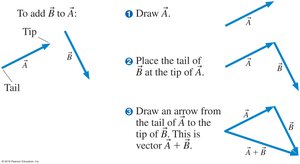
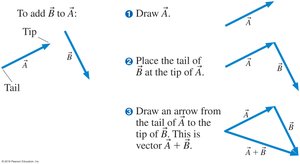
Vectors are added graphically by placing the tail of one at the tip of the other. The resultant vector is drawn from the tail of the first to the tip of the last.
Step 1: Draw vector A.
Step 2: Place the tail of vector B at the tip of vector A.
Step 3: Draw the resultant vector from the tail of A to the tip of B.
Vectors and Trigonometry
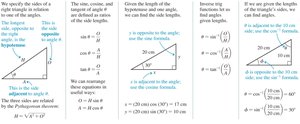
Trigonometry is used to calculate the lengths and angles of triangles formed by vectors. The Pythagorean theorem and trigonometric functions (sine, cosine, tangent) are essential tools:
Pythagorean theorem:
Sine:
Cosine:
Tangent:
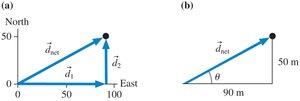
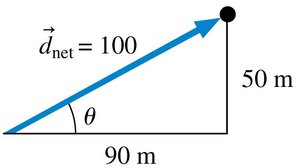
Example: Net Displacement Using Trigonometry
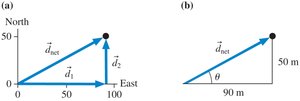
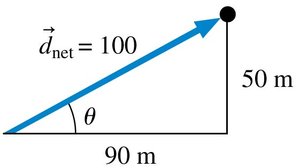
Anna walks 90 m east and 50 m north. Her net displacement is the hypotenuse of a right triangle:
Magnitude:
Direction: north of east
Velocity Vectors
The velocity vector points in the direction of motion and its magnitude equals the speed. Both length and direction can change during motion.
Significant Figures, Scientific Notation, and Units
Using Scientific Notation
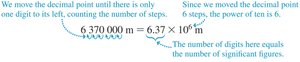
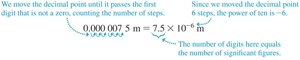
Scientific notation expresses numbers as a product of a coefficient and a power of ten, making it easier to handle very large or small values:
For numbers greater than 10: Move the decimal left, count steps, and use positive exponent.
For numbers less than 1: Move the decimal right, count steps, and use negative exponent.
Measurements and Significant Figures
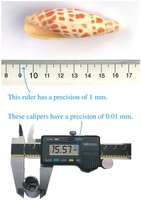
Significant figures indicate the precision of a measurement. The number of significant digits reflects the reliability of the measurement.
Use the least precise measurement to determine the number of significant figures in calculations.
Using Significant Figures in Calculations
Multiplication/Division: The answer should have the same number of significant figures as the least precise input.
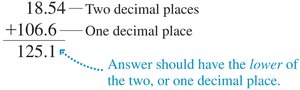
Addition/Subtraction: The answer should have the same number of decimal places as the least precise input.

Units and Unit Conversion
Scientists use the International System of Units (SI). Unit conversion is essential for comparing and calculating measurements in different systems.
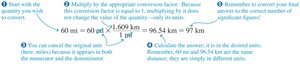
Start with the quantity to convert.
Multiply by the appropriate conversion factor.
Cancel units and calculate the answer.
Adjust significant figures as needed.