 Back
BackChapter 1: Representing Motion – College Physics Study Notes
Study Guide - Smart Notes
 Tailored notes based on your materials, expanded with key definitions, examples, and context.
Chapter 1: Representing Motion
Introduction
This chapter introduces the fundamental concepts of motion, including how to represent and describe motion using diagrams, mathematical principles, and scientific notation. It also reviews the basic mathematical tools and units used in physics.
Section 1.1: Motion – A First Look
Motion is defined as the change of an object’s position or orientation with time. The path along which an object moves is called its trajectory.
Types of Motion: Includes constant speed, speeding up, and slowing down.
Motion Diagram: A sequence of images showing an object's position at equal time intervals, useful for visualizing motion.
Section 1.2: Models and Modeling
Models are simplified representations of nature that capture essential features for study. Two main types:
Descriptive Models: Describe properties in the simplest terms.
Explanatory Models: Use laws of physics to predict behavior.
Particle Model: Treats a moving object as if all its mass is concentrated at a single point, simplifying motion analysis.
Section 1.3: Position and Time – Putting Numbers on Nature
To specify position, a reference point (origin), distance, and direction are needed. The combination forms a coordinate system.
Position: Represented by a coordinate along an axis.
Time: Each frame in a motion diagram is labeled with time (symbol t).
Displacement: The difference between final and initial position:
Time Interval: , always positive.
Example: Bicycle Ride Displacement
Emily rides from 3 mi east to 2 mi west of a water tower. Her displacement is:
Initial position: mi
Final position: mi
Displacement: mi (westward)
Problem-solving process: Strategize, Prepare, Solve, Assess.
Section 1.4: Velocity
Motion at constant speed in a straight line is called uniform motion. Speed measures how fast an object moves; velocity includes direction.
Average Velocity:
Speed:
Velocity to the left is negative; to the right is positive.
Example: Albatross Flight
Initial position: 60 mi east
Final position: 80 mi east
Time interval: 0.25 h
Velocity: mi/h (eastward)
Section 1.5: Significant Figures, Scientific Notation, and Units
Measurements are limited by precision, expressed through significant figures.
Multiplication/Division: Answer matches the least precise number.
Addition/Subtraction: Answer matches the smallest number of decimal places.
Scientific Notation: Used for very large or small numbers, clarifies significant figures.
SI Units: Standard units in science: meters (m), seconds (s), kilograms (kg).
Table: Common SI Units
Quantity | SI Unit |
|---|---|
Length | meter (m) |
Time | second (s) |
Mass | kilogram (kg) |
Example: Walking Speed Estimate
Distance: 1 mile
Time: 30 min
Speed:
Convert to m/s:
Section 1.6: Vectors and Motion – A First Look
Physical quantities are classified as scalars (magnitude only) or vectors (magnitude and direction).
Vector: Represented as an arrow; magnitude is length.
Displacement Vector: From initial to final position.
Vector Addition: Place tail of one at tip of another; resultant is from tail of first to tip of last.
Vectors and Trigonometry
Pythagorean Theorem:
Sine, Cosine, Tangent: , ,
Inverse trig functions find angles from side lengths.
Example: Anna’s Displacement
Anna walks 90 m east, then 50 m north. Her net displacement is the hypotenuse of a right triangle.
Magnitude: m
Direction: north of east
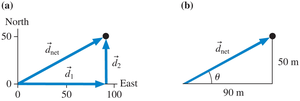
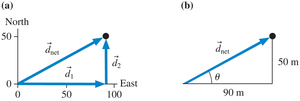
Velocity Vectors
Velocity vectors point in the direction of motion, with magnitude equal to speed. In motion diagrams, velocity vectors connect successive positions.
Section 1.7: Summary and Applications
Motion Diagrams: Use the particle model to represent motion with dots at equal time intervals.
Scalars and Vectors: Scalars (temperature, time, mass); vectors (velocity, displacement).
Describing Motion: Position, displacement, time interval, velocity.
Units: SI units are standard in science.
Working with Numbers: Scientific notation, unit conversions, significant figures, order-of-magnitude estimates.
Integrated Example: Goose Flight Speed
Actual distance flown: sum of two legs
Straight-line distance: hypotenuse of triangle
Extra distance: difference between actual and straight-line
Flight speed:
Convert to km/h:

Summary Table: Scalar vs Vector Quantities
Quantity | Type | Description |
|---|---|---|
Temperature | Scalar | Magnitude only |
Time | Scalar | Magnitude only |
Mass | Scalar | Magnitude only |
Velocity | Vector | Magnitude and direction |
Displacement | Vector | Magnitude and direction |
Additional info: These notes expand on brief points from the original slides and textbook, providing full academic context, definitions, examples, and relevant equations for college-level physics students.
