 Back
BackChapter 1: Representing Motion – Fundamental Concepts and Mathematical Tools
Study Guide - Smart Notes
 Tailored notes based on your materials, expanded with key definitions, examples, and context.
Representing Motion
Introduction to Motion
Motion is a fundamental concept in physics, describing the change of an object's position or orientation with time. Understanding motion requires both conceptual and mathematical tools, including units, diagrams, and vectors.
Trajectory: The path along which an object moves.
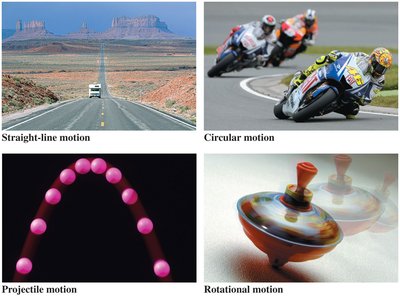
Types of Motion: Includes straight-line, circular, projectile, and rotational motion.
Units, Conversions, and Significant Figures
SI Units and Unit Conversion
Physics uses the International System of Units (SI) for consistency. Common SI units include meter (m) for length, kilogram (kg) for mass, and second (s) for time. Unit conversion is essential for translating measurements between different systems.
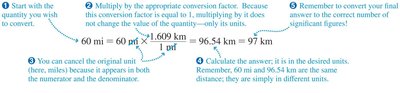
Unit Conversion: Multiply by a conversion factor equal to 1 to change units without altering the value.
Example: Converting 60 miles to kilometers using the factor 1.609 km/1 mi.
Significant Figures
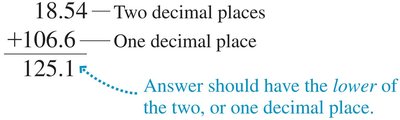
Significant figures reflect the precision of a measurement. Calculations must respect the least precise measurement.
Multiplication/Division: The answer should have the same number of significant figures as the least precise input.
Addition/Subtraction: The answer should have the same number of decimal places as the least precise input.

Scientific Notation
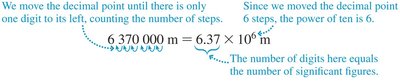
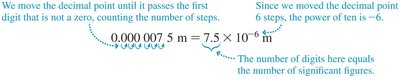
Scientific notation simplifies the expression of very large or small numbers and clarifies the number of significant figures.
For numbers > 1: Move the decimal left, count steps, and multiply by .
For numbers < 1: Move the decimal right, count steps, and multiply by .
Trigonometry and Vectors
Trigonometry Review
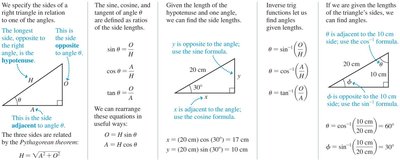
Trigonometry is used to analyze motion, especially when dealing with vectors. The sides of a right triangle are related to the angles by sine, cosine, and tangent functions.
Sine:
Cosine:
Tangent:
Pythagorean Theorem:
Motion Diagrams and the Particle Model
Motion Diagrams
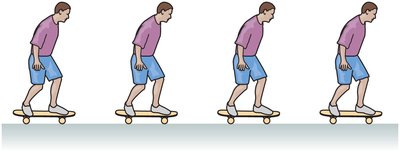
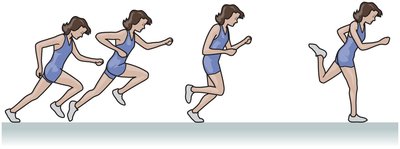
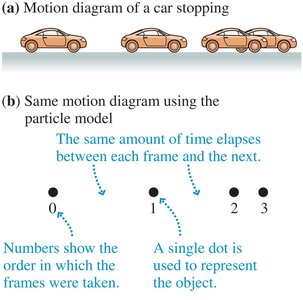
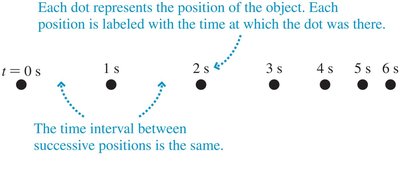
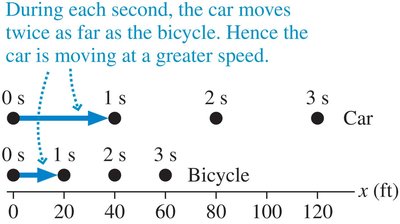
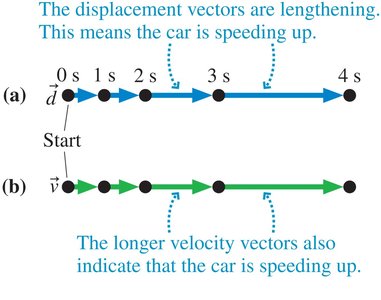
Motion diagrams visually represent an object's position at successive times. They help distinguish between constant speed, acceleration, and deceleration.
Constant Speed: Equal spacing between positions.
Speeding Up: Increasing spacing between positions.
Slowing Down: Decreasing spacing between positions.

Particle Model
The particle model simplifies motion by treating the object as a point mass. This allows for easier analysis using motion diagrams.
Each dot: Represents the object's position at a specific time.
Time intervals: Are equal between successive dots.
Position, Displacement, and Coordinate Systems
Position and Coordinate Systems
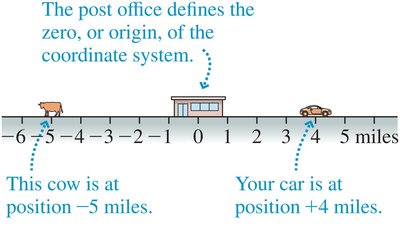
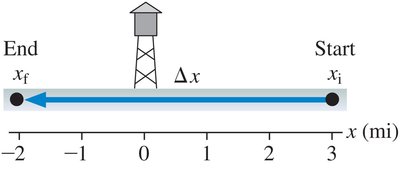
Position is specified relative to an origin and along an axis. The coordinate system includes both positive and negative directions.
Coordinate: Symbol representing position along an axis.
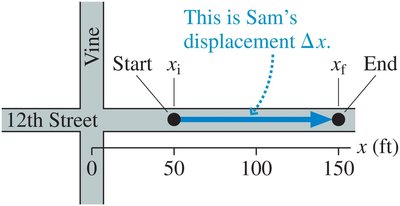
Displacement: Change in position, .
Time and Velocity
Time and Time Intervals
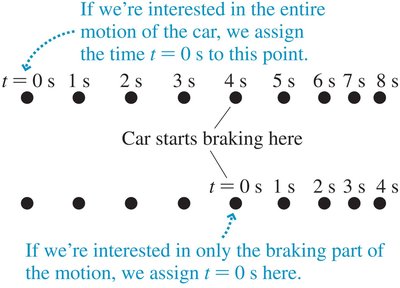
Time is measured from a reference instant, and time intervals () quantify the duration between two events.
Time interval:
Always positive: Time intervals measure elapsed time.
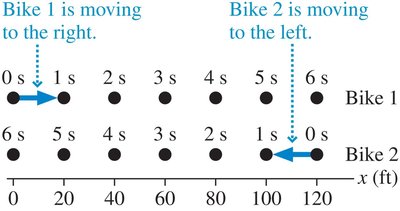
Velocity and Speed
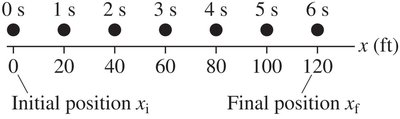
Velocity is a vector quantity describing both speed and direction. Speed is a scalar, measuring only how fast an object moves.
Uniform motion: Constant speed in a straight line.
Average velocity:
Scalars, Vectors, and Vector Operations
Scalars and Vectors
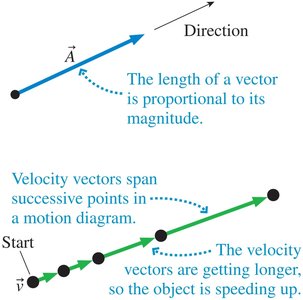
Scalars have only magnitude, while vectors have both magnitude and direction. Examples include temperature (scalar) and velocity (vector).
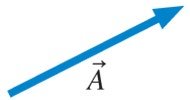
Vector representation: Arrows indicate direction and length proportional to magnitude.
Displacement Vectors
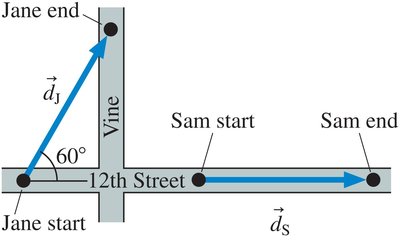
The displacement vector shows the distance and direction from the initial to the final position, regardless of the path taken.
Adding and Subtracting Vectors
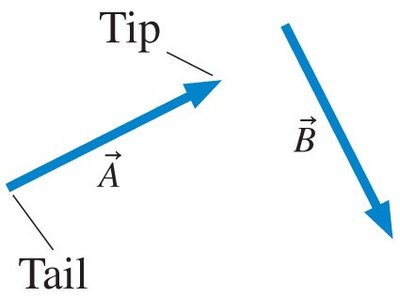
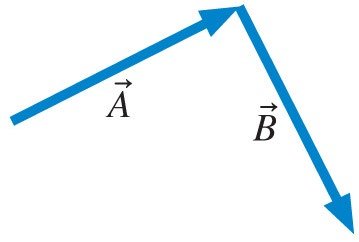
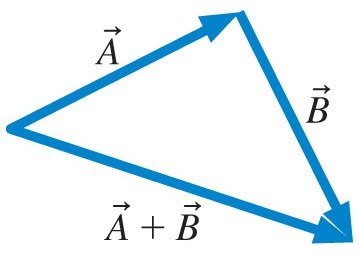
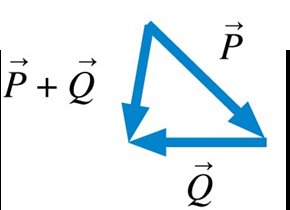
Vectors are added by placing the tail of one at the tip of another. The resultant vector is drawn from the tail of the first to the tip of the last.
Vector addition:
Resultant: Represents net displacement or velocity.
Trigonometry in Vector Analysis
Trigonometric functions are used to resolve vectors into components and to find angles or magnitudes.
Component form: ,
Angle calculation:
Examples and Applications
Example: Displacement Calculation
Emily rides from 3 mi east to 2 mi west of a water tower. Her displacement is .
Example: Velocity Calculation
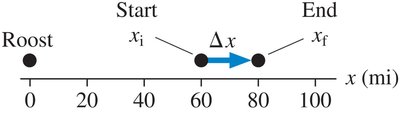
An albatross moves from 60 mi to 80 mi east of its roost in 0.25 h. Its velocity is .
Example: Vector Displacement
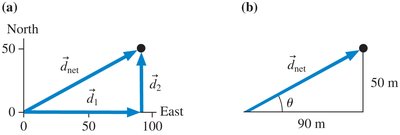
Anna walks 90 m east and 50 m north. Her net displacement is at north of east.
Example: Velocity Vectors in Motion Diagrams
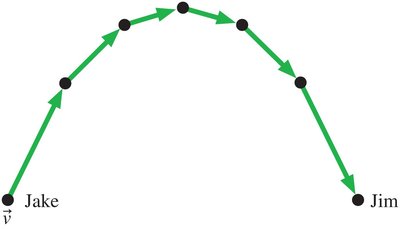
Velocity vectors are drawn in the direction of motion, with length proportional to speed. In projectile motion, vectors change direction and magnitude.
Summary Table: Common SI Units
Quantity | Unit | Abbreviation |
|---|---|---|
Time | Second | s |
Length | Meter | m |
Mass | Kilogram | kg |
Summary Table: Approximate Conversion Factors
Quantity | SI Unit | Approximate Conversion |
|---|---|---|
Mass | kg | 1 kg ≈ 2 pounds |
Length | m | 1 m ≈ 3 feet |
Length | cm | 3 cm ≈ 1 inch |
Length | km | 5 km ≈ 3 miles |
Speed | m/s | 1 m/s ≈ 2 mi/h |
Speed | km/h | 10 km/h ≈ 6 mi/h |
Additional info: Academic context and expanded explanations were added to ensure completeness and clarity for exam preparation.
