 Back
Chapter 1: Representing Motion – Physics with Calculus Study Notes
Study Guide - Smart Notes
 Tailored notes based on your materials, expanded with key definitions, examples, and context.
Chapter 1: Representing Motion
Introduction to Motion
Understanding motion is fundamental in physics. Motion refers to the change of an object’s position or orientation with time. Analyzing motion involves simplifying the scenario and applying mathematical language to describe it quantitatively.
Types of Motion:
Straight-line motion: Movement along a straight path.
Circular motion: Movement along a circular path.
Projectile motion: Movement through the air under gravity.
Rotational motion: Spinning about an axis.
Trajectory: The path an object follows, which may be straight or curved.
Motion Diagrams
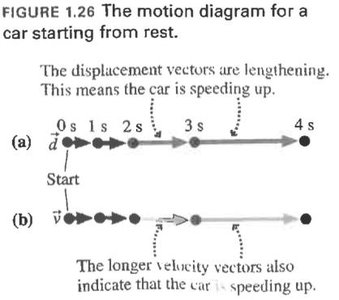
A motion diagram is a composite image showing an object’s positions at several equally spaced time intervals. It visually represents how an object moves over time.
Equally spaced images: Constant speed.
Increasing distance between images: Object is speeding up.
Decreasing distance: Object is slowing down.
Complex diagrams: Show changes in both speed and direction.
Operational Definitions and Models
Physics uses operational definitions—concepts defined by specific procedures or measurements. Modeling simplifies reality to focus on essential features, using either descriptive or explanatory models.
Descriptive models: Capture essential characteristics (e.g., mass on a spring).
Explanatory models: Explain why phenomena occur, based on physical laws (e.g., charge model).
The Particle Model
The particle model treats objects as if all their mass is concentrated at a single point. This simplification is useful for analyzing motion, especially when the object's size and shape are not important to the problem.
Particle: An object represented as a mass at a single point in space.
All objects under gravity (with no other forces) move identically in this model.
Position, Time, and Coordinate Systems
To analyze motion, we specify an object’s position (location at a specific time) and time (when the object is at that position). A coordinate system includes an origin and an axis with positive and negative directions.
Origin: Reference point for measuring distances.
Coordinate: Symbol representing position along an axis.
Time (t): Chosen with t = 0 at the start of observation.
Displacement and Time Intervals
Displacement is the change in position, a signed quantity indicating direction. Time interval is the elapsed time between two events.
(always positive)
Velocity and Speed
Speed is the distance traveled per unit time, while velocity is displacement per unit time, including direction.
Speed is always positive; velocity can be positive or negative.
Positive velocity: right/upward; Negative velocity: left/downward.
Significant Figures, Scientific Notation, and Units
Measurements in physics must be reported with the correct number of significant figures, using scientific notation for clarity, and standard SI units for consistency.
Significant figures: Digits known reliably from measurement.
Scientific notation: (one digit left of decimal).
SI units: Time (seconds), Length (meters), Mass (kilograms).
Prefixes: Mega (), Kilo (), Centi (), Milli (), Micro (), Nano ().
Unit Conversions and Estimation
Unit conversions use conversion factors (ratios equal to 1). Order-of-magnitude estimates provide rough, one-significant-figure calculations, denoted by ~.
1 in = 2.54 cm; 1 ft = 0.305 m; 1 mi = 1.609 km; 1 mph = 0.447 m/s
1 m/s ≈ 2 mph; 10 km/h ≈ 6 mph
Scalars and Vectors
Scalar quantities have only magnitude (e.g., mass, temperature). Vector quantities have both magnitude and direction (e.g., displacement, velocity).
Vector: Represented by an arrow; length = magnitude, direction = direction of quantity.
Notation: Arrow over symbol (e.g., ).
Displacement Vectors
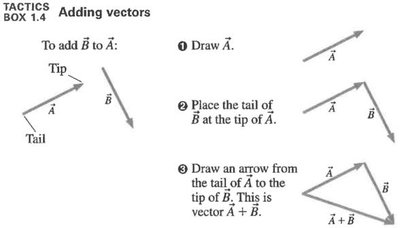
Displacement is a vector drawn from the initial to the final position, regardless of the path taken. The vector sum combines multiple displacements into a single resultant vector.
Net displacement:
Vectors and Trigonometry
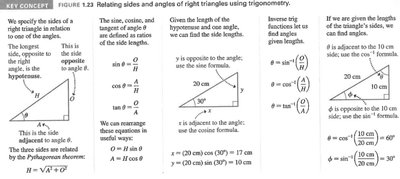
Trigonometry relates the sides and angles of right triangles, which is essential for resolving vectors into components and finding resultant vectors.
Pythagorean theorem:
Worked Example: Displacement Using Vectors
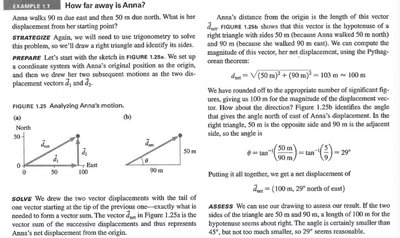
Consider a person walking 90 m east and then 50 m north. The displacement from the starting point is the vector sum of these two legs. Using the Pythagorean theorem and trigonometry, the magnitude and direction of the displacement can be found:
Angle: north of east
Velocity Vectors and Motion Diagrams
Velocity vectors point in the direction of motion and their length represents speed. On a motion diagram, velocity vectors between successive positions show how speed and direction change over time. As an object accelerates from rest, velocity vectors increase in length.
Longer velocity vector: Faster speed
Shorter velocity vector: Slower speed
Velocity and displacement vectors point in the same direction
Summary Table: Key Concepts in Representing Motion
Concept | Definition | Equation/Example |
|---|---|---|
Displacement | Change in position (vector) | |
Velocity | Displacement per unit time (vector) | |
Speed | Distance per unit time (scalar) | |
Vector Addition | Combining vectors tip-to-tail | |
Pythagorean Theorem | Relates sides of right triangle |
