Back
BackChapter 1: Representing Motion – Study Notes for College Physics
Study Guide - Smart Notes
 Tailored notes based on your materials, expanded with key definitions, examples, and context.
Chapter 1: Representing Motion
The Nature of Science
Science is a systematic approach to understanding the natural world through observation, hypothesis formation, and theory development. The process is iterative, with predictions tested against observations, leading to refinement or rejection of theories.
Observation: The first step in scientific inquiry, requiring careful attention to what is important.
Hypothesis: A proposed explanation based on limited evidence, serving as a starting point for further investigation.
Theory: A detailed explanation that makes testable predictions. Theories are subject to change if new evidence arises.
Law: A concise statement describing how nature behaves under certain conditions.
Principle: Similar to a law, but applies to a narrower range of phenomena.
Models, Theories, and Laws
Models are simplified representations of phenomena, helping us understand and predict behavior. Theories provide detailed explanations, while laws and principles describe consistent patterns in nature.
Descriptive models: Describe properties in the simplest terms.
Explanatory models: Offer predictive power based on physical laws.
Pseudoscience
Pseudoscience refers to claims or practices that are presented as scientific but lack empirical evidence and proper methodology. It often seeks confirmation rather than falsification and can be harmful to scientific progress.
Units, Standards, and the SI System
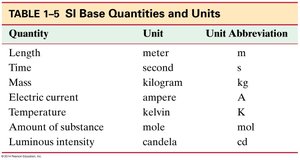
Scientists use the International System of Units (SI) for consistency in measurements. SI units are fundamental for expressing physical quantities.
Length: meter (m)
Time: second (s)
Mass: kilogram (kg)
Electric current: ampere (A)
Temperature: kelvin (K)
Amount of substance: mole (mol)
Luminous intensity: candela (cd)
Unit Conversion
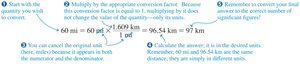
Converting between units is essential, especially when different systems are used. The process involves multiplying by conversion factors and ensuring the correct number of significant figures.
Start with the quantity to convert.
Multiply by the appropriate conversion factor.
Cancel units as needed.
Calculate the answer in the desired units.
Report the answer with the correct number of significant figures.
Measurements and Significant Figures
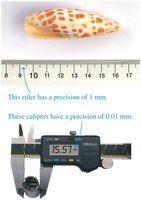
Measurements are limited by the precision of the instrument used. Significant figures indicate the reliability of a measurement.
Precision: The smallest unit a device can measure.
Significant figures: Digits that are reliably known.
Uncertainty: Always recorded with measurements, e.g., $D = 50\,\text{mm} \pm 1\,\text{mm}$.
Rules for Significant Figures
Proper use of significant figures is crucial in calculations:
Multiplication/Division: The answer should have the same number of significant figures as the least precise number.
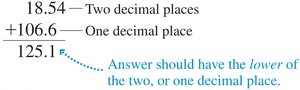
Addition/Subtraction: The answer should have the same number of decimal places as the least precise number.
Exact numbers (e.g., π, integers) do not affect significant figures.
Keep extra digits in intermediate steps to minimize round-off errors, but report the final answer with proper significant figures.

Scientific Notation
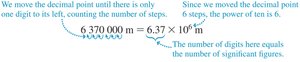
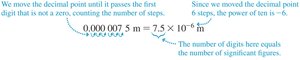
Scientific notation is used to express very large or small numbers clearly, showing the number of significant figures.
For numbers greater than 10: Move the decimal left until one digit remains to the left, multiply by $10^n$.
For numbers less than 1: Move the decimal right past the first nonzero digit, multiply by $10^{-n}$.
Estimation and Order-of-Magnitude
Estimation is a quick method to check if answers are reasonable, often within an order of magnitude. An order-of-magnitude estimate uses one significant figure and is denoted by the symbol $\sim$.
Useful for quick checks and rough calculations.
Example: Estimating yearly water intake or hours of sleep.
Section 1.1 Motion: A First Look
Types of Motion
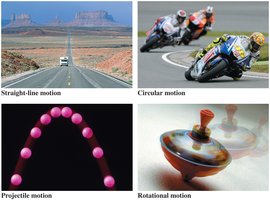
Motion is the change of an object’s position or orientation with time. The path along which an object moves is called its trajectory. There are several types of motion:
Straight-line motion
Circular motion
Projectile motion
Rotational motion
Motion Diagrams
Motion diagrams visually represent the position of an object at successive time intervals. They help analyze motion, including constant speed, speeding up, and slowing down.
Constant speed: Equal spacing between positions.
Speeding up: Increasing spacing between positions.
Slowing down: Decreasing spacing between positions.
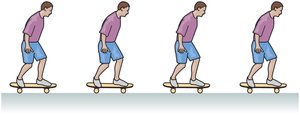
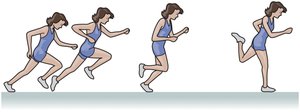

Motion in Two Dimensions
Motion diagrams can also represent changes in both speed and direction, as seen in projectile or curved motion.
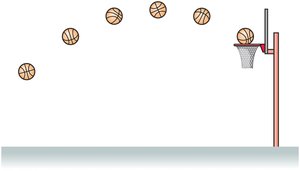
Comparing Motion
Motion diagrams can be used to compare the speed of different objects over the same time interval.
Objects with greater spacing between positions are moving faster.


Section 1.2 Models and Modeling
Models in Physics
Models are essential tools in physics, simplifying complex phenomena while retaining key features. They can be descriptive or explanatory, and are used to make predictions and understand behavior.
Descriptive models: Simplify properties for easier analysis.
Explanatory models: Use physical laws to predict outcomes.
The Particle Model
The particle model treats a moving object as if all its mass is concentrated at a single point. This simplification is useful for analyzing motion without considering the object's size or shape.
Motion diagrams can be simplified using the particle model.
Each dot represents the object's position at a specific time.
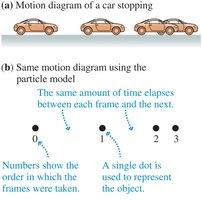
Section 1.3 Position and Time: Putting Numbers on Nature
Position and Coordinate Systems
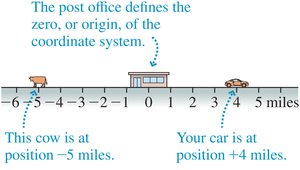
To specify an object's position, a reference point (origin), distance from the origin, and direction are needed. A coordinate system consists of an origin and an axis marked in both positive and negative directions.
Coordinate: Symbol representing position along an axis.
Time in Motion Diagrams
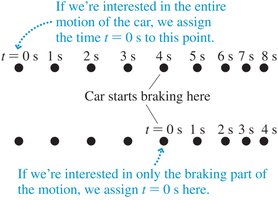
Each frame in a motion diagram is labeled with its corresponding time, denoted by the symbol t. The choice of when to assign t = 0 depends on the context of the motion being studied.
Time intervals help analyze changes in position and speed.