 Back
BackChapter 1: Representing Motion – Study Notes
Study Guide - Smart Notes
 Tailored notes based on your materials, expanded with key definitions, examples, and context.
Representing Motion
Introduction to Motion
Motion is a fundamental concept in physics, describing the change in position or orientation of an object over time. Understanding motion requires both qualitative and quantitative approaches, including diagrams, mathematical relationships, and units.
Types of Motion
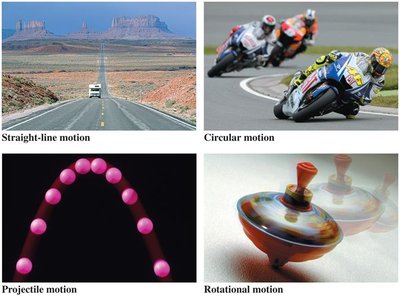
There are several types of motion, each characterized by the path an object follows:
Straight-line motion: Movement along a single direction.
Circular motion: Movement along a circular path.
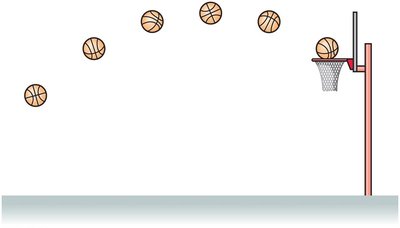
Projectile motion: Movement under the influence of gravity, typically following a parabolic trajectory.
Rotational motion: Movement around a fixed axis.
Motion Diagrams
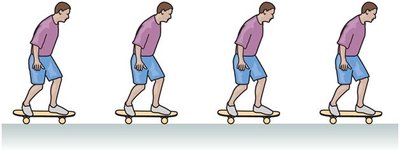
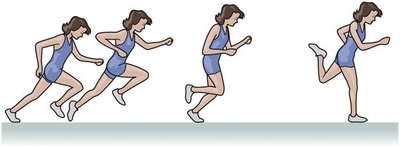
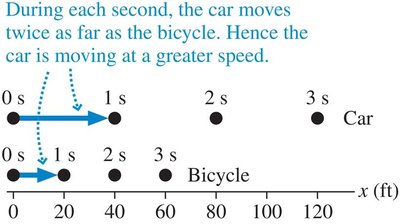
Motion diagrams are visual representations of an object's position at successive times. They help simplify complex motion and are often used with the particle model, which treats the object as a single point mass.
Constant speed: Equal spacing between positions.
Speeding up: Increasing spacing between positions.
Slowing down: Decreasing spacing between positions.
Models and Modeling
Models are simplified representations of physical systems, used to describe and predict behavior. Two main types are:
Descriptive models: Describe properties in simple terms.
Explanatory models: Use laws of physics to predict outcomes.
The particle model is a key simplification, treating all mass as concentrated at a single point.

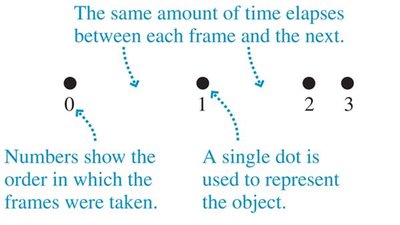
Position, Time, and Displacement
Position and Coordinate Systems
To specify an object's position, a reference point (origin), distance, and direction are needed. A coordinate system consists of an origin and an axis with positive and negative directions.
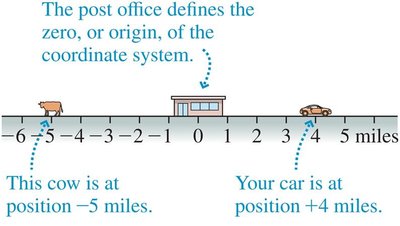
Time and Motion Diagrams
Each frame in a motion diagram is labeled with its corresponding time, denoted by the symbol t.
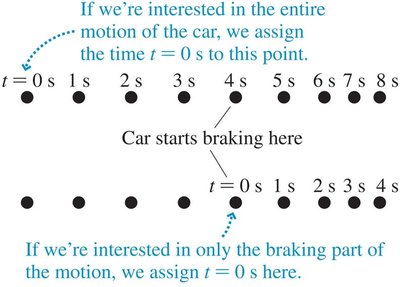
Displacement
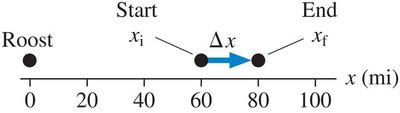
Displacement is the change in position, calculated as the difference between final and initial positions:
Formula:
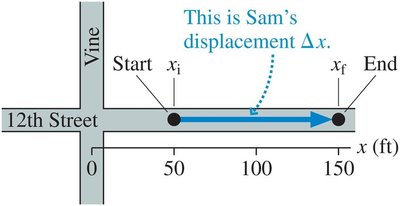
Time Intervals
A time interval measures the elapsed time between two events:
Formula:
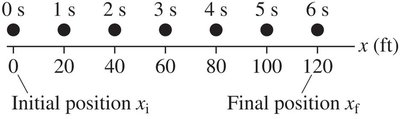
Example: Displacement Calculation
Emily rides from 3 miles east to 2 miles west of a water tower. Her displacement is:
Formula:
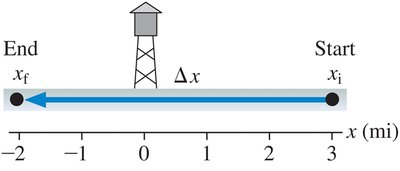
Distance vs. Displacement
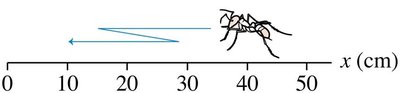
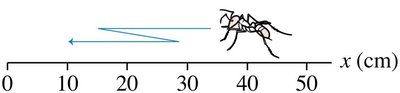
Distance is the total path length traveled, while displacement is the straight-line change in position. For example, an ant zig-zagging covers a distance of 50 cm but a displacement of -30 cm.
Velocity and Speed
Definitions
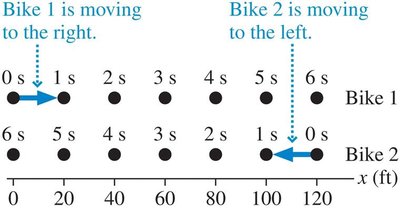
Speed is the rate at which an object moves, regardless of direction. Velocity includes both speed and direction.
Speed formula:
Velocity formula:
Example: Albatross Flight
An albatross moves from 60 mi to 80 mi east of its roost in 0.25 h:
Velocity:
Significant Figures, Scientific Notation, and Units
Measurements and Significant Figures
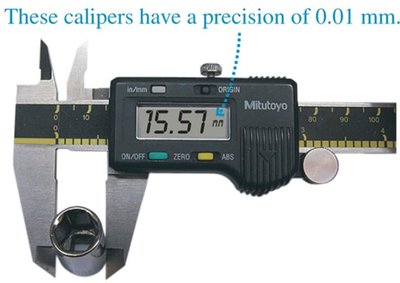
Measurements have limited precision, indicated by significant figures—digits that are reliably known.
Rules for Significant Figures
Multiplication/division: Answer has the same number of significant figures as the least precise value.
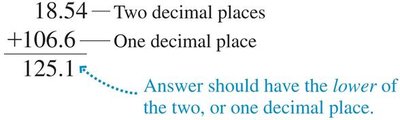
Addition/subtraction: Answer has the same number of decimal places as the least precise value.

Scientific Notation
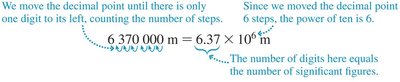
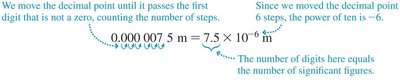
Scientific notation expresses very large or small numbers as a decimal multiplied by a power of ten, clarifying significant figures.
SI Units and Unit Conversion
The SI system is the standard in science. Common units include:
Quantity | Unit | Abbreviation |
|---|---|---|
Time | Second | s |
Length | Meter | m |
Mass | Kilogram | kg |
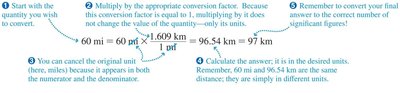
Unit conversions use conversion factors to switch between systems.
Order-of-Magnitude Estimates
Order-of-magnitude estimates use rough values and are accurate to about one significant figure, indicated by the symbol .
Quantity | SI Unit | Approximate Conversion |
|---|---|---|
Mass | kg | 1 kg 2 lb |
Length | m | 1 m 3 ft |
Length | cm | 3 cm 1 in |
Length | km | 5 km 3 mi |
Speed | m/s | 1 m/s 2 mph |
Speed | km/h | 10 km/h 6 mph |
Vectors and Motion: A First Look
Scalars and Vectors
Physical quantities are classified as:
Scalars: Have only magnitude (e.g., temperature, mass).
Vectors: Have both magnitude and direction (e.g., velocity, displacement).

Displacement Vectors
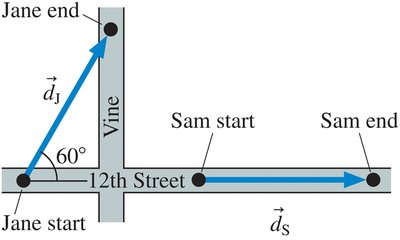
The displacement vector shows the distance and direction from an object's initial to final position, regardless of the path taken.
Vector Addition and Subtraction
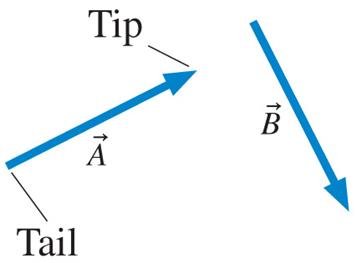
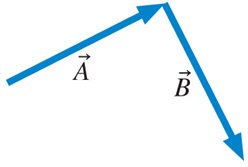
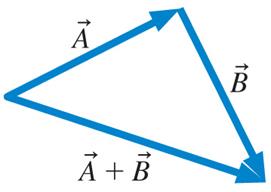
Vectors are added graphically by placing the tail of one at the tip of another. The resultant vector is drawn from the tail of the first to the tip of the last.
Net displacement: Sum of individual displacement vectors.

Trigonometry and Vectors
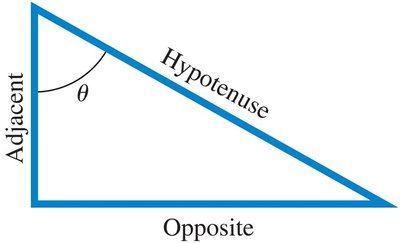
Trigonometry is used to relate the sides and angles of triangles, essential for vector calculations.
Pythagorean theorem:
Sine:
Cosine:
Tangent:
Example: Net Displacement Calculation
Anna walks 90 m east and 50 m north. Her net displacement is:
Magnitude:
Direction: north of east
Summary of Key Concepts
Motion diagrams and the particle model simplify the study of motion.
Scalars have magnitude only; vectors have magnitude and direction.
Position is specified relative to a coordinate system; displacement is the change in position.
Velocity is displacement divided by time interval.
SI units are standard in science; unit conversions are essential.
Significant figures indicate measurement precision; scientific notation clarifies large/small numbers.
Order-of-magnitude estimates are rough calculations used for quick approximations.
