 Back
BackChapter 1: Representing Motion – Study Notes for College Physics
Study Guide - Smart Notes
 Tailored notes based on your materials, expanded with key definitions, examples, and context.
Representing Motion
Introduction to Motion
Motion is a fundamental concept in physics, describing the change of an object’s position or orientation with time. The path along which an object moves is called its trajectory. Understanding motion is essential for analyzing physical phenomena and forms the basis for more advanced topics in physics.
Types of Motion: Includes constant speed, speeding up, and slowing down.
Trajectory: The path taken by an object as it moves.
Motion Diagrams
Motion diagrams are visual representations of an object's movement over time. They help analyze motion by showing the position of an object at successive time intervals.
Constant Speed: Equal spacing between positions.
Speeding Up: Increasing spacing between positions.
Slowing Down: Decreasing spacing between positions.

Models and Modeling
Models are simplified representations of physical systems that capture essential features. In physics, models help us understand and predict behavior.
Descriptive Models: Describe properties in simple terms.
Explanatory Models: Use laws of physics to predict outcomes.
Particle Model: Treats an object as if all its mass is concentrated at a single point, simplifying analysis of motion.
Position, Displacement, and Time
To describe motion quantitatively, we use position, displacement, and time. A coordinate system is established with an origin and axes to specify positions.
Position: Location of an object relative to a reference point.
Displacement: Change in position, calculated as .
Time Interval: Elapsed time, , always positive.
Velocity and Speed
Velocity and speed are measures of how fast and in what direction an object moves. Uniform motion refers to constant speed in a straight line.
Speed: Scalar quantity, measures how fast an object moves.
Velocity: Vector quantity, includes both speed and direction.
Average Velocity:
Significant Figures, Scientific Notation, and Units
Measurements in physics require precision, which is indicated by significant figures. Scientific notation is used to express very large or small numbers conveniently. The International System of Units (SI) is the standard for scientific measurements.
Significant Figures: Digits that are reliably known in a measurement.
Scientific Notation: Expresses numbers as a product of a coefficient and a power of ten.
SI Units: Standard units for length (meter), time (second), mass (kilogram).
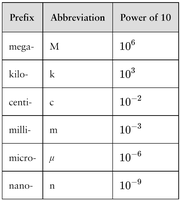
Common SI Prefixes
Prefixes are used to denote powers of ten for units.
Prefix | Abbreviation | Power of 10 |
|---|---|---|
mega- | M | |
kilo- | k | |
centi- | c | |
milli- | m | |
micro- | \mu | |
nano- | n |
Conversions Between Measurement Systems
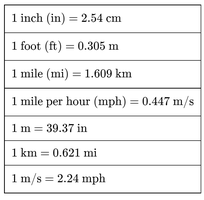
It is important to convert between SI units and English units, especially in the United States.
Conversion | Value |
|---|---|
1 inch (in) | 2.54 cm |
1 foot (ft) | 0.305 m |
1 mile (mi) | 1.609 km |
1 mile per hour (mph) | 0.447 m/s |
1 m | 39.37 in |
1 km | 0.621 mi |
1 m/s | 2.24 mph |
Estimation and Order-of-Magnitude
Order-of-magnitude estimates are rough calculations using one significant figure, useful for quick approximations.
Order-of-Magnitude: Indicated by the symbol .
Example: Estimating walking speed as 1 m/s.
Vectors and Motion: A First Look
Physical quantities can be classified as scalars or vectors. Vectors have both magnitude and direction, and are represented graphically by arrows.
Scalar: Described by a single number and unit (e.g., mass, temperature).
Vector: Has magnitude and direction (e.g., displacement, velocity).
Magnitude: Length of the vector.
Displacement Vectors
The displacement vector shows the distance and direction from the initial to the final position, regardless of the path taken.
Vector Addition and Trigonometry
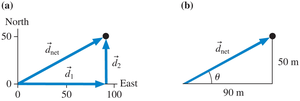
Vectors are added graphically by placing the tail of one at the tip of another. Trigonometry is used to calculate lengths and angles in vector problems.
Pythagorean Theorem:
Sine, Cosine, Tangent: , ,
Example: Net Displacement Calculation
Anna walks 90 m east and then 50 m north. Her net displacement is found using the Pythagorean theorem:
Direction:
Velocity Vectors
Velocity vectors point in the direction of motion and their magnitude equals the speed. They are useful for representing motion in two dimensions.
Significant Figures in Calculations
When converting units or performing calculations, the number of significant figures in the result should match the least precise measurement used.

Summary and Organization
This chapter introduces the basic concepts and techniques for representing and analyzing motion. Mastery of these ideas is essential for understanding subsequent chapters in physics.
Motion diagrams and models simplify analysis.
Position, displacement, and velocity are key quantities.
Precision in measurement and unit conversion is crucial.
Vectors and trigonometry are fundamental tools for describing motion in two dimensions.
