 Back
BackChapter 1: Units, Physical Quantities, and Vectors – Structured Study Notes
Study Guide - Smart Notes
 Tailored notes based on your materials, expanded with key definitions, examples, and context.
Units, Physical Quantities, and Vectors
The Nature of Physics
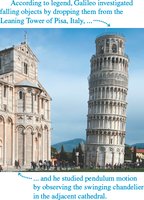
Physics is an experimental science that seeks to understand the fundamental patterns and laws governing the natural world. These patterns are called physical theories, and well-established theories are known as physical laws or principles.
Solving Problems in Physics
Effective problem-solving in physics follows a systematic approach. The four essential steps are:
Identify relevant concepts, target variables, and known quantities.
Set Up the problem: Choose appropriate equations and sketch the situation.
Execute the solution: Perform calculations and mathematical operations.
Evaluate your answer: Compare with estimates and check for consistency.
Idealized Models
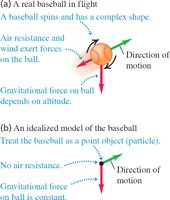
To simplify complex physical situations, physicists use idealized models. These models ignore certain real-world factors to focus on essential aspects of the problem.
For example, a real baseball in flight is affected by air resistance, wind, and altitude, while an idealized model treats it as a point object with constant gravitational force and no air resistance.
Standards and Units
Physics relies on three fundamental quantities: length, time, and mass. The International System of Units (SI) is the standard system used worldwide:
Length: meter (m)
Time: second (s)
Mass: kilogram (kg)
Unit Prefixes
Prefixes are used to denote multiples or fractions of units, making it easier to express very large or small quantities. Examples include:
Milli- (m):
Kilo- (k):
Micro- (μ):
Unit Consistency and Conversions
Equations in physics must be dimensionally consistent. All terms added or equated must have the same units. Always carry units through calculations and convert to standard units as needed.
For example, to convert 3 minutes to seconds:
Uncertainty and Significant Figures
Measurement uncertainty is indicated by the number of significant figures. Rules for significant figures:
Multiplication/Division: The result has no more significant figures than the factor with the fewest.
Addition/Subtraction: The result is limited by the term with the fewest digits to the right of the decimal.
Vectors and Scalars
Definitions
A scalar is a quantity described by a single number (magnitude only), such as mass or temperature. A vector has both magnitude and direction, such as displacement or force. Vectors are denoted in boldface with an arrow above.
Drawing Vectors
Vectors are represented as arrows. The length indicates magnitude, and the direction shows the vector's orientation in space.
Adding Two Vectors Graphically
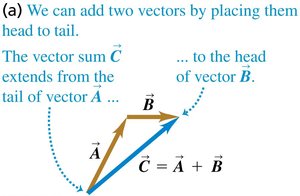
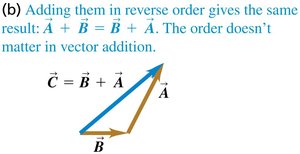
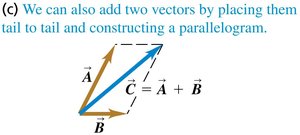
Vectors can be added graphically using the head-to-tail method or by constructing a parallelogram. The order of addition does not affect the result.
Head-to-tail: Place the tail of the second vector at the head of the first.
Parallelogram: Place vectors tail-to-tail and complete the parallelogram; the diagonal is the sum.
Addition of Parallel and Antiparallel Vectors
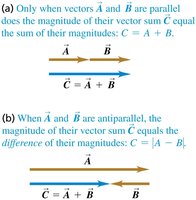
When vectors are parallel, their sum is the sum of their magnitudes. When antiparallel, the sum is the difference of their magnitudes.
Adding More Than Two Vectors Graphically
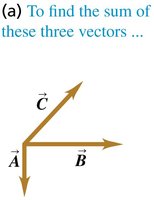
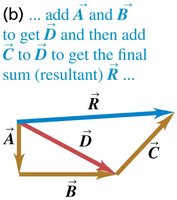
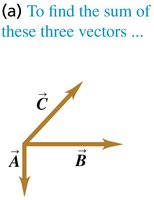
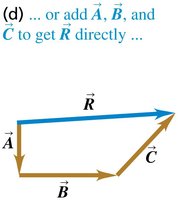
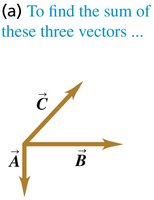
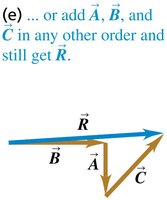
To add several vectors, use the head-to-tail method repeatedly. The resultant vector is independent of the order of addition.
Subtracting Vectors
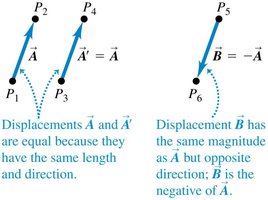
Subtracting a vector is equivalent to adding its negative. The negative of a vector has the same magnitude but opposite direction.


Multiplying a Vector by a Scalar
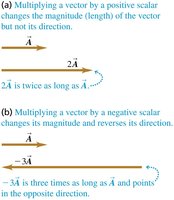
Multiplying a vector by a positive scalar changes its magnitude but not its direction. Multiplying by a negative scalar reverses its direction.
Addition of Two Vectors at Right Angles
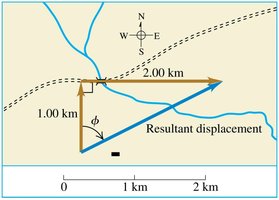
When adding two vectors at right angles, graphical addition is followed by trigonometric calculation of the resultant's magnitude and direction.
Resultant magnitude:
Direction:
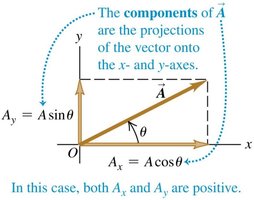
Components of a Vector
Any vector can be decomposed into x and y components. This method provides greater accuracy and flexibility in calculations.
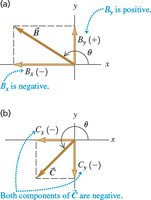
Positive and Negative Components
Vector components can be positive or negative, depending on their direction relative to the axes.
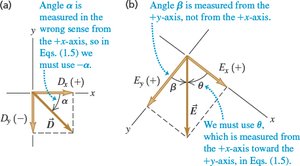
Finding Components
Components are calculated from the vector's magnitude and direction. Care must be taken with angles measured from different axes.
Calculations Using Components
To find the magnitude and direction of a vector from its components:
Magnitude:
Direction:
To add vectors using components:
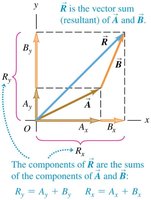
Unit Vectors
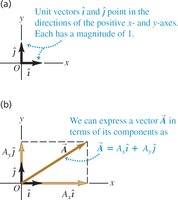
Unit vectors have magnitude 1 and indicate direction along coordinate axes. Common unit vectors are:
: +x direction
: +y direction
: +z direction
Any vector can be written as .
Multiplying Vectors
The Scalar (Dot) Product
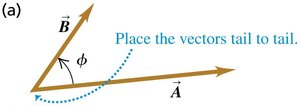
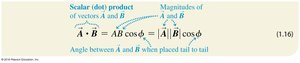
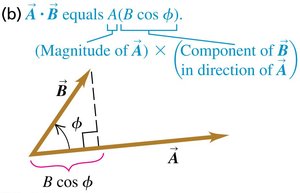
The scalar product (dot product) of two vectors results in a scalar. It is defined as:
Where is the angle between the vectors.
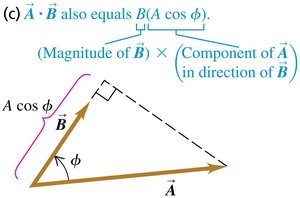
Properties of the Scalar Product
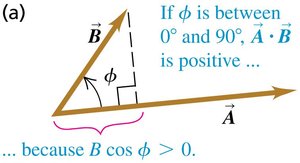
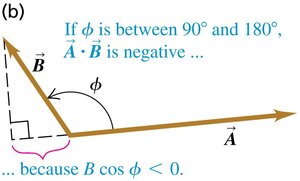
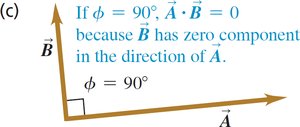
The scalar product can be positive, negative, or zero, depending on the angle between the vectors:
If , is positive.
If , is negative.
If , .
Calculating a Scalar Product Using Components
In terms of components:
Finding an Angle Using the Scalar Product
The angle between two vectors can be found using:
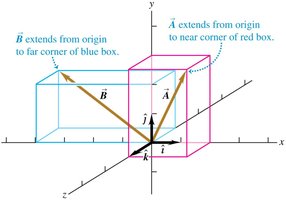
The Vector (Cross) Product
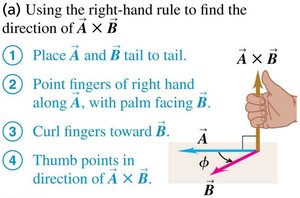
The vector product (cross product) of two vectors results in a vector perpendicular to both. The magnitude is:
The direction is given by the right-hand rule.
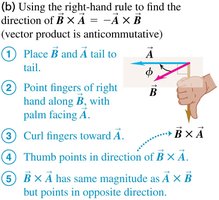
The Vector Product is Anticommutative
The cross product is anticommutative:
Calculating the Vector Product
To calculate the vector product:
Magnitude:
Direction: Use the right-hand rule.
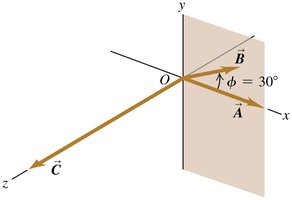
Example: If and are perpendicular, and the direction is perpendicular to the plane containing $\vec{A}$ and $\vec{B}$.
Additional info: Academic context and explanations have been expanded for clarity and completeness. All images included are directly relevant to the adjacent content and reinforce the educational material.
