 Back
BackChapter 1: Units, Physical Quantities, and Vectors – Study Notes
Study Guide - Smart Notes
 Tailored notes based on your materials, expanded with key definitions, examples, and context.
Chapter 1: Units, Physical Quantities, and Vectors
What is Physics?
Physics is an experimentally based science focused on understanding and explaining the fundamental principles that govern the physical universe. The ultimate goal of physics is to predict future events based on these principles.
Kinematics: Study of how objects move.
Dynamics: Study of why objects move.
Conservation of Energy: Principle that energy is conserved in isolated systems.
Conservation of Momentum: Principle that momentum is conserved in isolated systems.
These themes extend to topics such as rotation, fluids, oscillations, and waves.
Physics and Mathematics
Mathematics is the language of physics. Equations in physics have specific meanings and allow for quantitative reasoning. For example, the equation for displacement in constant velocity motion is:
It is essential to use equations with correct units and to understand their physical significance.
Units and Measurement
Physical quantities must always be expressed with units. The International System of Units (SI) is standard in physics:
Length: meter (m)
Time: second (s)
Mass: kilogram (kg)
Conversion between units is often necessary. For example, converting speed from miles per hour to meters per second:
Always write out units and conversion factors to ensure accuracy.

Significant Figures
Significant figures reflect the precision of a measurement. The rules are:
Multiplication/Division: The result has as many significant digits as the number with the least significant digits.
Addition/Subtraction: The result has as many decimal places as the number with the least decimal places.
Keep one extra significant figure in intermediate steps, but round the final answer appropriately.
Dimensional Analysis
Dimensional analysis uses the dimensions of physical quantities to check equations or derive relationships. For example, to check if is dimensionally correct:
Dimensions:
This confirms the equation is dimensionally consistent. Dimensional analysis cannot determine numerical constants.
Order of Magnitude Estimation
Order of magnitude estimates provide quick, approximate answers using powers of ten and one significant figure. For example, estimating the time to drive around the world:
Earth's circumference:
Time:
Such estimates help check the reasonableness of detailed calculations.
Vectors and Scalars
Scalars and Vectors
Physical quantities are classified as either scalars or vectors:
Scalars: Have only magnitude (e.g., mass, temperature).
Vectors: Have both magnitude and direction (e.g., displacement, velocity, force).
Vectors are represented by arrows; their length indicates magnitude and their orientation indicates direction. Vectors can be moved parallel to themselves without changing their meaning.

Vector Addition and Subtraction
Vectors are added by placing the tail of one at the head of another. The resultant vector is drawn from the tail of the first to the head of the last. Vector addition is commutative: .
To subtract vectors, add the negative: .
Vector Components
Any vector can be resolved into components along the x and y axes:
Signs of components depend on the vector's direction relative to the axes.
Unit Vectors and Vector Notation
Unit vectors have magnitude 1 and indicate direction along coordinate axes:
i: x-direction
j: y-direction
k: z-direction
Any vector can be written as .
Multiplying Vectors
There are two main ways to multiply vectors:
Dot Product (Scalar Product): (results in a scalar)
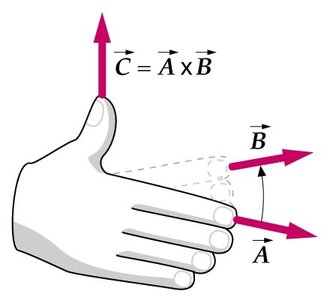
Cross Product (Vector Product): (results in a vector perpendicular to both)
The direction of the cross product is given by the right-hand rule.
Properties of Vector Operations
Dot Product:
Cross Product:
Unit vector properties: , , , etc.
Solving Problems with Vectors
Draw and label axes and vectors.
Resolve vectors into components.
Calculate using components in each direction.
Combine results to find the final vector.
Example: A hiker walks 5.0 km southeast, 8.0 km at 30° east of north, and 2.0 km west. Find the resultant displacement using vector components and trigonometry.
Summary Table: Scalar vs. Vector Quantities
Quantity | Scalar | Vector |
|---|---|---|
Mass | ✔ | |
Displacement | ✔ | |
Temperature | ✔ | |
Velocity | ✔ | |
Force | ✔ |
Additional info: This chapter provides foundational tools for all subsequent topics in physics, including the use of vectors and units in problem-solving, and the mathematical operations essential for describing physical phenomena.
