 Back
BackChapter 10: Energy and Work – Study Notes
Study Guide - Smart Notes
 Tailored notes based on your materials, expanded with key definitions, examples, and context.
Energy and Work
Introduction to Energy
Energy is a fundamental concept in physics, representing the ability of a system to perform work. It exists in various forms and can be transferred or converted, but not created or destroyed. The SI unit of energy is the Joule (J).
Energy: The property of objects that enables them to do work or produce change.
Work: The process of energy transfer to or from a system by means of a force acting through a distance.
Kinetic Energy: Energy associated with motion.
Potential Energy: Stored energy due to position or configuration.
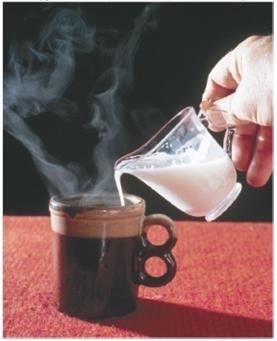
Thermal Energy: Energy related to the random motion of particles in a substance.
Power: The rate at which work is done or energy is transferred.
The Basic Energy Model
Types (Forms) of Energy
Energy manifests in several forms, each associated with different physical phenomena:
Kinetic Energy: Energy of motion.
Potential Energy: Energy stored due to position (e.g., gravitational, elastic).
Mechanical Energy: The sum of kinetic and potential energies in a system.
Thermal Energy: Disordered microscopic energy (internal energy).
Heat: Transfer of thermal energy due to temperature difference.
Mechanical Wave: Energy propagated by oscillations in a medium (e.g., sound).
Electric, Magnetic, Radiant, Nuclear, Ionization, Chemical, Rest Energy: Other specialized forms of energy.
Transferring Energy
Energy can be transferred between systems in several ways:
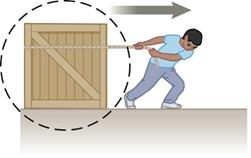
Work: Transfer of energy by a force causing displacement.
Heat: Transfer of energy via microscopic collisions (thermal conduction).
Mechanical Waves: Transfer energy through oscillations in a medium (e.g., sound waves).
Electrical Transmission: Transfer via electric currents.
Electromagnetic Radiation: Transfer via electromagnetic waves (e.g., light).
Work
Definition and Calculation of Work
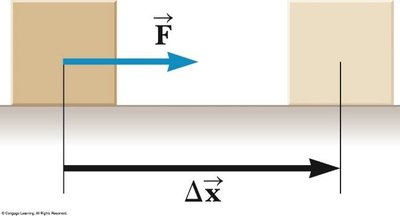
Work is done when a force causes displacement. For a constant force F acting along the direction of displacement Δx:
Formula:
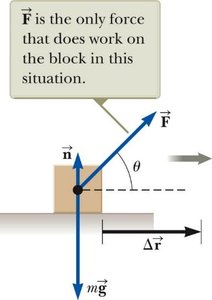
If the force is not aligned with the displacement, only the component of the force in the direction of displacement does work:
General Formula:
Units: Joule (J), where
Work is a scalar quantity (no direction).
The sign of work depends on the direction of force relative to displacement (positive if in the same direction, negative if opposite).
Work and Direction of Force
Work depends on the angle between the force and displacement vectors:
If the force is perpendicular to displacement (), , so .
Forces such as the normal force or gravity may do no work if they are perpendicular to the displacement.
Positive and Negative Work
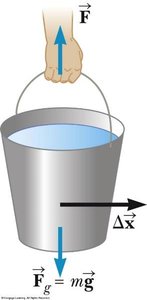
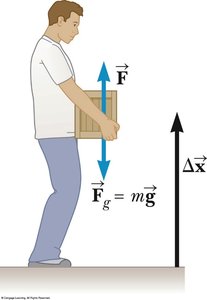
Work can be positive or negative:
Positive Work: Force and displacement are in the same direction (e.g., lifting a box).
Negative Work: Force and displacement are in opposite directions (e.g., lowering a box).
Work Done by a Varying Force
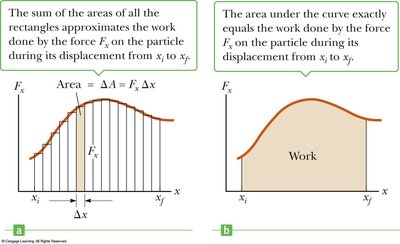
When the force varies with position, the work done is the area under the force vs. displacement curve:
For a variable force ,
Graphically, this is the area under the vs. curve.
Example: Pulling a Sled
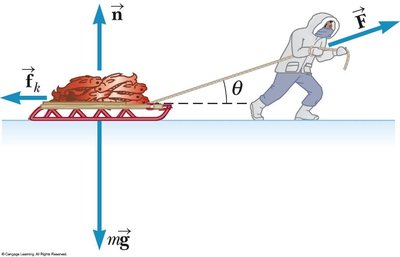
When pulling a sled at an angle, only the horizontal component of the force does work:
Work done:
Friction does negative work, removing energy from the system.
Kinetic Energy
Definition and Formula
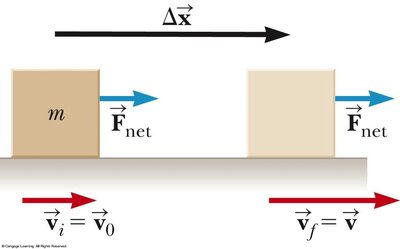
Kinetic energy is the energy of motion for an object of mass and speed :
Formula:
Work-Energy Theorem
The net work done on an object equals the change in its kinetic energy:
Work-Energy Theorem:
Speed increases if net work is positive; decreases if negative.
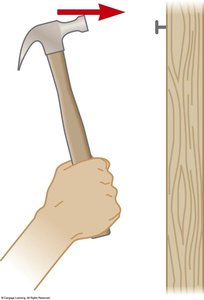
Example: Hammer and Nail
A moving hammer has kinetic energy, which it transfers to a nail as work when coming to rest.
Conservative and Nonconservative Forces
Types of Forces
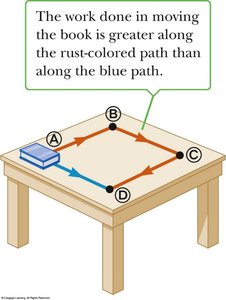
Conservative Forces: Work done is path-independent; energy can be fully recovered (e.g., gravity, spring force).
Nonconservative Forces: Work done depends on the path; energy is dissipated (e.g., friction, air drag).
Example: Friction as a Nonconservative Force
Work done against friction depends on the path taken, not just the endpoints.
Potential Energy
Definition
Potential energy is stored energy due to the position or configuration of a system. It is a property of the system, not just a single object.
Gravitational Potential Energy
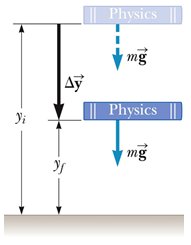
For an object of mass at height above a reference point:
Formula:
Change in potential energy:
Conservation of Mechanical Energy
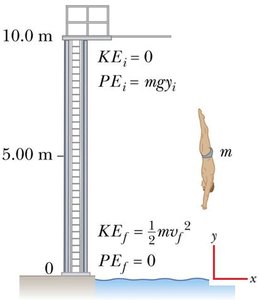
In the absence of nonconservative forces, the total mechanical energy (kinetic + potential) of a system remains constant:
Formula:
Example: Platform Diver
A diver's potential energy is converted to kinetic energy as they fall, conserving total mechanical energy.
Elastic Potential Energy
Hooke's Law and Springs
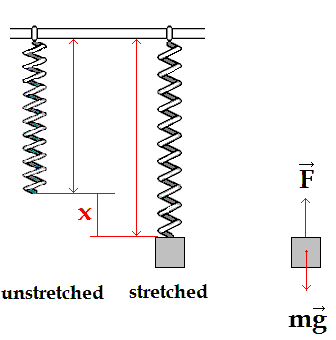
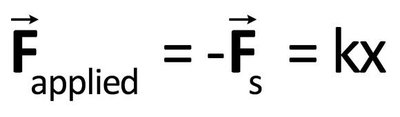
The force exerted by a spring is proportional to its displacement from equilibrium:
Hooke's Law:
is the spring constant (N/m).
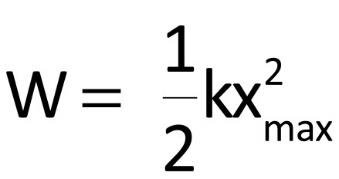
Work Done by a Spring
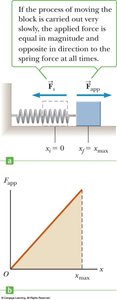
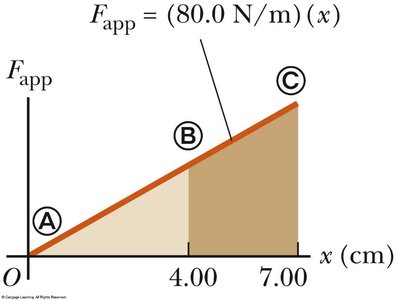
The work done in stretching or compressing a spring is equal to the area under the force vs. displacement graph:
Formula:
Example: Stretching a Spring
Calculating work done in stretching a spring from one length to another using the area under the force-displacement graph.
Elastic Potential Energy
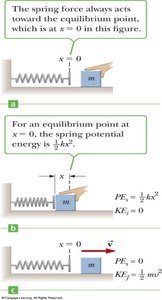
The energy stored in a stretched or compressed spring:
Formula:
Energy is zero when the spring is at equilibrium ().
Thermal Energy and Conservation of Energy
Thermal Energy
Thermal energy is the microscopic, disordered equivalent of mechanical energy, often resulting from friction or other dissipative processes.
Conservation of Energy (General)
The total energy of an isolated system remains constant, though it may change forms (mechanical, thermal, chemical, etc.).
Power
Definition and Calculation
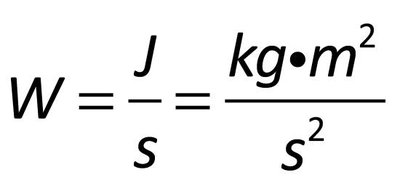
Power is the rate at which work is done or energy is transferred:
Average Power:
Instantaneous Power: (force and velocity must be parallel)
SI Unit: Watt (W), where
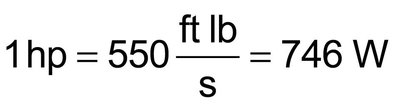
US Customary Unit: Horsepower (hp), where
Summary Table: Forms of Energy
Form of Energy | Description | Example |
|---|---|---|
Kinetic | Energy of motion | Moving car |
Potential (Gravitational) | Energy due to position in a gravitational field | Object held at height |
Elastic | Energy stored in stretched/compressed spring | Stretched spring |
Thermal | Microscopic kinetic energy | Hot coffee |
Chemical | Energy stored in molecular bonds | Food, fuel |
Radiant | Energy of electromagnetic waves | Sunlight |
Additional info: This guide covers all major aspects of energy and work as presented in a typical introductory physics course, including definitions, formulas, examples, and the role of conservative and nonconservative forces.
