 Back
BackChapter 10: Energy and Work – Study Notes
Study Guide - Smart Notes
 Tailored notes based on your materials, expanded with key definitions, examples, and context.
Energy and Work
Introduction to Energy
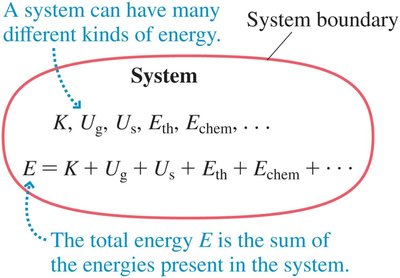
Energy is a fundamental concept in physics, representing the capacity to do work or produce change. Every physical system possesses a total energy, which can exist in various forms and can be transformed or transferred between systems.
Total Energy (E): The sum of all forms of energy present in a system.
System Boundary: The imaginary boundary that separates the system from its environment.
Forms of Energy
Energy exists in several distinct forms, each associated with different physical phenomena:
Kinetic Energy (K): Energy of motion.
Gravitational Potential Energy (U_g): Energy stored due to an object's position above the ground.
Elastic (Spring) Potential Energy (U_s): Energy stored when an elastic object is stretched or compressed.
Thermal Energy (E_{th}): Energy related to the temperature of a system, arising from the motion of atoms and molecules.
Chemical Energy (E_{chem}): Energy stored in chemical bonds.
Nuclear Energy (E_{nuclear}): Energy stored in the nucleus of an atom.
Energy Transformations
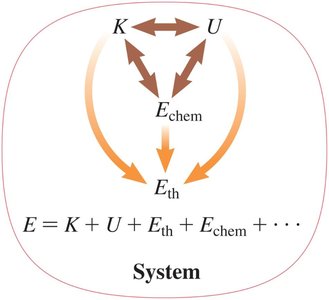
Within a system, energy can be transformed from one form to another. For example, chemical energy can be converted to kinetic or thermal energy.
Energy Transfers: Work and Heat
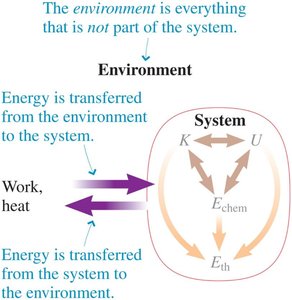
Energy can be transferred between a system and its environment through two main processes: work and heat.
Work (W): The mechanical transfer of energy by applying a force over a distance.
Heat (Q): The nonmechanical transfer of energy due to a temperature difference.
Examples of Work and Energy Transfer
Mechanical Work: An athlete does work on a shot put, giving it kinetic energy.
Thermal Work: Striking a match does work, converting energy into thermal energy.
Elastic Work: Pulling a slingshot stores energy as elastic potential energy.



The Work-Energy Principle
The Work-Energy Equation
Work represents energy transferred into or out of a system. The total energy of a system changes by the amount of work done on it:
Work-Energy Equation:
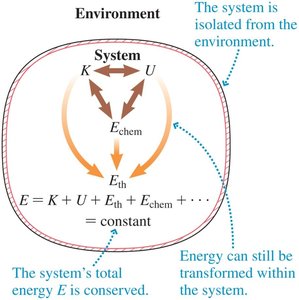
If no energy is transferred into or out of a system, it is called an isolated system.
Law of Conservation of Energy
In an isolated system, the total energy remains constant, though energy can still be transformed between different forms within the system.
Work
Definition of Work
Work is done on a system by external forces (forces from outside the system). Work is a scalar quantity, even though force and displacement are vectors.
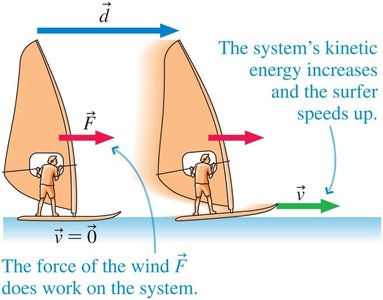
Unit of Work: Joule (J), where
Calculating Work
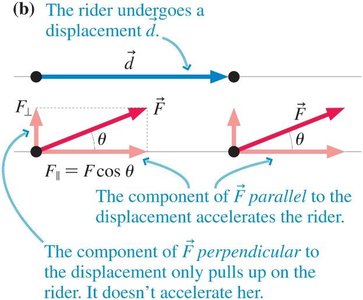
The work done by a constant force over a displacement is given by:
is the angle between the force and the displacement vectors.
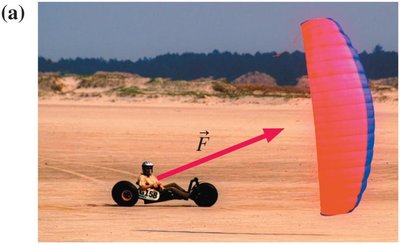
Force at an Angle to Displacement
Only the component of the force in the direction of displacement does work. If the force is at an angle to the displacement, the effective component is .
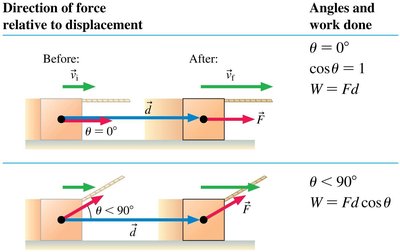
Work for Different Angles
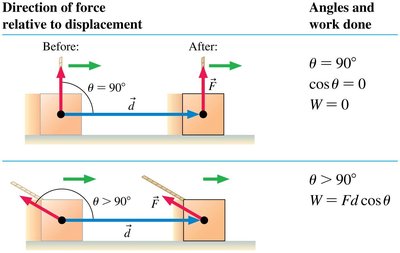
Angle () | Work Done () |
|---|---|
(maximum positive work) | |
(positive work) | |
(no work) | |
(negative work) | |
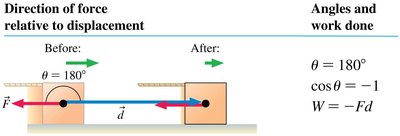
(maximum negative work) |
Sign of Work
The sign of work depends on the angle between the force and displacement:
Positive Work: Force has a component in the direction of displacement ().
Negative Work: Force has a component opposite to displacement ().
Zero Work: Force is perpendicular to displacement ().
Forces That Do No Work
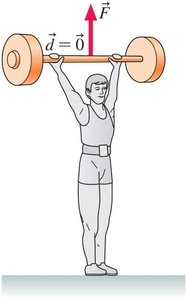
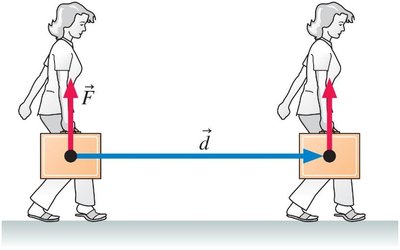
A force does no work if:
The object undergoes no displacement.
The force is perpendicular to the displacement.
The part of the object on which the force acts does not move (e.g., pushing against a wall).
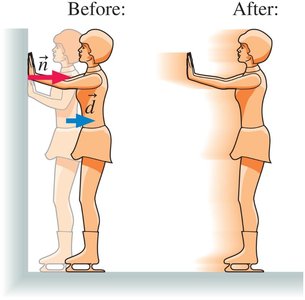
Kinetic Energy
Translational Kinetic Energy
Kinetic energy due to motion in a straight line is called translational kinetic energy. It is given by:
Where is mass and is velocity.
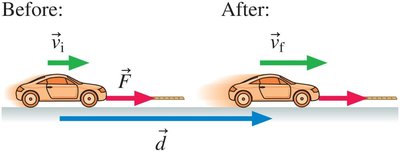
Rotational Kinetic Energy
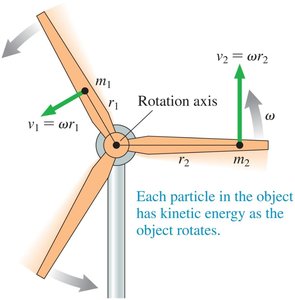
For rotating objects, kinetic energy is expressed as:
is the moment of inertia, is the angular velocity.
Potential Energy
Gravitational Potential Energy
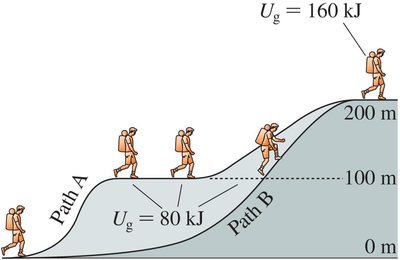
Gravitational potential energy is energy stored due to an object's position in a gravitational field. The change in gravitational potential energy is proportional to the change in height:
Reference level is chosen where ; only changes in matter.
Gravity is a conservative force; depends only on the change in height, not the path taken.
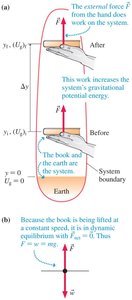
Elastic (Spring) Potential Energy
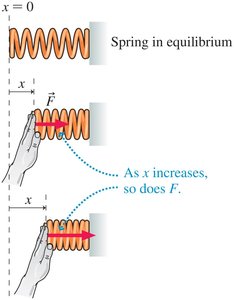
Elastic potential energy is stored when a spring is compressed or stretched. Hooke's law describes the force required:
is the spring constant, is the displacement from equilibrium.
The elastic potential energy stored is:
Thermal Energy
Thermal Energy and Temperature
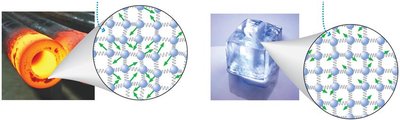
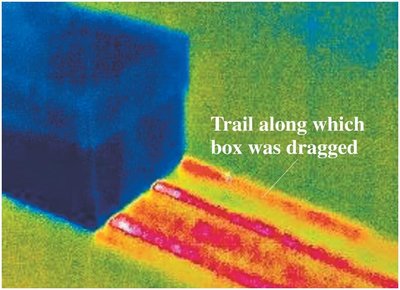
Thermal energy is associated with the temperature of a body and arises from the motion of atoms and molecules. Friction and drag convert mechanical energy into thermal energy.
Creating Thermal Energy
Friction: Work done by friction increases thermal energy:
Drag: Work done by drag also increases thermal energy:
Summary Table: Forms of Energy
Form of Energy | Symbol | Equation | Example |
|---|---|---|---|
Kinetic | K | Moving car | |
Gravitational Potential | U_g | Object at height | |
Elastic Potential | U_s | Compressed spring | |
Thermal | E_{th} | — | Heated object |
Chemical | E_{chem} | — | Battery, food |
Nuclear | E_{nuclear} | — | Atomic nucleus |
Additional info: This summary covers the core concepts of energy and work, including forms of energy, energy transformations, the work-energy principle, and the role of thermal energy in physical systems. For further study, see chapters on thermal properties, oscillations, and advanced energy applications.
