 Back
BackChapter 10: Motion in a Plane – Physics Study Guide
Study Guide - Smart Notes
 Tailored notes based on your materials, expanded with key definitions, examples, and context.
Motion in a Plane
Overview
This chapter introduces the fundamental concepts and mathematical tools required to analyze motion in two dimensions. It covers vector operations, decomposition of forces, friction, work, and momentum, providing a comprehensive foundation for understanding complex physical systems.
Straight is a Relative Term
Reference Frames and Trajectories
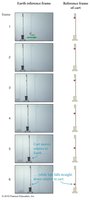
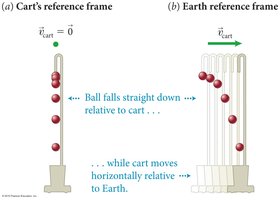
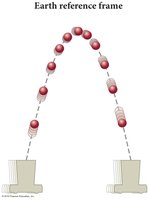
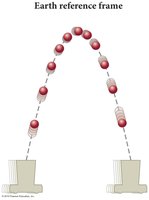
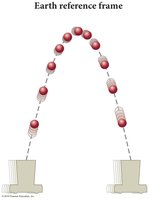
The trajectory of a free-falling object depends on the observer's reference frame. In a moving frame, the path may appear straight, while in a stationary frame, the object exhibits both horizontal and vertical motion.
Reference Frame: The perspective from which motion is observed (e.g., cart vs. Earth).
Trajectory: The path followed by an object, which can differ based on the observer's motion.
Decomposition: Motion can be separated into horizontal (constant velocity) and vertical (free fall) components.
Vectors in a Plane
Vector Addition and Subtraction
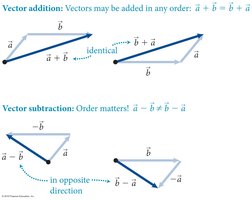
Vectors are fundamental in describing motion in two dimensions. Their addition is commutative, but subtraction is not. Vectors can be decomposed into components along perpendicular axes.
Vector Addition: Place the tail of the second vector at the head of the first; the sum is the vector from the tail of the first to the head of the second.
Vector Subtraction: Reverse the direction of the vector to be subtracted and add it to the other vector.
Commutativity: Addition is commutative (), subtraction is not ().
Vector Components and Decomposition
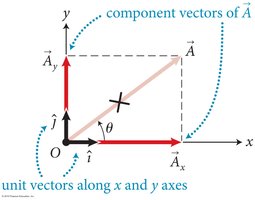
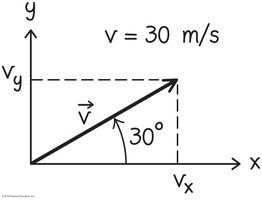
Any vector can be decomposed into x and y components using a rectangular coordinate system. This is essential for analyzing motion and forces in two dimensions.
Component Vectors:
Magnitude:
Angle:
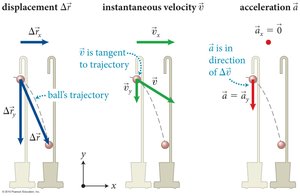
Acceleration Components
In two-dimensional motion, acceleration can be decomposed into components parallel and perpendicular to the instantaneous velocity.
Parallel Component: Changes the speed of the object.
Perpendicular Component: Changes the direction of velocity but not its magnitude.
Decomposition of Forces
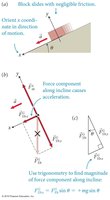
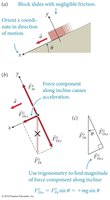
Forces on Inclined Planes
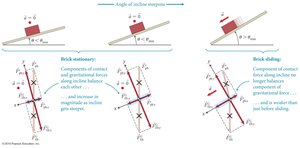
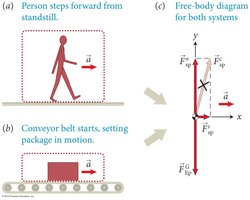
When analyzing motion on an inclined surface, it is useful to decompose forces into components parallel (tangential) and perpendicular (normal) to the surface.
Tangential Component: Drives motion along the surface.
Normal Component: Acts perpendicular to the surface, often balancing gravity.
Coordinate Choice: Choose axes aligned with the direction of acceleration for easier analysis.
Friction
Static and Kinetic Friction
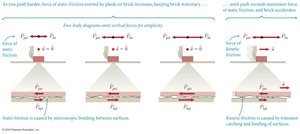
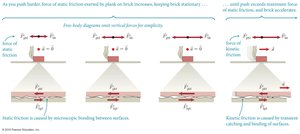
Friction arises from microscopic interactions between surfaces. It opposes relative motion and can be classified as static (no relative motion) or kinetic (surfaces sliding).
Static Friction: Prevents motion up to a maximum value.
Kinetic Friction: Acts when surfaces are sliding, generally less than static friction.
Normal Force: Perpendicular component of contact force, balances gravity.
Work and Friction
Energy Dissipation
Kinetic friction causes energy dissipation and irreversible changes, while static friction does not dissipate energy.
Static Friction: Elastic, no energy loss.
Kinetic Friction: Non-elastic, causes energy dissipation.
Vector Algebra
Coordinate Systems
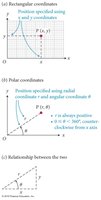
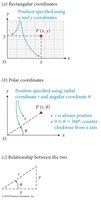
Vectors can be represented in rectangular (Cartesian) or polar coordinates. Conversion between these systems uses trigonometric relationships.
Rectangular Coordinates:
Polar Coordinates:
Conversion: ,
Vector Decomposition and Addition
Decomposition:
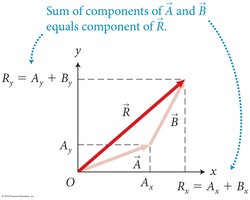
Addition: ,
Example: Speeding Ball
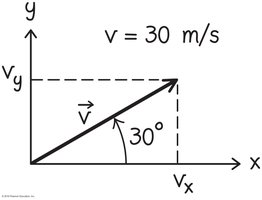
A ball thrown at 30° to the horizontal with a speed of 30 m/s:
m/s
m/s


Projectile Motion in Two Dimensions
Kinematics of Projectiles
Projectile motion can be analyzed by decomposing it into horizontal and vertical components. The horizontal velocity remains constant, while the vertical velocity changes due to gravity.
Position Vector:
Velocity Components: (constant),
Position Components: ,


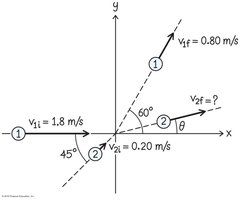
Collisions and Momentum in Two Dimensions
Conservation of Momentum
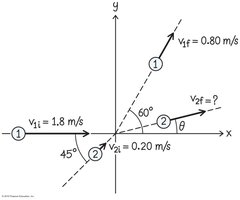
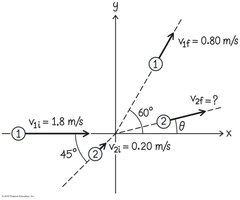
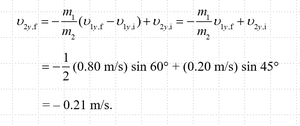
Momentum is conserved in both the x and y directions for isolated systems. The equations for conservation are applied separately to each component.
Momentum Conservation:
Momentum Conservation:
Work as the Product of Two Vectors
Work and Scalar (Dot) Product
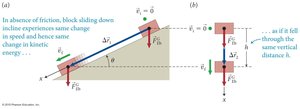
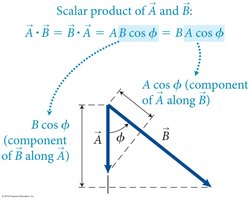
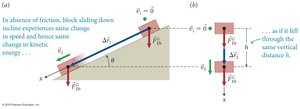
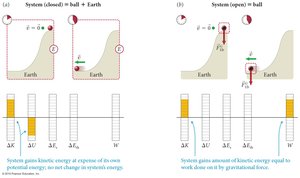
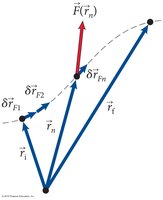
Work is defined as the scalar product of force and displacement. The work done by gravity is independent of the path taken.
Work:
Path Independence: For gravity, regardless of the path.
Dot Product Properties: Commutative, zero if vectors are perpendicular.
Coefficients of Friction
Quantitative Description of Friction
The maximum force of static friction is proportional to the normal force, with the proportionality constant called the coefficient of static friction (). Kinetic friction is also proportional to the normal force, but with a smaller coefficient ().
Static Friction:
Kinetic Friction:
Procedure: Draw a free-body diagram, decompose forces, solve for normal and frictional forces.
Summary Table: Types of Friction
Type | Formula | Coefficient | Motion |
|---|---|---|---|
Static Friction | No relative motion | ||
Kinetic Friction | Surfaces sliding |
Summary Table: Vector Operations
Operation | Formula | Commutativity |
|---|---|---|
Addition | Yes | |
Subtraction | No | |
Dot Product | Yes |
Summary Table: Projectile Motion Equations
Component | Equation |
|---|---|
Horizontal Position | |
Vertical Position | |
Horizontal Velocity | |
Vertical Velocity |
Summary Table: Conservation of Momentum in Two Dimensions
Component | Equation |
|---|---|
x | |
y |
Summary Table: Work and Energy
Type | Equation |
|---|---|
Constant Force | |
Variable Force | |
Gravity |
