 Back
BackChapter 11: Equilibrium and Elasticity – Structured Study Notes
Study Guide - Smart Notes
 Tailored notes based on your materials, expanded with key definitions, examples, and context.
Equilibrium
Conditions for Equilibrium
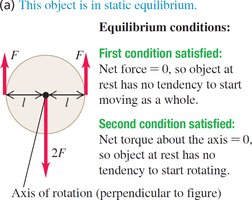
For an extended object to be in static equilibrium, two fundamental conditions must be satisfied. These conditions ensure that the object remains at rest and does not rotate.
First Condition (Translational Equilibrium): The vector sum of all external forces acting on the object must be zero. This prevents the object from accelerating linearly.

Second Condition (Rotational Equilibrium): The sum of external torques about any point must be zero. This prevents the object from rotating.

Both conditions must be satisfied for true static equilibrium.
Examples of Equilibrium Conditions
Different force and torque arrangements illustrate the importance of both equilibrium conditions:
Case 1: Both conditions satisfied; object remains at rest and does not rotate.
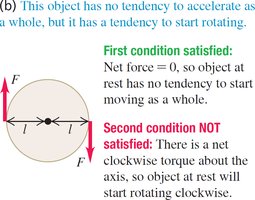
Case 2: Net force is zero, but net torque is not; object will rotate.
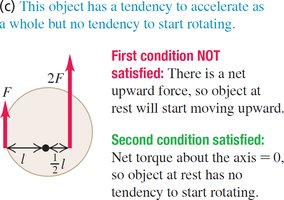
Case 3: Net torque is zero, but net force is not; object will accelerate.
Center of Gravity
Definition and Properties
The center of gravity is the point at which the entire weight of an object can be considered to act. For most practical purposes, especially when gravity is uniform, the center of gravity coincides with the center of mass.
Key Point: The net gravitational torque about any point is the same as if all the weight acted at the center of gravity.
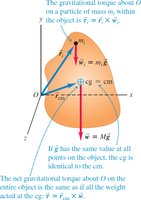
Example: The Petronas Towers in Malaysia have a negligible difference in gravity from top to bottom, so their center of gravity is almost identical to their center of mass.

Equilibrium and Area of Support
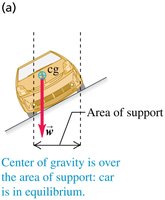
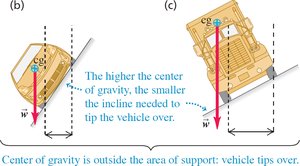
An object supported at several points must have its center of gravity within the area bounded by the supports to be in equilibrium.
Key Point: If the center of gravity is outside the area of support, the object will tip over.
Suspension and Rotational Equilibrium
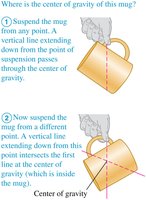
When an object is suspended or supported at a single point, its center of gravity is always at or directly above/below the point of suspension.
Example: Locating the center of gravity of a mug by suspending it from different points.
Applying Center of Gravity
Static Equilibrium Problems
Problems involving static equilibrium often require careful analysis of forces and torques. Typical examples include planks, ladders, and exercise positions.
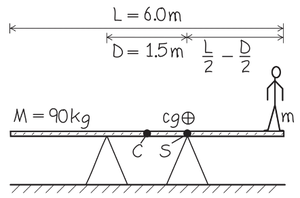
Example 1: A uniform plank supported at two points, with a person standing at one end.

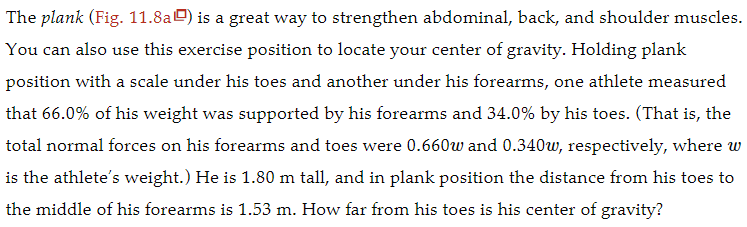
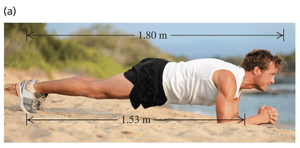
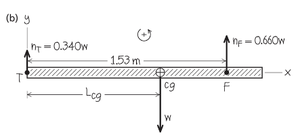
Example 2: Locating the center of gravity in a plank exercise position.
Problem-Solving Strategy for Static Equilibrium
Step-by-Step Approach
Solving static equilibrium problems requires a systematic approach:
Identify relevant concepts: Use , , and .
Sketch the situation: Draw the object and all forces acting on it.
Draw a free-body diagram: Indicate the point of application for each force.
Choose coordinate axes: Specify directions for axes and rotation.
Choose a reference point: Compute torques about this point.
Write equilibrium equations: Set up equations for forces and torques.
Check your answer: Recompute torques about a different reference point for verification.
Worked Examples
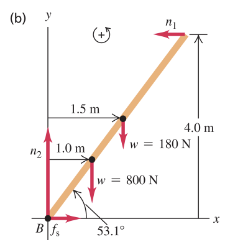
Non-slipping Ladder
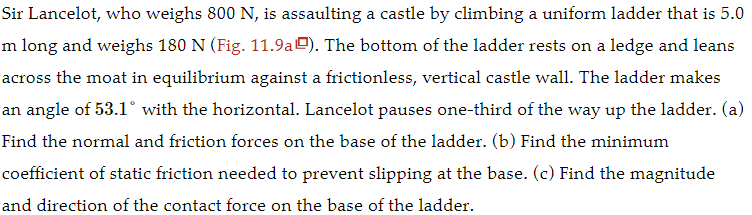
Analyzing a ladder in equilibrium against a wall involves calculating normal and friction forces, and determining the minimum coefficient of static friction.
Example: Sir Lancelot climbing a ladder; forces and torques are analyzed.
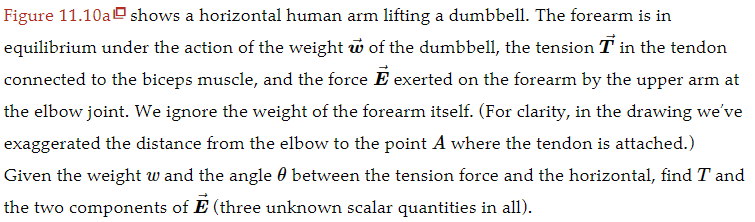
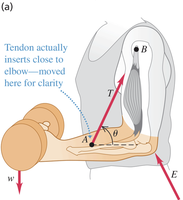
Dumbbell Curls
The forearm in equilibrium while lifting a dumbbell demonstrates the application of force and torque analysis in biomechanics.
Example: Forces acting on the forearm, including tension in the tendon and reaction at the elbow.
Supporting a Diving Board
Calculating forces at support points and ends of a diving board with a diver standing at the free end.
Example: Forces at the support and left-hand end.

Non-Uniform Objects
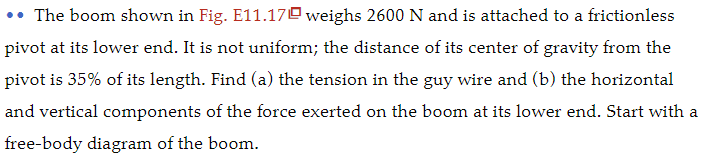
For objects with non-uniform mass distribution, the center of gravity may not be at the geometric center. Analysis involves finding tension and force components.
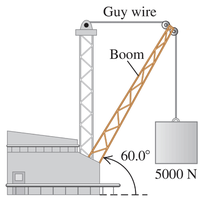
Example: Boom supported by a guy wire; tension and force components are calculated.
Summary Table: Conditions for Equilibrium
The following table summarizes the two main conditions for equilibrium:
Condition | Equation | Physical Meaning |
|---|---|---|
Translational Equilibrium | No net force; object does not accelerate | |
Rotational Equilibrium | No net torque; object does not rotate |
Key Terms and Concepts
Static Equilibrium: State in which an object is at rest and both net force and net torque are zero.
Center of Gravity: Point where the weight of an object is considered to act.
Torque (): Rotational equivalent of force; .
Area of Support: Region bounded by points supporting an object; center of gravity must be within this area for stability.
Example Applications: Engineering structures, biomechanics, vehicle stability, and everyday objects.
Additional info: Academic context and explanations have been expanded for clarity and completeness. All images included are directly relevant to the adjacent explanations.
