 Back
BackChapter 11: Using Energy – Thermodynamics and Energy Transformations
Study Guide - Smart Notes
 Tailored notes based on your materials, expanded with key definitions, examples, and context.
Thermal Physics and Thermodynamics
Introduction to Thermal Physics
Thermal physics is the study of heat, temperature, and their relation to energy and work. It combines the principles of thermodynamics, statistical mechanics, and kinetic theory to explain the macroscopic and microscopic behavior of matter.
Thermodynamics: The science of heat, temperature, and their relation to energy and work.
Statistical Mechanics: Uses probability theory to study the average behavior of systems with many particles.
Kinetic Theory: Describes gases as large numbers of particles in constant, random motion.
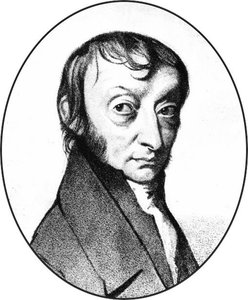
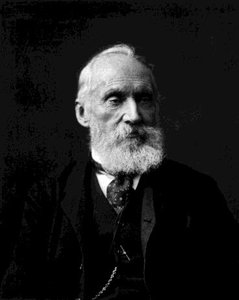
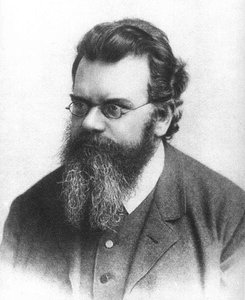
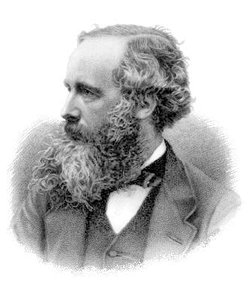
Key Contributors: Avogadro, Lord Kelvin, Boltzmann, Maxwell, Carnot, Clausius.
Basic Concepts and Definitions
Temperature, Thermal Energy, and Heat
Temperature is a measure of the average kinetic energy of the particles in a substance. Thermal energy is the total internal energy due to the random motions of particles. Heat is the energy transferred between objects due to a temperature difference.
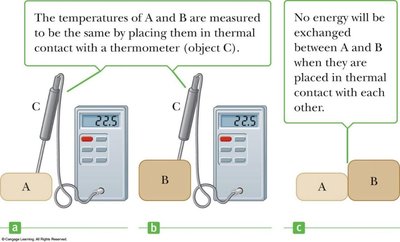
Thermal Contact: Two objects are in thermal contact if energy can be exchanged between them.
Thermal Equilibrium: Exists when two objects in thermal contact have no net energy exchange.
Zeroth Law of Thermodynamics
The Zeroth Law establishes the concept of temperature. If object A is in thermal equilibrium with object C, and object B is also in thermal equilibrium with object C, then A and B are in thermal equilibrium with each other. This law allows the use of thermometers to measure temperature.
Thermometers and Temperature Scales
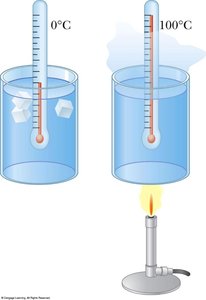
Thermometers use physical properties that change with temperature (e.g., volume of a liquid, pressure of a gas, electrical resistance) to measure temperature. Common temperature scales include Celsius, Fahrenheit, and Kelvin.
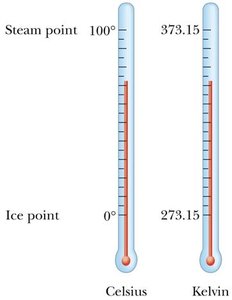
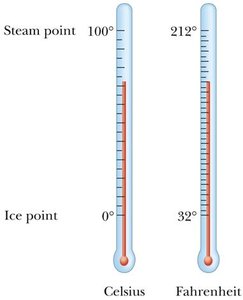
Celsius Scale: 0°C (freezing point of water), 100°C (boiling point of water).
Fahrenheit Scale: 32°F (freezing point), 212°F (boiling point).
Kelvin Scale: Absolute zero (0 K), triple point of water (273.16 K).

Constant-Volume Gas Thermometer and Absolute Zero
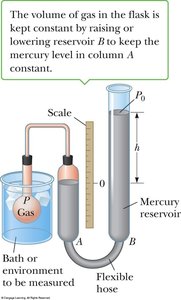
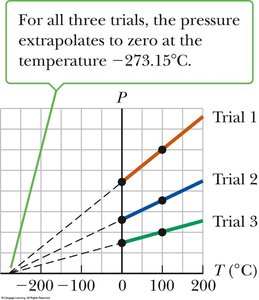
A constant-volume gas thermometer measures temperature by the pressure of a gas at constant volume. All gases extrapolate to zero pressure at -273.15°C, which defines absolute zero (0 K).
The Triple Point of Water
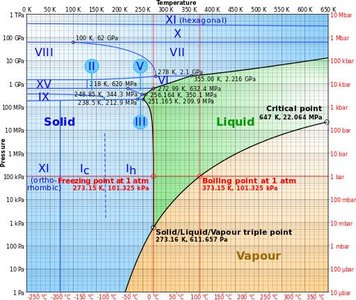
The triple point of water is the unique temperature and pressure where water can exist as solid, liquid, and gas in equilibrium: 0.01°C (273.16 K) and 611.657 Pa.
Energy, Work, and the First Law of Thermodynamics
Internal Energy
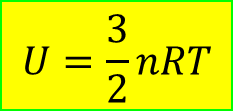
Internal energy (U) is the sum of all kinetic and potential energies of the atoms and molecules in a system. For a monatomic ideal gas, internal energy is purely translational kinetic energy:
The First Law of Thermodynamics
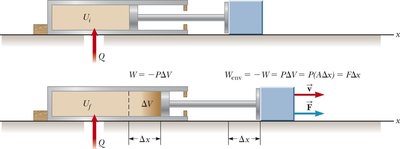
The First Law states that the change in internal energy of a system equals the heat added to the system plus the work done on the system:
Q: Positive if heat is added to the system, negative if removed.
W: Positive if work is done on the system, negative if done by the system.
Molar Specific Heat and Degrees of Freedom
The molar specific heat () is the energy required to raise the temperature of one mole of a substance by one Kelvin:
Each independent way a molecule can store energy is called a degree of freedom. For a monatomic ideal gas, the change in internal energy is:
Energy in the Body and Metabolic Rate
Metabolic Rate
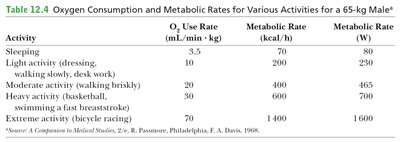
The metabolic rate is the rate at which chemical potential energy from food and oxygen is transformed into internal energy to balance losses by work and heat. It is proportional to the rate of oxygen consumption:
where is in L/s and is in kcal/s.
Activity | O2 Use Rate (mL/min·kg) | Metabolic Rate (kcal/h) | Metabolic Rate (W) |
|---|---|---|---|
Sleeping | 3.5 | 70 | 80 |
Light activity | 10 | 200 | 250 |
Moderate activity | 20 | 400 | 465 |
Heavy activity | 30 | 600 | 700 |
Extreme activity | 70 | 1400 | 1600 |
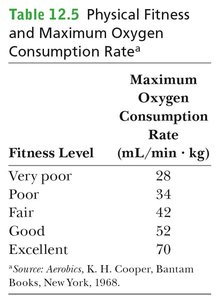
Fitness Level | Maximum Oxygen Consumption Rate (mL/min·kg) |
|---|---|
Very poor | 28 |
Poor | 34 |
Fair | 42 |
Good | 52 |
Excellent | 70 |
Heat Engines and the Second Law of Thermodynamics
Heat Engines
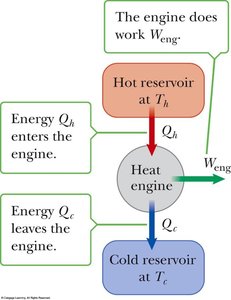
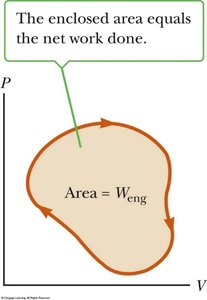
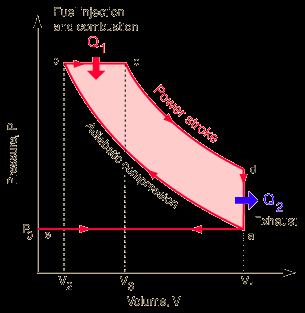
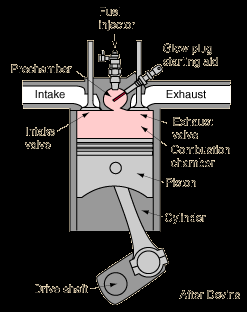
A heat engine takes in energy by heat from a high-temperature source, does work, and expels energy to a low-temperature sink. The process is cyclic, so the internal energy returns to its initial value after each cycle.
Thermal Efficiency
The thermal efficiency (e) of a heat engine is the ratio of the work done to the energy absorbed from the hot reservoir:
The Carnot Engine and Carnot's Theorem
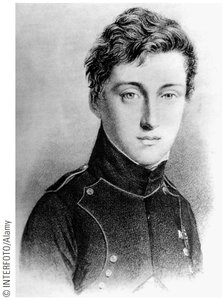
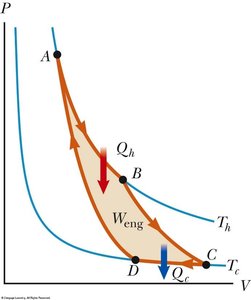
The Carnot engine is an idealized heat engine with maximum possible efficiency, operating between two reservoirs at temperatures and . Carnot's theorem states that no real engine can be more efficient than a Carnot engine operating between the same two temperatures.
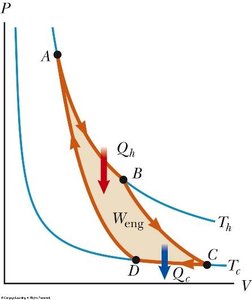
The Carnot Cycle
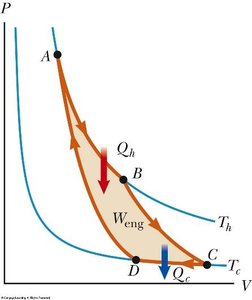
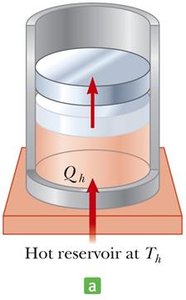
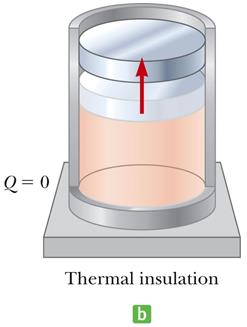
A to B: Isothermal expansion at , heat absorbed.
B to C: Adiabatic expansion, temperature drops from to .
C to D: Isothermal compression at , heat expelled.
D to A: Adiabatic compression, temperature rises from to .
Efficiency of a Carnot Engine
The efficiency of a Carnot engine depends only on the temperatures of the hot and cold reservoirs:
where and are in Kelvin.
The Third Law of Thermodynamics
The third law states that it is impossible to reach absolute zero in a finite number of steps. All real engines are less efficient than the Carnot engine due to irreversibilities such as friction and rapid cycles.
Heat Pumps and Refrigerators
Heat Pumps
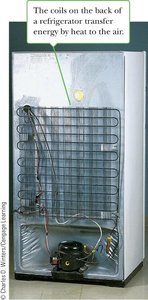
Heat pumps transfer energy from a cold reservoir to a hot reservoir by doing work. Refrigerators and air conditioners are common examples operating in cooling mode.
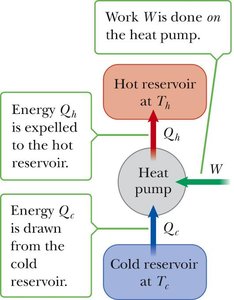
The coefficient of performance (COP) for a refrigerator is:
Entropy and the Second Law of Thermodynamics
Entropy
Entropy (S) is a measure of disorder or randomness in a system. For a reversible process at constant temperature:
Entropy is a state function; its change depends only on the initial and final states, not the path taken.
The Second Law of Thermodynamics
No heat engine can convert all absorbed energy into work; some must be expelled to a cold reservoir.
Heat flows spontaneously from hot to cold objects.
Reversible processes are idealizations; most real processes are irreversible.
Perpetual Motion Machines
Perpetual motion machines of the first kind violate the First Law (energy conservation), and those of the second kind violate the Second Law (entropy increase). Such machines are impossible.
Entropy, Disorder, and the Heat Death of the Universe
Statistical mechanics shows that isolated systems tend toward greater disorder (higher entropy). The entropy of the universe always increases, leading to a state of maximum entropy where no energy is available for work—sometimes called the "heat death" of the universe.
Glossary of Key Terms
Temperature
Thermal Energy
Heat
Thermodynamics
Zeroth Law of Thermodynamics
First Law of Thermodynamics
Second Law of Thermodynamics
Third Law of Thermodynamics
Heat Engine
Heat Pump
Entropy
