 Back
BackChapter 12: Sound – Properties, Intensity, Sources, and the Doppler Effect
Study Guide - Smart Notes
 Tailored notes based on your materials, expanded with key definitions, examples, and context.
Sound: Characteristics and Properties
What is Sound?
Sound is a mechanical wave that propagates through matter (solids, liquids, or gases) as a result of vibrating particles. It cannot travel through a vacuum because it requires a medium for transmission.
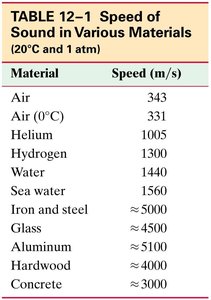
Speed of Sound: The speed at which sound travels depends on the medium. It is generally slowest in gases, faster in liquids, and fastest in solids. Temperature also affects the speed, especially in gases.
Formula for Speed in Air: The speed of sound in air at temperature T (in °C) is given by:
Loudness, Pitch, and Frequency Ranges
Loudness: Related to the intensity of the sound wave (energy per unit area per unit time).
Pitch: Related to the frequency of the sound wave. Higher frequency means higher pitch.
Audible Range: Humans can typically hear frequencies from about 20 Hz to 20,000 Hz. The upper limit decreases with age.
Ultrasound: Frequencies above 20,000 Hz (used in medical imaging and focusing devices).
Infrasound: Frequencies below 20 Hz.
Intensity of Sound and Decibels
Sound Intensity
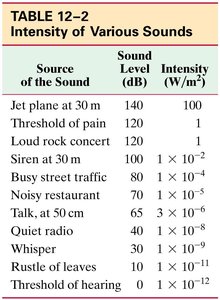
The intensity of a sound wave is the energy transported per unit time across a unit area. The human ear can detect a wide range of intensities, from W/m2 (threshold of hearing) to 1 W/m2 (threshold of pain).
Inverse Square Law: In open areas, sound intensity decreases with the square of the distance from the source: .
Perceived Loudness: Not directly proportional to intensity; it is more closely related to the logarithm of intensity.
Decibel Scale
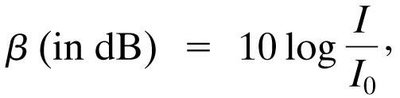
The decibel (dB) scale is a logarithmic measure of sound intensity relative to a reference level ( W/m2$). The formula for sound level in decibels is:
Examples of Sound Levels
Source of Sound | Sound Level (dB) | Intensity (W/m2) |
|---|---|---|
Jet plane at 30 m | 140 | 100 |
Threshold of pain | 120 | 1 |
Loud rock concert | 120 | 1 |
Siren at 30 m | 100 | 1 × 10⁻² |
Busy street traffic | 80 | 1 × 10⁻⁴ |
Noisy restaurant | 70 | 1 × 10⁻⁵ |
Talk, at 50 cm | 65 | 3 × 10⁻⁶ |
Quiet radio | 40 | 1 × 10⁻⁸ |
Whisper | 30 | 1 × 10⁻⁹ |
Rustle of leaves | 10 | 1 × 10-11 |
Threshold of hearing | 0 | 1 × 10-12 |
Sources of Sound: Vibrating Strings and Air Columns
How Musical Instruments Produce Sound
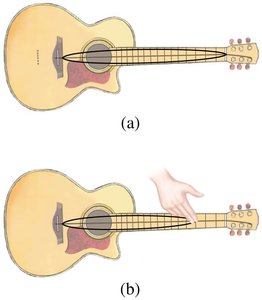
Musical instruments generate sound through the vibration of strings, membranes, metal or wood shapes, or air columns. The vibration can be initiated by plucking, striking, bowing, or blowing, and is transmitted to the air and then to our ears.
Vibrating Strings: The pitch can be changed by altering the length, tension, or density of the string.
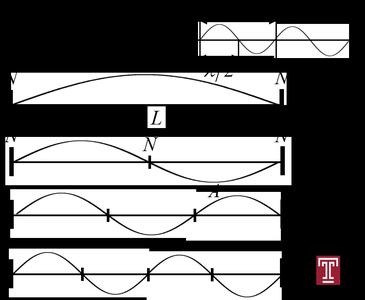
Standing Waves: Strings and air columns support standing waves, which determine the possible frequencies (harmonics) that can be produced.
Standing Waves in Strings
For a string fixed at both ends, the allowed wavelengths and frequencies are:
Wavelength of the fundamental:
Frequency of the nth harmonic: , where and

Standing Waves in Air Columns
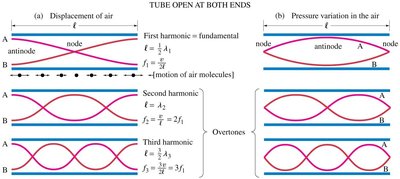
Tubes Open at Both Ends: Both ends are displacement antinodes (pressure nodes). All harmonics are present.
Tubes Closed at One End: Closed end is a displacement node (pressure antinode), open end is a displacement antinode (pressure node). Only odd harmonics are present.

The Doppler Effect
What is the Doppler Effect?
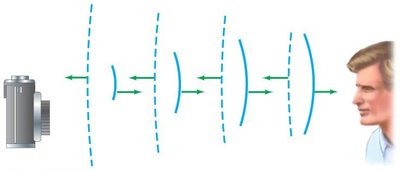
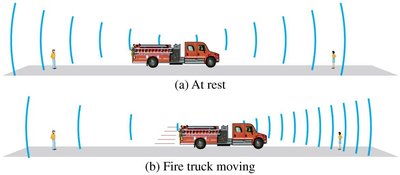
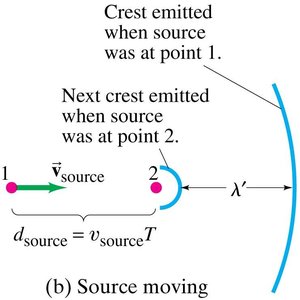
The Doppler effect is the change in frequency (and wavelength) of a wave as observed by someone who is moving relative to the source of the wave. It is commonly experienced with sound waves, such as the change in pitch of a passing siren.
Source Moving Toward Observer: Observed frequency increases (higher pitch).
Source Moving Away from Observer: Observed frequency decreases (lower pitch).
Doppler Effect Equations
Source Moving Toward Stationary Observer:
Source Moving Away from Stationary Observer:
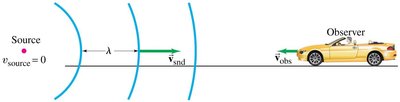
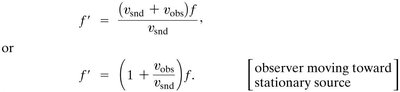
Observer Moving Toward Stationary Source:
Observer Moving Away from Stationary Source:



Temperature Dependence
The speed of sound in air increases with temperature, which affects the magnitude of the Doppler shift. Higher temperatures result in a greater speed of sound and can alter the observed frequency shift for moving sources or observers.
Summary Table: Speed of Sound in Various Materials
Material | Speed (m/s) |
|---|---|
Air | 343 |
Air (0°C) | 331 |
Helium | 1005 |
Hydrogen | 1300 |
Water | 1440 |
Sea water | 1560 |
Iron and steel | ≈ 5000 |
Glass | ≈ 4500 |
Aluminum | ≈ 5100 |
Hardwood | ≈ 4000 |
Concrete | ≈ 3000 |
Additional info: The notes above include expanded academic context and explanations for all key terms, formulas, and concepts relevant to the study of sound in introductory college physics. All images included are directly relevant to the adjacent explanations and reinforce the educational content.
