 Back
Chapter 13: Liquids – Physics with Calculus Study Notes
Study Guide - Smart Notes
 Tailored notes based on your materials, expanded with key definitions, examples, and context.
Liquids
Pressure
Pressure is a fundamental concept in fluid mechanics, describing the force exerted per unit area perpendicular to the surface of an object. It is crucial for understanding how fluids interact with surfaces and objects submerged within them.
Definition: Pressure is the force per unit area, mathematically expressed as .
Units: The SI unit is the Pascal (Pa), where . Other units include PSI (pounds per square inch).
Area Dependence: The pressure increases as the area decreases for a given force.
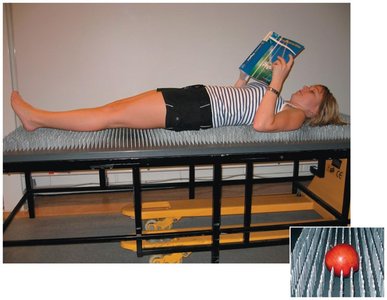
Example: A person lying on a bed of nails is unharmed because the force is distributed over a large area, resulting in low pressure.
Pressure in a Liquid
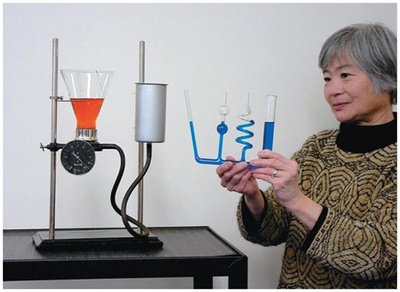
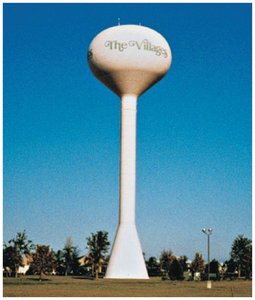
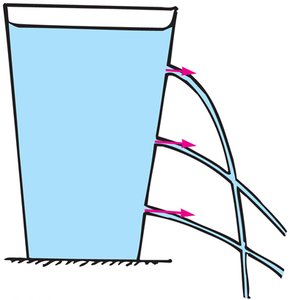
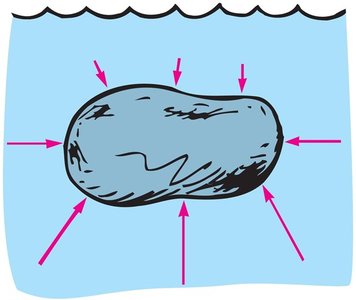
Liquid pressure is the force per unit area that a liquid exerts on an object. It is depth-dependent and acts equally in all directions, regardless of the container's shape.
Depth Dependence: Pressure increases with depth, not with the volume of liquid above.
Directionality: Pressure acts equally in all directions at a given depth.
Equation:
Container Shape Independence: Pressure at a particular depth is the same regardless of the container's shape.
Example: Water spurts out perpendicular to the surface from holes at different depths, with greater speed at greater depth.
Buoyancy in a Liquid
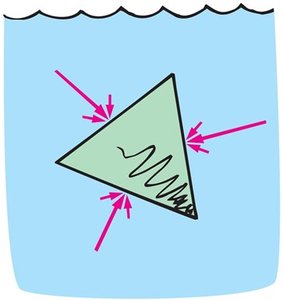
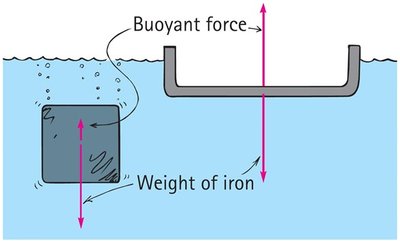
Buoyancy is the apparent loss of weight experienced by objects submerged in a fluid, resulting from the upward force exerted by the fluid.
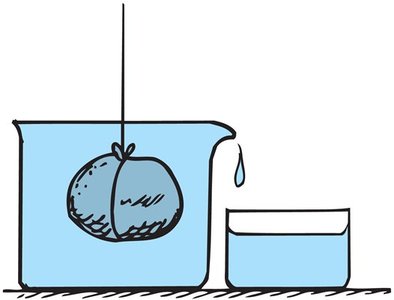
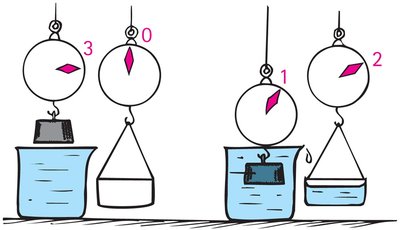
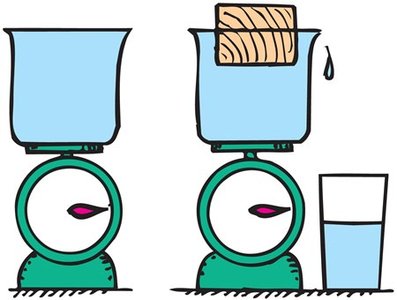
Definition: The buoyant force equals the weight of the fluid displaced by the object.
Displacement Rule: A completely submerged object displaces a volume of liquid equal to its own volume.
Forces: Two forces act on a submerged object: buoyancy (upward) and gravity (downward).
Sink or Float: An object sinks if its weight is greater than the buoyant force, floats if its weight is less, and remains at any depth if the forces are equal.
Archimedes’ Principle
Archimedes’ Principle states that an immersed body is buoyed up by a force equal to the weight of the fluid it displaces. This principle applies to both liquids and gases.
Apparent Weight: The apparent weight of a submerged object is its weight out of water minus the buoyant force.
Flotation: A floating object displaces a weight of fluid equal to its own weight.
Density Effects: Objects with lower density displace more fluid and experience greater buoyant force.
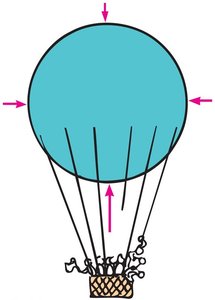
Applications: Ships float higher in salt water due to its greater density; balloons rise in air by displacing their weight in air.

What Makes an Object Sink or Float?
The floating or sinking of an object depends on its density relative to the fluid and the volume of fluid displaced.
Rules:
An object more dense than the fluid will sink.
An object less dense than the fluid will float.
An object with equal density to the fluid will remain submerged at a constant depth.
Buoyant Force: Depends on the volume of fluid displaced, not the material of the object.
Pascal’s Principle
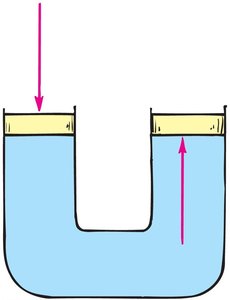
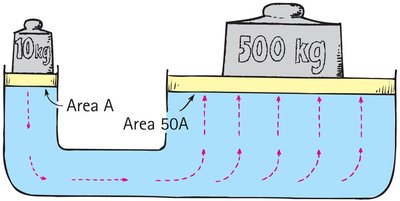
Pascal’s Principle, discovered by Blaise Pascal, states that a change in pressure at any point in an enclosed fluid at rest is transmitted undiminished to all points in the fluid. This principle is foundational for hydraulic systems.
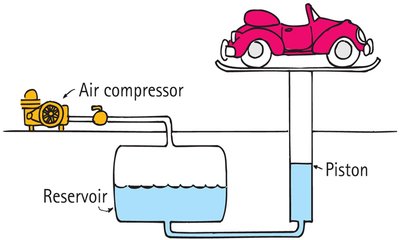
Hydraulic Press: Pressure applied to one piston is transmitted to another, allowing a small force to lift a much larger load.
Applications: Used in construction equipment and auto lifts.
Energy Conservation: The energy output cannot exceed the energy input in hydraulic devices.


Surface Tension
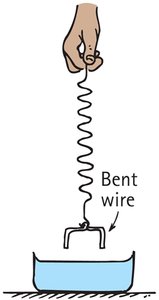
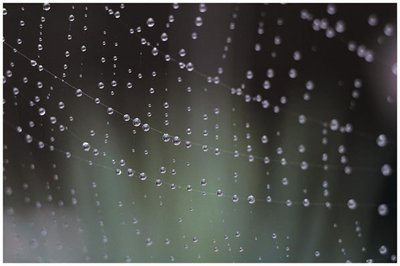
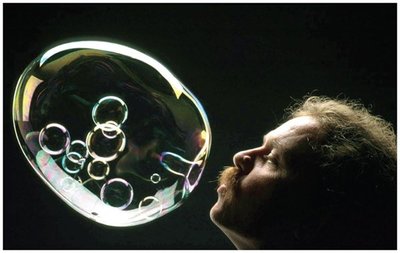
Surface tension is the contractive tendency of the surface of liquids, caused by molecular attractions. It explains phenomena such as the formation of droplets and the behavior of objects at the liquid surface.
Definition: Surface tension is due to the imbalance of molecular forces at the surface.
Examples: Water droplets and bubbles are spherical due to surface tension.
Factors: Surface tension depends on the type of liquid, presence of solutes (e.g., soap), and temperature.
Capillarity
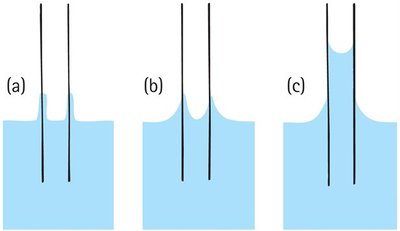
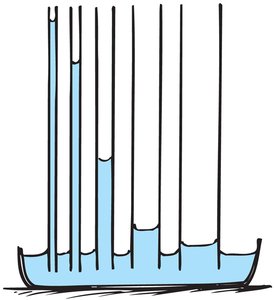
Capillarity is the rise of a liquid in a fine, hollow tube or narrow space, resulting from adhesion and surface tension. It is important in biological and physical systems.
Mechanism: Adhesion draws the liquid into the tube, while surface tension contracts the surface, raising the liquid.
Height Dependence: The height of capillary rise depends on the weight of the liquid and the narrowness of the tube.
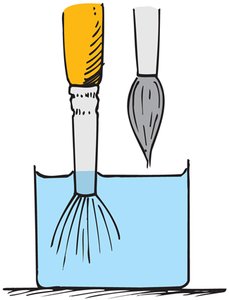
Examples: Oil rises in a wick, hair gets wet in a bathtub, and insects struggle to escape water due to capillarity.
Summary Table: Key Properties of Liquids
Property | Definition | Key Equation | Example/Application |
|---|---|---|---|
Pressure | Force per unit area | Bed of nails, water tower | |
Liquid Pressure | Pressure at depth in a liquid | Water spurting from holes | |
Buoyancy | Upward force on submerged object | Floating ships, balloons | |
Pascal's Principle | Pressure transmitted undiminished | — | Hydraulic press, auto lift |
Surface Tension | Contractive tendency of liquid surface | — | Water droplets, bubbles |
Capillarity | Rise of liquid in narrow tube | — | Oil in wick, hair in water |
