 Back
BackChapter 13: Temperature and Kinetic Theory – Study Notes
Study Guide - Smart Notes
 Tailored notes based on your materials, expanded with key definitions, examples, and context.
Temperature and Kinetic Theory
Atomic Theory of Matter
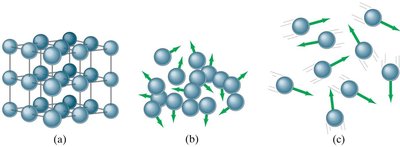
The atomic theory of matter states that all substances are composed of atoms and molecules. These particles are in constant motion, and their arrangement and movement differ in solids, liquids, and gases.
Atomic Mass Unit (u): The unified atomic mass unit is defined such that a carbon-12 atom has a mass of exactly 12 u. In kilograms, 1 u = 1.6605 × 10⁻²⁷ kg.
Brownian Motion: The random, jittery motion of tiny particles suspended in a fluid, caused by collisions with the fluid's molecules.
States of Matter: On a microscopic scale, solids have closely packed, ordered molecules; liquids have closely packed but disordered molecules; gases have molecules far apart and moving freely.
Example: Brownian motion can be observed as the erratic movement of pollen grains in water.

Temperature and Thermometers
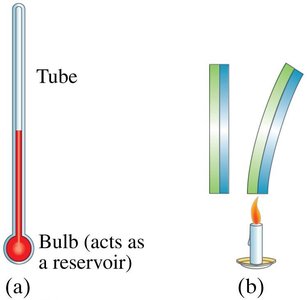
Temperature is a measure of how hot or cold an object is. Most materials expand when heated, a property used in many thermometers.
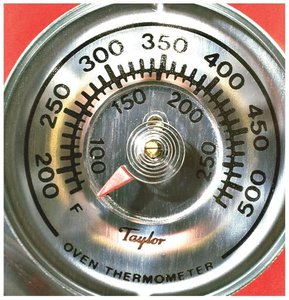
Thermometers: Devices that measure temperature by exploiting a property of matter that changes with temperature (e.g., volume of a liquid, length of a metal strip).
Types of Thermometers: Common types include liquid-in-glass thermometers and bimetallic strips.
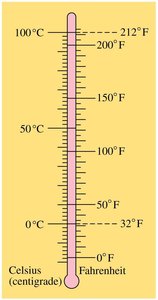
Temperature Scales: The Celsius and Fahrenheit scales are commonly used. Water freezes at 0°C (32°F) and boils at 100°C (212°F).
Conversion Formulas:


Thermal Equilibrium and the Zeroth Law of Thermodynamics
When two objects are placed in thermal contact, they exchange energy until they reach the same temperature, a state called thermal equilibrium. The zeroth law of thermodynamics states that if two objects are each in thermal equilibrium with a third object, they are in equilibrium with each other.
Application: This law forms the basis for temperature measurement using thermometers.
The Gas Laws and Absolute Temperature
The behavior of gases is described by several empirical laws relating pressure (P), volume (V), and temperature (T):
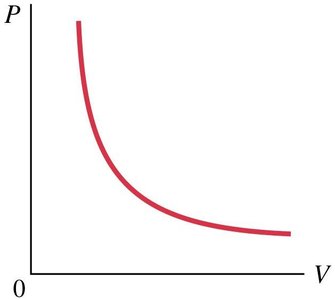
Boyle’s Law: At constant temperature, the volume of a gas is inversely proportional to its pressure: .
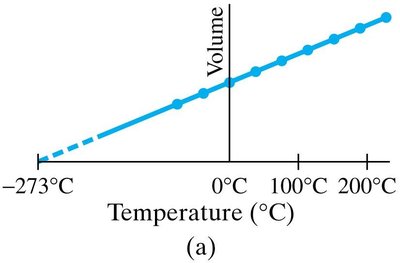
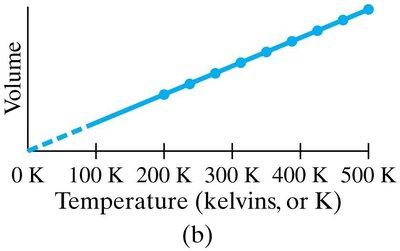
Charles’s Law: At constant pressure, the volume of a gas is directly proportional to its temperature: (temperature in kelvins).
Absolute Zero: Extrapolating the volume-temperature relationship, the volume becomes zero at −273.15°C, defined as absolute zero (0 K).
Kelvin Scale: The absolute temperature scale (Kelvin) starts at absolute zero. The freezing point of water is 273.15 K, and the boiling point is 373.15 K.
Pressure-Temperature Relationship: At constant volume, pressure is directly proportional to temperature: .
The Ideal Gas Law
The ideal gas law combines the relationships among pressure, volume, temperature, and the amount of gas:
n: Number of moles of gas
R: Universal gas constant ( J/(mol·K))
Standard Temperature and Pressure (STP): T = 273 K, P = 1.00 atm (1.013 × 10⁵ N/m2), 1 mol of ideal gas occupies 22.4 L at STP.
Avogadro’s Number: molecules/mol
Number of Molecules:

Ideal Gas Law in Terms of Molecules: Avogadro’s Number
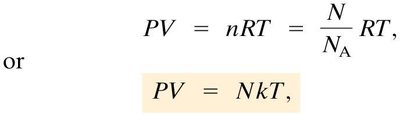
The ideal gas law can also be written in terms of the number of molecules (N) and Boltzmann’s constant (k):
k: Boltzmann’s constant ( J/K)
Kinetic Theory and the Molecular Interpretation of Temperature
The kinetic theory of gases explains macroscopic properties of gases in terms of the motion of their molecules. Key assumptions include:
Large number of molecules moving randomly
Molecules are far apart on average
Collisions are perfectly elastic
Molecules obey classical mechanics
Pressure in an Ideal Gas
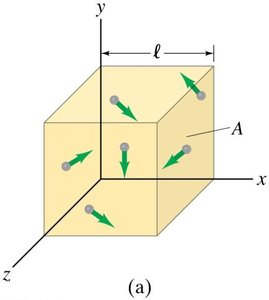
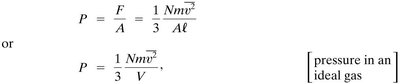
The pressure exerted by a gas on the walls of its container is due to collisions of molecules with the walls. The pressure is given by:
Temperature and Kinetic Energy
The average translational kinetic energy of a molecule in an ideal gas is directly proportional to the absolute temperature:
Root-Mean-Square Speed
The root-mean-square (rms) speed of molecules in a gas is:

Example Applications
Comparing Kinetic Energies: At the same temperature, the average kinetic energy of molecules is the same for all gases, regardless of mass. For example, oxygen and hydrogen molecules at the same temperature have the same average kinetic energy, even though their masses differ.
Effect of Changing Volume and Pressure: If the volume and pressure of a gas both double (with the amount of gas constant), the average speed of the molecules remains the same, since temperature does not change.
Additional info: The kinetic theory provides a molecular-level explanation for temperature, pressure, and the behavior of gases, forming a foundation for thermodynamics and statistical mechanics.
