 Back
Chapter 14: Gases – Properties, Laws, and Applications
Study Guide - Smart Notes
 Tailored notes based on your materials, expanded with key definitions, examples, and context.
Gases
The Atmosphere
The atmosphere is an ocean of air that surrounds the Earth and exerts pressure on all objects within it. This pressure is a result of the weight of the air above us. The magnitude of atmospheric pressure was dramatically demonstrated in 1654 by Otto von Guericke with the Magdeburg hemispheres experiment, which showed how strong atmospheric pressure can be.
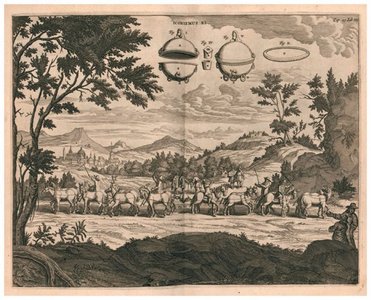
Atmospheric Pressure
Atmospheric pressure is caused by the weight of the air above a given point. It varies with location and altitude and is not uniform across the globe. Atmospheric pressure is commonly measured to help predict weather conditions.
At sea level, atmospheric pressure is approximately 101 kilopascals (kPa), or about N/m2.
The pressure at the bottom of a column of air (from the top of the atmosphere to sea level) is equivalent to the pressure at the bottom of a 10.3-meter column of water.
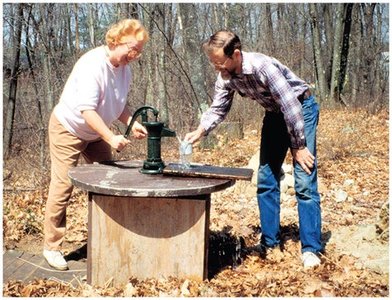
This means the maximum height to which atmospheric pressure can push water up a tube (such as in a vacuum pump or straw) is 10.3 meters.
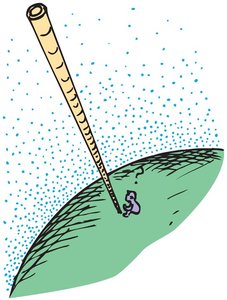
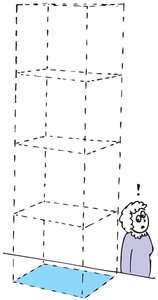
Mechanical pumps that do not rely on atmospheric pressure are not limited by this 10.3-meter constraint.
The Barometer
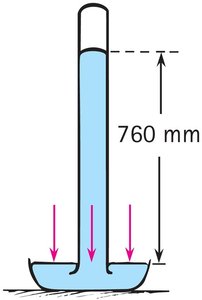
A barometer is a device used to measure atmospheric pressure. The classic mercury barometer consists of a tube filled with mercury, inverted in a dish of mercury. The height of the mercury column is a direct measure of atmospheric pressure.
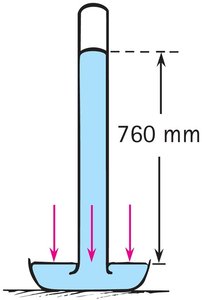
The pressure exerted by the mercury column balances the atmospheric pressure on the mercury in the dish.
If water were used instead of mercury, the barometer would need to be 13.6 times taller (about 10.3 meters) due to water's lower density.
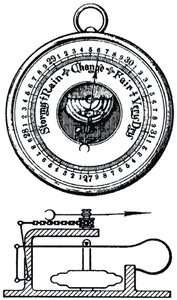
An aneroid barometer uses a partially evacuated metal box with a flexible lid that bends with changes in atmospheric pressure. This type of barometer can also function as an altimeter, measuring elevation based on pressure changes.
Boyle’s Law
Boyle’s Law describes the relationship between the pressure and volume of a gas at constant temperature. It states that the pressure and volume of a gas are inversely proportional, provided the temperature remains constant.
If the pressure on a gas increases, its volume decreases by the same factor, and vice versa.
The mathematical expression for Boyle’s Law is:
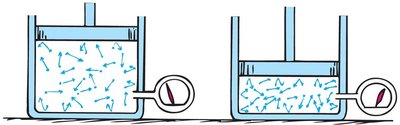
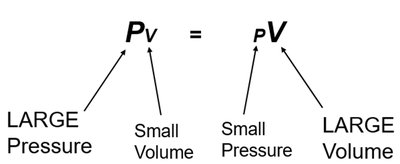
Example: If the volume of a gas is tripled while temperature is constant, the pressure becomes one-third of its original value.
Buoyancy of Air
Archimedes’ principle applies to gases as well as liquids: an object surrounded by air is buoyed up by a force equal to the weight of the air it displaces.
If the weight of displaced air is greater than the object’s weight, the object rises (e.g., a helium balloon).
If the weights are equal, the object hovers.
If the object’s weight is greater, it falls.
Gas-filled balloons (using hydrogen, helium, or heated air) rise until the buoyant force equals their weight. As they rise, the atmosphere becomes less dense, and the balloon expands.
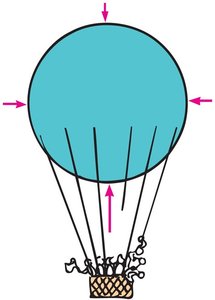
Example: A dirigible that hovers in air displaces both its volume and weight of air, indicating it has the same net density as air.
Bernoulli’s Principle
Bernoulli’s principle, discovered by Daniel Bernoulli, states that where the speed of a fluid increases, the internal pressure decreases, and vice versa. This principle applies to smooth, steady (laminar) flow.
Streamlines represent the flow of fluids; where they are closer together, the fluid moves faster and pressure is lower.
Laminar flow is smooth and steady, while turbulent flow is chaotic at high speeds.
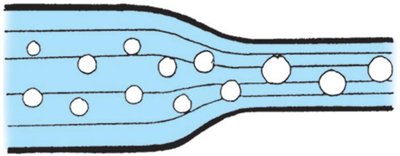
Applications:
Blowing over a paper lifts it due to lower pressure above.
Convertible car roofs puff upward as air moves faster over the top.
Wind can lift a peaked roof off a house due to pressure differences.
Perfume atomizers use fast-moving air to draw liquid up a tube.
Trucks passing closely are drawn together due to lower pressure between them.
Ships passing closely can be drawn sideways for the same reason.
Example: On windy days, waves are higher because air travels faster over the crests, reducing pressure and allowing higher crests.
Plasma
Plasma is the fourth state of matter, consisting of an electrified gas where atoms are ionized (stripped of electrons). Plasmas are rare on Earth but common in the universe (e.g., stars, auroras).
Fluorescent lamps and neon signs contain plasma, which conducts electricity and emits light.
Plasma TVs use thousands of tiny plasma cells to produce images.
High-temperature plasmas (e.g., jet engine exhaust) can conduct electricity, especially with added salts or metals, and are used in Magneto Hydro Dynamic (MHD) power generation.
Examples of plasma: Sun, stars, auroras, fluorescent lamps, plasma TVs, and MHD power generators.
