 Back
Chapter 14: Periodic Motion and Harmonic Oscillators
Study Guide - Smart Notes
 Tailored notes based on your materials, expanded with key definitions, examples, and context.
Periodic Motion and Harmonic Oscillators
Introduction to Simple Harmonic Motion (SHM)
Simple harmonic motion (SHM) is a type of periodic motion where an object moves back and forth about an equilibrium position under a restoring force proportional to its displacement. SHM is fundamental in physics, describing systems such as springs, pendulums, and oscillating circuits.
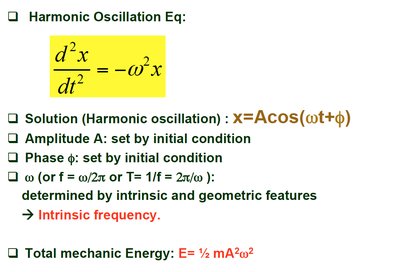
Harmonic Oscillation Equation: The motion is governed by the differential equation , where is the angular frequency.
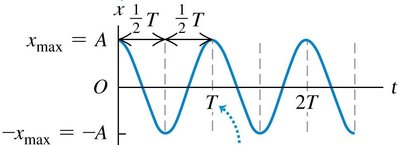
General Solution: , with amplitude and phase set by initial conditions.
Intrinsic Frequency: depends on the physical and geometric properties of the system.
Total Mechanical Energy:
Energy in Simple Harmonic Motion
Energy in SHM oscillates between kinetic and potential forms, but the total energy remains constant (in the absence of damping).
Kinetic Energy:
Potential Energy:
Energy Conservation:
Maximum Potential Energy: Occurs at maximum displacement ().
Maximum Kinetic Energy: Occurs at equilibrium position ().
Examples of Simple Harmonic Oscillators
Several physical systems exhibit SHM, including springs, pendulums, and torsional oscillators.
Spring-Mass System: A mass attached to a spring oscillates with angular frequency .
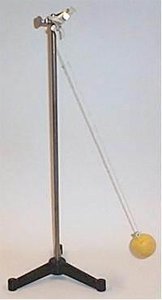
Simple Pendulum: A point mass suspended by a massless string exhibits SHM for small angles.
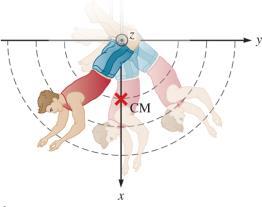
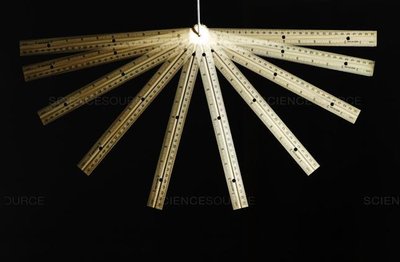
Physical Pendulum: An extended object swinging about a pivot also undergoes SHM for small amplitudes.
Torsional Pendulum: An object suspended by a wire or rod twists back and forth, with restoring torque proportional to angular displacement.
Simple Pendulum
Motion and Equation
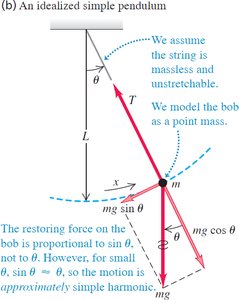
A simple pendulum consists of a point mass (bob) suspended by a massless, unstretchable string. For small angular displacements, its motion is approximately simple harmonic.
Restoring Force:
Small Angle Approximation: (in radians)
SHM Equation:
Angular Frequency:
Period:
Application: Pendulum on Mars
The period of a pendulum depends on the gravitational acceleration. If the period doubles on Mars compared to Earth, the gravity on Mars can be calculated using the ratio of periods.
Period Ratio:
Calculation: If , then
Physical Pendulum
Definition and Equation
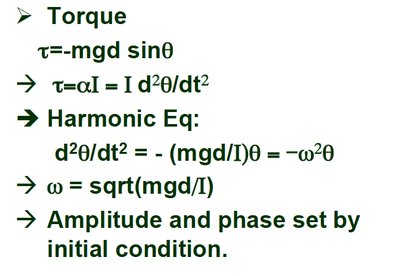
A physical pendulum is any real pendulum with an extended object instead of a point-mass bob. For small amplitudes, its motion is simple harmonic.
Restoring Torque:
SHM Equation:
Angular Frequency:
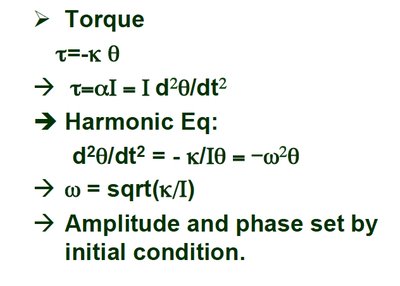
Torsional Pendulum
Definition and Equation
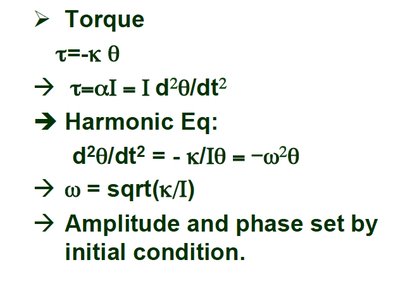
A torsional pendulum consists of an object suspended by a wire or rod that twists about its axis. The restoring torque is proportional to the angular displacement.
Restoring Torque:
SHM Equation:
Angular Frequency:
Damped Oscillations
Equation and Effects
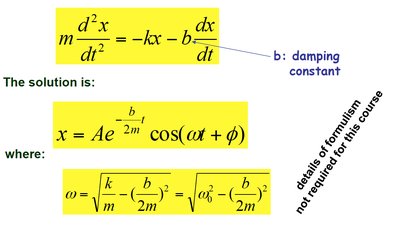
Damped oscillations occur when a resistive force (such as friction or air resistance) is present, causing the amplitude to decrease over time.
Damped Oscillator Equation:
Solution:
Angular Frequency:
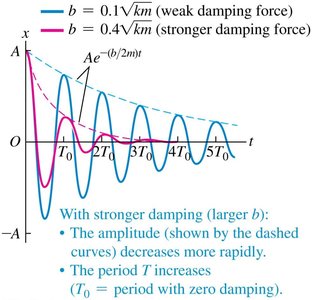
Amplitude: Decreases exponentially with time.
Period: Increases as damping increases.

Types of Damping
The behavior of a damped oscillator depends on the relative magnitude of the damping constant.
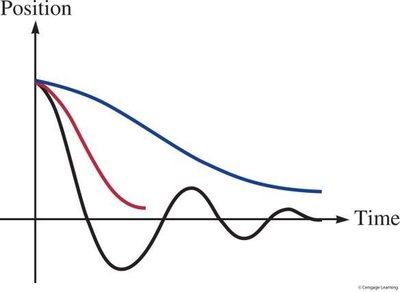
Underdamped: Oscillations occur with gradually decreasing amplitude ().
Critically Damped: Returns to equilibrium as quickly as possible without oscillating ().
Overdamped: Returns to equilibrium slowly without oscillating ().
Forced (Driven) Oscillations and Resonance
Equation and Amplitude
When an external periodic force acts on an oscillator, the system exhibits forced oscillations. The amplitude depends on the driving frequency and damping.
Driven Oscillator Equation:
Amplitude of Forced Oscillation:
Resonance: Occurs when the driving frequency matches the natural frequency, resulting in maximum amplitude.

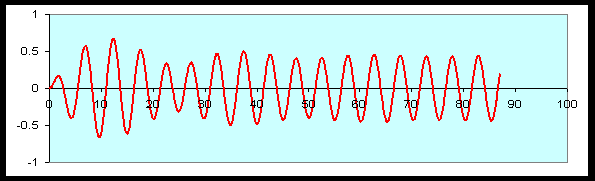

Resonance in Real Systems
Resonance can have dramatic effects in real systems, such as bridges and buildings. If the frequency of external forces matches the natural frequency of the structure, large oscillations can occur, potentially leading to structural failure.
Historical Example: The Broughton Suspension Bridge collapsed in 1831 due to resonance induced by troops marching in step.
Angers Bridge: Another example of catastrophic resonance in bridge engineering.
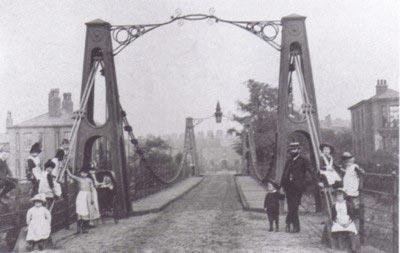

Summary Table: Types of Oscillators
Oscillator Type | Restoring Force/Torque | SHM Equation | Angular Frequency |
|---|---|---|---|
Spring-Mass | |||
Simple Pendulum | |||
Physical Pendulum | |||
Torsional Pendulum |
Additional info: Academic context and equations have been expanded for completeness and clarity. Images included are directly relevant to the explanation of each paragraph.
