 Back
Chapter 14: Periodic Motion and Simple Harmonic Motion (SHM)
Study Guide - Smart Notes
 Tailored notes based on your materials, expanded with key definitions, examples, and context.
Periodic Motion
Definition and Examples
Periodic motion refers to any motion that repeats itself at regular intervals. Such motions are fundamental in physics and are observed in many natural and engineered systems.
Examples: Heartbeat, pendulum clocks, bouncing balls.
Period (T): The time taken for one complete cycle of motion.
Frequency (f): The number of cycles per second, measured in Hertz (Hz).
Formula:
Example: If a heart beats 70 times in one minute, the period is and the frequency is .



Simple Harmonic Motion (SHM)
Definition and Characteristics
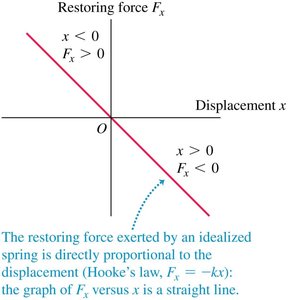
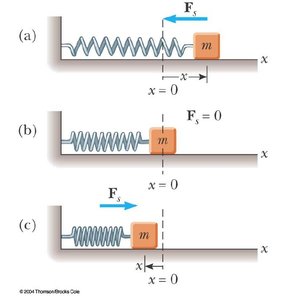
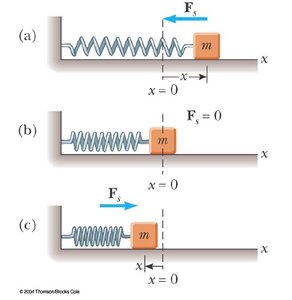
Simple Harmonic Motion is a special type of periodic motion where the restoring force is directly proportional to the displacement and acts in the opposite direction.
Restoring Force: (Hooke's Law)
Equilibrium Position: The point where the net force is zero.
Oscillation: The object moves back and forth between maximum displacements.
Small Amplitude Oscillations
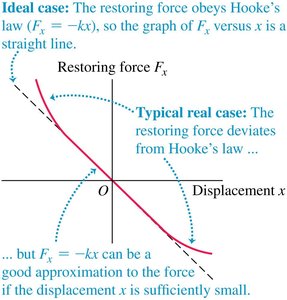
For small amplitudes, many oscillatory systems approximate SHM, even if the restoring force is not perfectly linear.
Mathematical Description of SHM
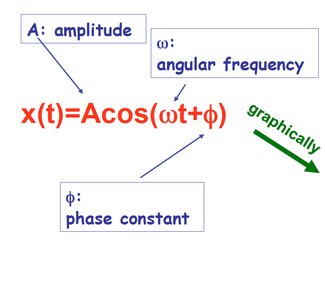
The position of a particle in SHM is given by:
General Solution:
Amplitude (A): Maximum displacement from equilibrium.
Angular Frequency (\omega):
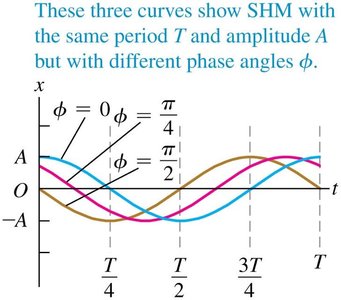
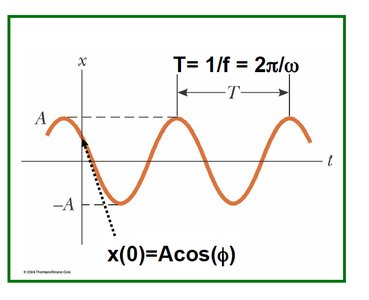
Phase Angle (\phi): Determines the initial position at .
Period and Frequency
The period and frequency are intrinsic properties of the system, determined by mass and spring constant for a spring-mass system.
Period:
Frequency:
Phase and Initial Conditions
The phase angle sets the initial position of the oscillator. For , different values of $\phi$ correspond to different starting points in the cycle.
Velocity and Acceleration in SHM
Formulas
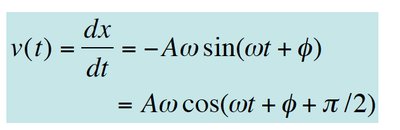
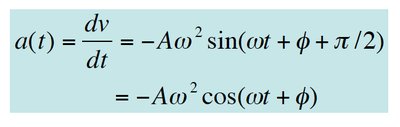
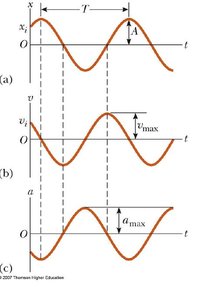
The velocity and acceleration are time-dependent and derived from the position function:
Velocity:
Acceleration:
Oscillator Equation
Differential Equation
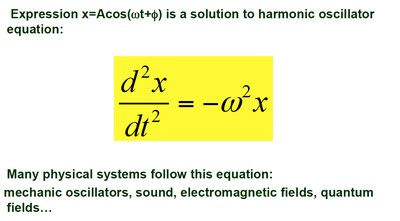
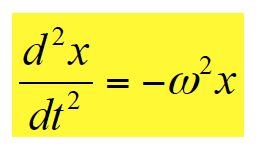
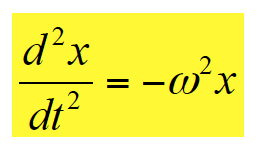
SHM is governed by the second-order differential equation:
Solution:
Spring-Block Oscillator
Physical System and Equations
A block attached to an ideal spring is a classic example of SHM. The restoring force follows Hooke's Law, and the motion is described by Newton's Second Law.
Hooke's Law:
Newton's Second Law:
Angular Frequency:
Energy in SHM
Kinetic, Potential, and Total Mechanical Energy
Energy in SHM oscillates between kinetic and potential forms, but the total mechanical energy remains constant.
Kinetic Energy:
Potential Energy:
Total Mechanical Energy: (constant)
Exercises and Applications
Exercise 1: Spring-Block System
A block of mass kg attached to a spring moves on a frictionless surface. At m, m/s2, m/s. Find:
(a) Spring constant:
(b) Amplitude:
(c) Maximum speed:
(d) Maximum acceleration:
Exercise 2: Two-Block System with Static Friction
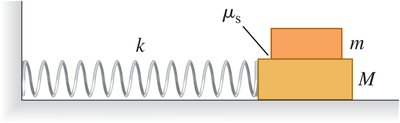
Two blocks (m = 0.500 kg, M = 4.00 kg) are attached to a spring (k = 150 N/m) on a frictionless surface, but static friction exists between the blocks. For small amplitude, both blocks move together in SHM. For larger amplitude, the top block slips.
(a) Period: ,
(b) Maximum amplitude without slipping: , where
Summary Table: Key SHM Quantities
Quantity | Symbol | Formula | Unit |
|---|---|---|---|
Period | T | s | |
Frequency | f | Hz | |
Angular Frequency | \omega | rad/s | |
Amplitude | A | Maximum displacement | m |
Spring Constant | k | From Hooke's Law | N/m |
Kinetic Energy | K | J | |
Potential Energy | U | J | |
Total Energy | E | J |
Additional info:
SHM is foundational for understanding waves, oscillations, and many physical systems.
Phase angle and amplitude are set by initial conditions, while frequency depends on system parameters.
Energy conservation in SHM is a key concept for later chapters on mechanical waves and thermodynamics.
