 Back
BackChapter 15: Periodic Motion – Principles and Practice of Physics
Study Guide - Smart Notes
 Tailored notes based on your materials, expanded with key definitions, examples, and context.
Chapter 15: Periodic Motion
Introduction to Periodic Motion
Periodic motion refers to any motion that repeats itself at regular time intervals. This chapter explores the kinematics and dynamics of periodic motion, focusing on the continuous conversion between potential and kinetic energy in closed systems. Examples include swings, pendulums, vibrating strings, and atoms in solids.
Periodic Motion: Motion that repeats at regular intervals.
Oscillation: The repetitive variation, typically in time, of some measure about a central value.
Vibration: A type of oscillation, often referring to mechanical systems.
Examples: Swings, rocking chairs, mosquito wings, guitar strings, and atoms in solids.
Section 15.1: Periodic Motion and Energy
Periodic motion is characterized by the continuous conversion between potential and kinetic energy in a closed system. In idealized systems (ignoring friction and drag), energy is conserved and oscillates between these two forms.
Equilibrium Position: The central position about which the object moves.
Displacement (x): The object's position relative to equilibrium.
Period (T): The time to complete one full cycle.
Frequency (f): The number of cycles per second, .
Amplitude (A): The maximum displacement from equilibrium.
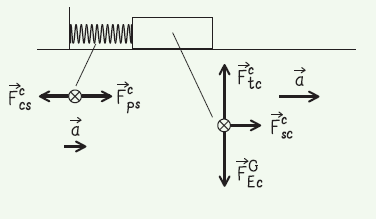
Key Point: In a closed system, only internal forces (such as the spring force) act, and these do not do net work on the system as a whole.
Real Oscillators: In practice, energy is lost to friction and drag, causing damping. For this chapter, we idealize the system as closed (no energy loss).
Examples of Oscillating Systems
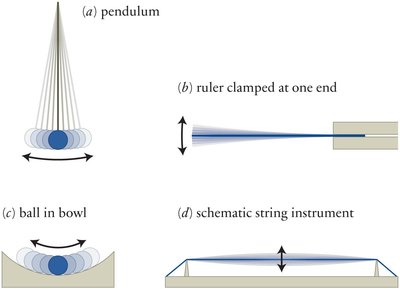
Many physical systems can be modeled as oscillators, each with a restoring force and associated potential energy.
Pendulum: Restoring force is gravity; potential energy is gravitational.
Ruler clamped at one end: Restoring force is elastic; potential energy is elastic.
Ball in bowl: Restoring force is gravity; potential energy is gravitational.
String instrument: Restoring force is tension; potential energy is elastic.
Section 15.2: Simple Harmonic Motion (SHM)
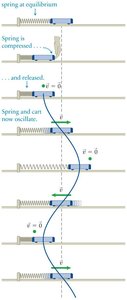
Simple harmonic motion is a special type of periodic motion where the restoring force is directly proportional to displacement and acts in the direction opposite to that displacement. The motion is isochronous, meaning the period is independent of amplitude (within the model's valid range).
Isochronous: Period does not depend on amplitude.
Simple Harmonic Oscillator: A system that exhibits SHM.
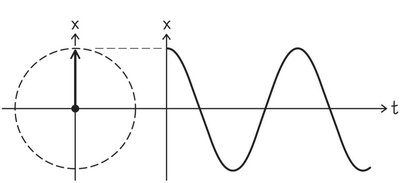
Mathematical Form: The position as a function of time is sinusoidal: .
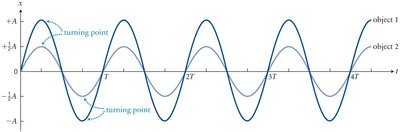
Key Point: All isochronous systems trace a sine curve, regardless of their physical nature.
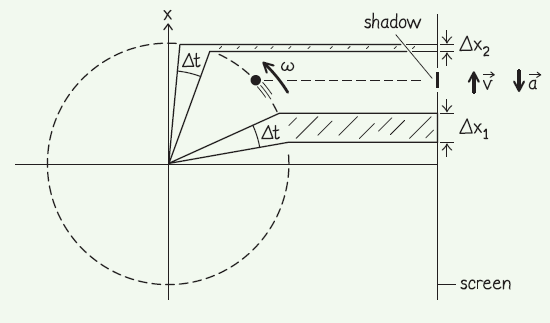
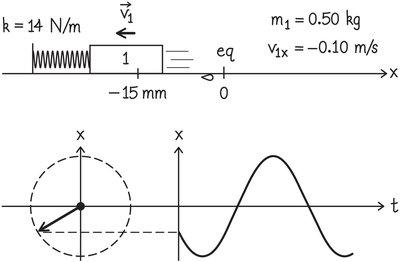
Relationship to Circular Motion: The projection of uniform circular motion onto one axis produces SHM. The position of the shadow of a rotating ball is described by , where is the radius of the circle.
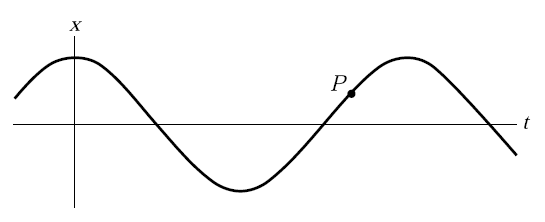
Checkpoint: Velocity and Acceleration in SHM
At various points in the oscillation, the velocity and acceleration of the mass can be positive, negative, or zero, depending on the position and direction of motion.
Restoring Forces in Simple Harmonic Motion
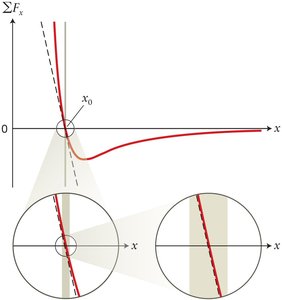
Periodic motion requires a restoring force that tends to return the object to equilibrium. For small displacements, the restoring force is linearly proportional to displacement, leading to SHM.
Stable Equilibrium: Small displacements from equilibrium result in oscillations.
Restoring Force: for a spring, where is the spring constant.
Sources of Restoring Forces
Restoring forces can arise from tension, elasticity, or gravity, depending on the system.
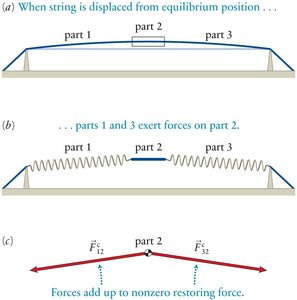
Gravitational Restoring Force: The Pendulum
For a pendulum, the restoring force is the component of gravity perpendicular to the string. For small angles, , so the restoring force is .
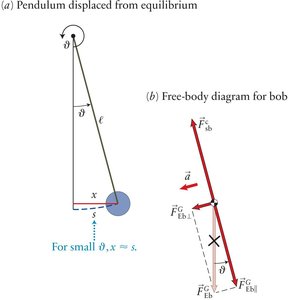
Mass and Period of Oscillation
For most oscillators, increasing mass increases the period, while increasing the restoring force decreases the period.
For pendulums, the period is independent of mass.
Section 15.5: Energy of a Simple Harmonic Oscillator
The energy in a simple harmonic oscillator alternates between kinetic and potential forms, but the total mechanical energy remains constant (in the absence of non-conservative forces).
Phasor: A rotating arrow whose tip traces a reference circle, representing the phase of the oscillator.
Angular Frequency: , where is the period.
Phase:
Position:
Velocity:
Acceleration:
Newton's Second Law:
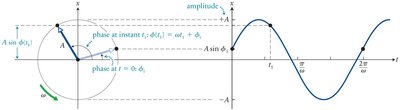
Energy Relationships:
Potential Energy:
Kinetic Energy:
Total Mechanical Energy: (constant, proportional to )
Section 15.6: Simple Harmonic Motion and Springs
For a mass attached to a spring, the restoring force is given by Hooke's Law: . Setting the origin at equilibrium (), the equation of motion becomes .
Angular Frequency:
General Solution:
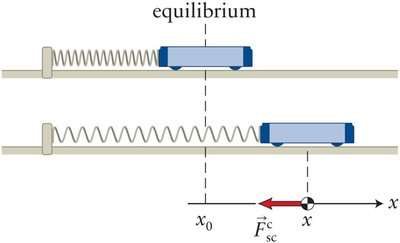
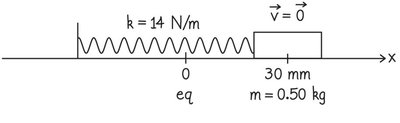
Example 15.3: Cart Pulled Away and Released from Rest
A cart of mass kg attached to a spring with N/m is pulled 30 mm from equilibrium and released from rest. The position and velocity at any time can be found using the SHM equations.
Example 15.4: Cart Struck with Spring Already Compressed
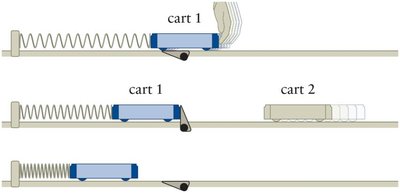
Two carts interact via a spring. After an elastic collision, the maximum compression of the spring and the timing of the oscillation can be analyzed using conservation of energy and SHM principles.
Example 15.5: Vertical Oscillations
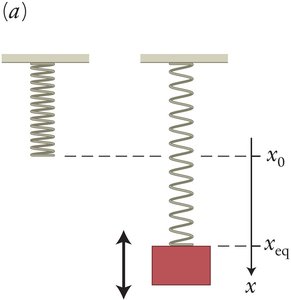
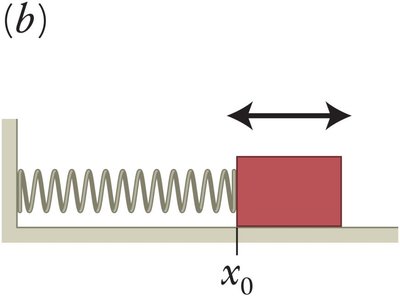
A block of mass kg is suspended from a spring with N/m. The equilibrium position is found by balancing the spring force and gravity. The frequency of vertical oscillations is compared to that of a horizontal system with the same parameters (ignoring friction).
Summary Table: Key Quantities in Simple Harmonic Motion
Quantity | Symbol | Formula | Units |
|---|---|---|---|
Period | T | s | |
Frequency | f | Hz | |
Angular Frequency | \omega | rad/s | |
Amplitude | A | Maximum displacement | m |
Position | x(t) | m | |
Velocity | v_x(t) | m/s | |
Acceleration | a_x(t) | m/s^2 | |
Total Energy | E | J |
Additional info: The above notes synthesize and expand upon the provided lecture slides and textbook images, ensuring all key concepts, formulas, and examples relevant to periodic motion and simple harmonic motion are included for comprehensive exam preparation.
