 Back
Chapter 15: Temperature, Heat, and Expansion – Study Notes
Study Guide - Smart Notes
 Tailored notes based on your materials, expanded with key definitions, examples, and context.
Temperature, Heat, and Expansion
Temperature
Temperature is a fundamental physical quantity that measures the warmth or coldness of an object. It is directly related to the average kinetic energy of the particles in a substance and is measured using thermometers. Temperature has no upper limit, but it does have a precise lowest value known as absolute zero.
Definition: Temperature corresponds to the average translational kinetic energy of molecules in a substance.
Measurement: Thermometers (liquid or infrared) are used to measure temperature, relying on thermal equilibrium between the thermometer and the object.
Temperature Scales:
Celsius (°C): 0°C for freezing, 100°C for boiling water.
Fahrenheit (°F): 32°F for freezing, 212°F for boiling water.
Kelvin (K): Absolute zero at 0 K; intervals same as Celsius.
Key Concept: The temperature of a substance is proportional to the average kinetic energy per molecule, not the total internal energy.
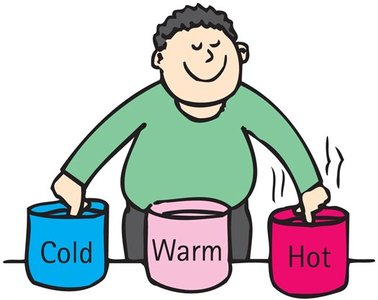

Example:
Two liters of boiling water and one liter of boiling water have the same temperature, but the larger volume contains more total molecular kinetic energy.
Heat
Heat is the internal energy transferred from one object to another due to a temperature difference. It is energy in transit, always flowing from higher to lower temperature until thermal equilibrium is reached.
Definition: Heat is the transfer of internal energy caused by a temperature difference.
Direction of Flow: Heat flows spontaneously from hot to cold objects, never unassisted from cold to hot.
Units: Heat is measured in joules or calories.
1 calorie = 4.18 joules
1 kilocalorie (Calorie) = 1000 calories
Example:
If a red-hot thumbtack is placed in warm water, heat flows from the thumbtack to the water.
Specific Heat Capacity
Specific heat capacity is the quantity of heat required to change the temperature of a unit mass of a substance by 1 degree Celsius. It reflects a material's resistance to temperature change, also known as thermal inertia.
Definition: , where = specific heat capacity, = heat added, = mass, = temperature change.
Material Differences: Different substances require different amounts of heat for the same temperature change. Water has a high specific heat capacity compared to metals like iron.
Mechanisms:
Increasing molecular jiggle raises temperature.
Increasing internal vibration, rotation, or potential energy does not raise temperature.
Climate Impact: Water's high specific heat moderates climate, as oceans retain heat and release it slowly, affecting coastal temperatures.
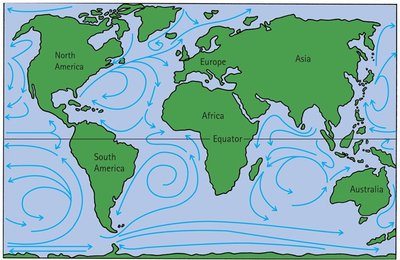
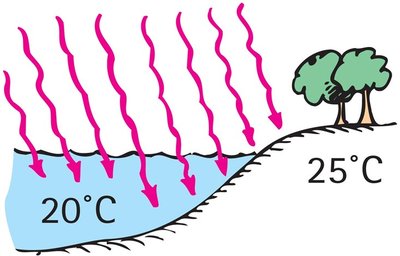
Example:
It takes longer to heat water in an iron pot than in a silver pot due to differences in specific heat capacity.
Substance | Specific Heat Capacity (J/g°C) |
|---|---|
Water | 4.18 |
Iron | ~0.52 |
Land (soil) | Lower than water |
Silver | ~0.24 |
Additional info: Values are approximate and for comparison. |
Thermal Expansion
Thermal expansion is the increase in size of a substance due to a rise in temperature, as molecules move faster and further apart. Most substances expand when heated and contract when cooled.
Definition: Thermal expansion is caused by increased molecular motion.
Applications:
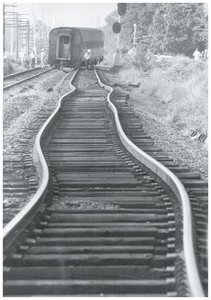
Railroad tracks can buckle in summer due to expansion.
Expansion joints in bridges and gaps in sidewalks accommodate expansion and contraction.
Bimetallic Strips: Used in thermostats and devices, they bend due to different expansion rates of metals (e.g., brass and iron).
Liquids vs. Solids: Liquids expand more than solids; e.g., gasoline can overflow on hot days.

Example:
Telephone lines are strung with sag in summer to prevent snapping in winter due to contraction.
Thermal Expansion of Water
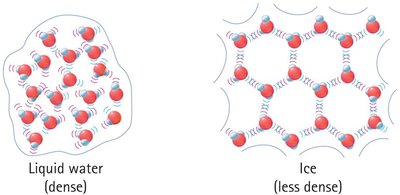
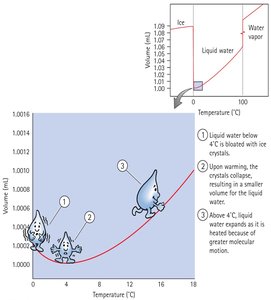
Water exhibits unique expansion behavior. When water freezes, it expands due to the formation of open-structured ice crystals, making ice less dense than liquid water. As water warms from 0°C to 4°C, it contracts, then expands above 4°C.
Ice Formation: Ice expands about 9% compared to liquid water, causing it to float.
Density: Ice is less dense than liquid water at any temperature.
Volume Changes: Water contracts from 0°C to 4°C, then expands above 4°C.
Example:
When a sample of 0°C water is heated, it contracts until 4°C, then expands as temperature increases further.
Summary Table: Key Concepts
Concept | Definition | Units |
|---|---|---|
Temperature | Average kinetic energy per molecule | °C, °F, K |
Heat | Energy transferred due to temperature difference | Joules, calories |
Specific Heat Capacity | Heat required to change temperature of unit mass by 1°C | J/g°C |
Thermal Expansion | Increase in size due to temperature rise | Length, volume change |
Additional info: These concepts are foundational for understanding thermodynamics and the behavior of matter under temperature changes.
