 Back
BackChapter 15: Traveling Waves and Sound - Study Notes
Study Guide - Smart Notes
 Tailored notes based on your materials, expanded with key definitions, examples, and context.
Traveling Waves and Sound
Section 15.1 The Wave Model
Waves are disturbances that transfer energy through a medium or space. They are classified as transverse or longitudinal based on the direction of particle motion relative to wave propagation.
Transverse Waves: Particles move perpendicular to the direction of wave travel. Example: waves on a string.
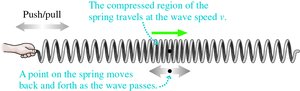
Longitudinal Waves: Particles move parallel to the direction of wave travel. Example: sound waves in air, waves in a spring.
Mechanical Waves: Require a medium to propagate.
Example: Shaking a string up and down creates a transverse wave; compressing and releasing a spring creates a longitudinal wave.
Section 15.2 Traveling Waves
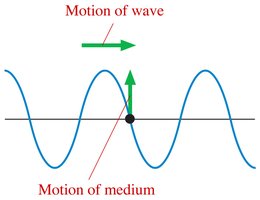
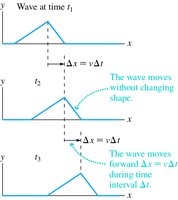
Traveling waves move energy from one location to another without transporting matter. The motion of the wave is distinct from the motion of the medium.
Wave Motion: The disturbance moves through the medium.
Medium Motion: Particles oscillate but do not travel with the wave.
Wave Speed: Determined by the properties of the medium.
Example: Dropping a pebble in a pond creates circular waves that move outward.
Waves on a String
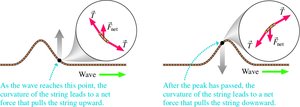
A transverse wave pulse on a string demonstrates how internal forces in the medium sustain wave motion after an initial disturbance.
Each point moves perpendicular to the wave's direction.
Wave continues due to internal dynamics.
Sound Waves
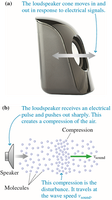
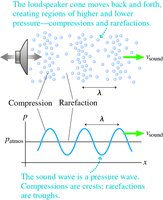
Sound waves are longitudinal mechanical waves. The motion of the sound wave is governed by the properties of air.
Compression: Region of higher pressure.
Rarefaction: Region of lower pressure.
Speed of sound in air at 20°C: 343 m/s.
Speed increases with temperature and decreases with molecular mass.
Wave Speed Is a Property of the Medium
Speed of sound is faster in liquids than gases, and fastest in solids.
Electromagnetic waves (light) travel much faster than mechanical waves.
Speed of light in vacuum:
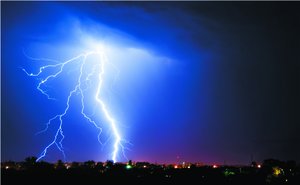
Example: Lightning and Thunder
Light from lightning reaches the observer almost instantly, while sound travels slower, allowing calculation of the distance to the lightning strike.
Section 15.3 Graphical and Mathematical Descriptions of Waves
Snapshot and History Graphs
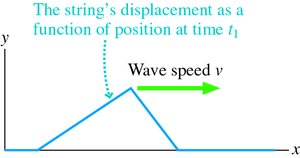
Waves can be described graphically using snapshot and history graphs.
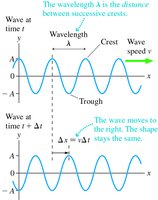
Snapshot Graph: Shows displacement as a function of position at a single instant.
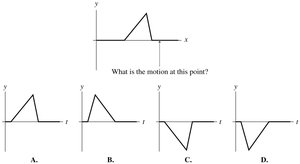
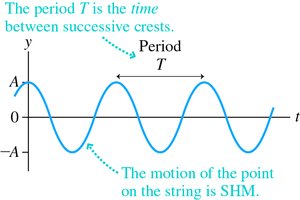
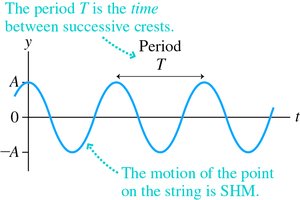
History Graph: Shows displacement of a single point over time.
QuickCheck Examples
Understanding the motion of points on a string and the relationship between snapshot and history graphs is essential for analyzing wave behavior.
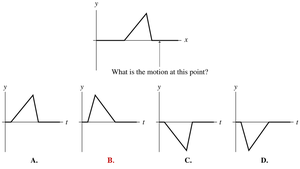
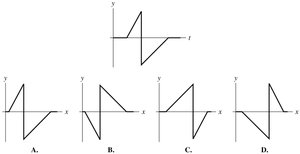
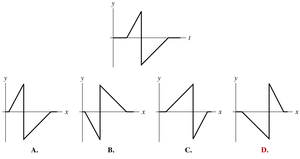
The Mathematical Description of Sinusoidal Waves
Sinusoidal waves are produced by sources oscillating with simple harmonic motion (SHM). The amplitude, wavelength, period, and frequency characterize these waves.
Amplitude (A): Maximum displacement.
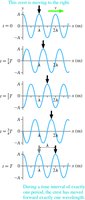
Wavelength (\lambda): Distance spanned in one cycle.
Period (T): Time to complete one cycle.
Frequency (f): Number of cycles per second,
Wave Equation: For a wave traveling to the right:
For a wave traveling to the left:
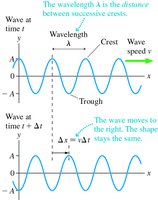
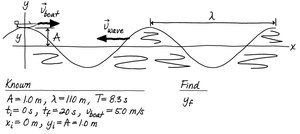
Example: Boat on Ocean Waves
A boat moving relative to water experiences vertical displacement due to passing waves. The displacement can be calculated using the wave equation and the boat's position and time.
Fundamental Relationship for Sinusoidal Waves
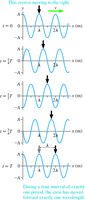
During one period, a wave crest travels one wavelength. The velocity of the wave is:
Section 15.4 Sound and Light Waves
Sound Waves
Sound waves are pressure waves consisting of compressions and rarefactions. The speed of sound depends on the medium.
Light and Electromagnetic Waves
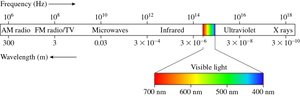
Electromagnetic waves include visible light, radio waves, microwaves, and ultraviolet light. All travel at the speed of light in a vacuum.
Visible light wavelength: 400–700 nm.
Different wavelengths correspond to different colors.
Section 15.5 Energy and Intensity
Energy and Intensity
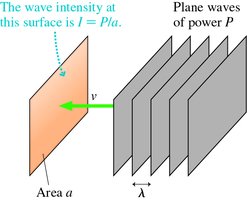
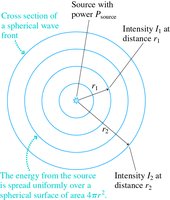
Waves transfer energy. The intensity is the power per unit area:
Intensity decreases as waves spread out.
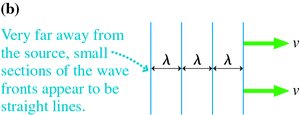
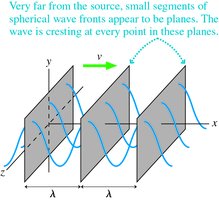
Plane waves and spherical waves describe wave propagation in different geometries.
Section 15.6 Loudness of Sound
The Decibel Scale
The loudness of sound is measured in decibels (dB). The threshold of hearing is 0 dB, corresponding to an intensity of .
Sound intensity level:

Section 15.7 The Doppler Effect and Shock Waves
The Doppler Effect
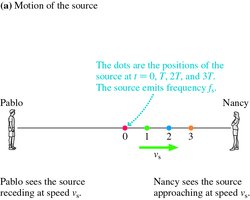
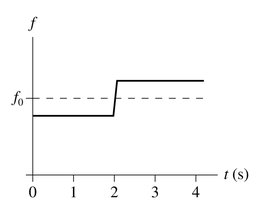
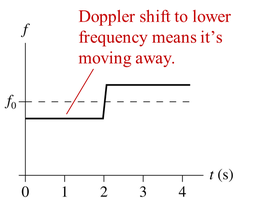
The Doppler effect is the change in frequency due to the motion of the source or observer. It is observed as a shift in pitch for sound waves and a shift in color for light waves.
Approaching source: frequency increases.
Receding source: frequency decreases.
Shock waves occur when an object moves faster than the speed of sound.

Doppler Effect Equations
For a moving source:
(approaching)
(receding)
For a moving observer:
(approaching)
(receding)
Doppler Effect for Light Waves
Light from receding sources is red-shifted; from approaching sources, it is blue-shifted. This effect is used in astronomy to measure the motion of galaxies.
All distant galaxies are red-shifted, indicating the universe is expanding.
