 Back
BackChapter 16: Sound and Hearing – Study Notes
Study Guide - Smart Notes
 Tailored notes based on your materials, expanded with key definitions, examples, and context.
Sound and Hearing
Introduction to Sound Waves
Sound is a mechanical wave that propagates as a longitudinal wave through a medium such as air, water, or solids. The study of sound involves understanding how these waves are generated, transmitted, and perceived by humans.
Sound waves require a medium to propagate and cannot travel through a vacuum.
The audible range for humans is approximately 20 Hz to 20,000 Hz.
Sound can be described in terms of particle displacement or pressure fluctuations within the medium.

Nature of Sound Waves
Sound waves are longitudinal, meaning the oscillations of particles are parallel to the direction of wave propagation. This is in contrast to transverse waves, where oscillations are perpendicular to the direction of travel.
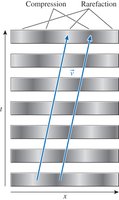
Regions of compression (high pressure) and rarefaction (low pressure) move through the medium.
The wave function for a sinusoidal sound wave traveling in the x-direction is given by:
Describing Sound Waves: Displacement and Pressure
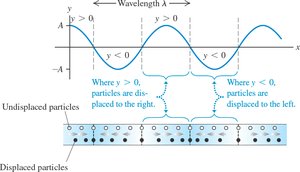
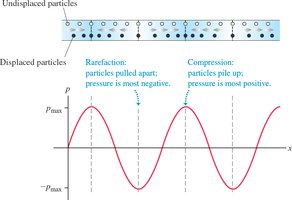
Sound waves can be described by the displacement of particles or by the pressure variations they produce.
Displacement wave: Shows how particles move from their equilibrium positions.
Pressure wave: Shows how pressure varies in the medium as the wave passes.
Speed of Sound
The speed of sound depends on the properties of the medium:
In fluids (liquids and gases):
In solids (rods or bars):
In an ideal gas:



Perception of Sound and Fourier Analysis
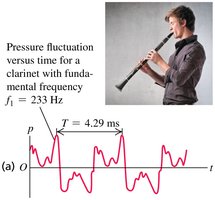
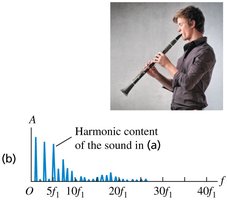
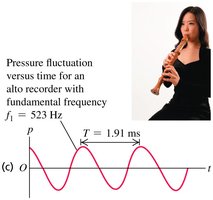
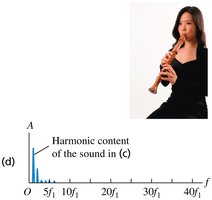
Humans perceive sound through pressure fluctuations detected by the ear. Complex sounds can be analyzed into their harmonic components using Fourier analysis.
Fourier analysis decomposes a complex sound into a sum of sinusoidal components (harmonics).
The timbre of an instrument is determined by the relative strengths of these harmonics.
Ultrasonic Imaging
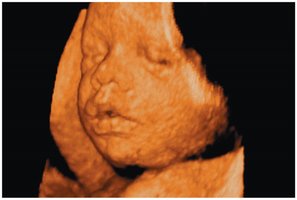
Ultrasound uses high-frequency sound waves to create images of internal body structures. It is widely used in medical diagnostics, such as fetal imaging and cardiac studies.
Sound Intensity and the Decibel Scale
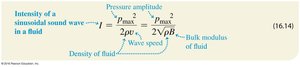
Sound intensity is the power per unit area carried by a wave. The human ear perceives sound intensity logarithmically, so the decibel (dB) scale is used.
Intensity (I):
Sound intensity level (β): , where is the reference intensity.

Sound Interference and Beats
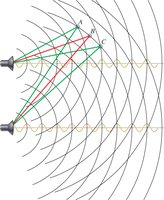
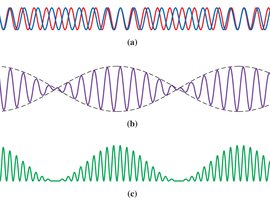
When two or more sound waves overlap, they interfere, producing regions of constructive and destructive interference. If two waves of slightly different frequencies interfere, they produce beats.
Constructive interference: Occurs when waves are in phase, amplifying the sound.
Destructive interference: Occurs when waves are out of phase, reducing the sound.
Beat frequency:
Sound Diffraction
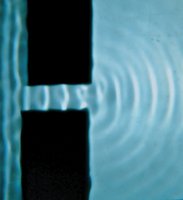
Sound waves can bend around obstacles and spread out after passing through narrow openings, a phenomenon known as diffraction. This explains why we can hear sounds even when the source is not in direct line of sight.
Active Noise Cancellation
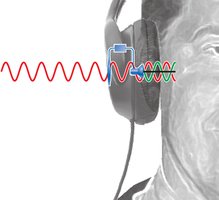
Active noise cancellation uses destructive interference to reduce unwanted ambient sounds. Headphones with this technology detect external noise and generate a sound wave with the opposite phase to cancel it out.
The Doppler Effect
The Doppler effect is the change in frequency or wavelength of a wave in relation to an observer moving relative to the source of the wave. It explains why the pitch of a siren changes as it passes by.
Observed frequency (moving source):
Observed frequency (moving observer):
Signs depend on the direction of motion (toward or away).


Standing Waves in Pipes
Standing sound waves can form in pipes, leading to resonance at specific frequencies. The boundary conditions (open or closed ends) determine the possible standing wave patterns and their frequencies.
Open pipe: Both ends are open; supports all harmonics.
Closed pipe: One end is closed; supports only odd harmonics.
Fundamental frequency (open pipe):
Fundamental frequency (closed pipe):
Applications and Human Hearing
Sound waves are essential in music, communication, and medical imaging. The human ear is sensitive to a wide range of frequencies and intensities, but prolonged exposure to high-intensity sounds can cause hearing damage.
Ultrasound is used in medical diagnostics.
Dynamic range of human hearing is about 120 dB.
Hearing loss can occur with exposure to sounds above 120 dB.
Summary Table: Speed of Sound in Various Media
Medium | Speed of Sound (m/s) |
|---|---|
Air (20°C) | 343 |
Water | 1482 |
Steel | 5960 |
Helium | 960 |
Carbon Dioxide | 260 |
Key Equations
Speed of sound in a fluid:
Speed of sound in a solid rod:
Speed of sound in an ideal gas:
Sound intensity:
Sound intensity level (dB):
Beat frequency:
Doppler effect (general):
