 Back
BackChapter 16: Traveling Waves – Physics Study Notes
Study Guide - Smart Notes
 Tailored notes based on your materials, expanded with key definitions, examples, and context.
Traveling Waves
Introduction to Waves
Waves are disturbances that transfer energy from one place to another without the permanent transfer of matter. They are fundamental to many areas of physics, including sound, light, and water waves.
Types of Waves
Main Classifications
Mechanical Waves: Require a physical medium (such as air, water, or a string) to propagate. Examples include sound waves and waves on a string.
Electromagnetic Waves: Do not require a medium and can travel through a vacuum. Examples include light, radio waves, and X-rays.
Transverse Waves: The displacement of the medium is perpendicular to the direction of wave propagation (e.g., waves on a string, electromagnetic waves).
Longitudinal Waves: The displacement of the medium is parallel to the direction of wave propagation (e.g., sound waves in air).
Wave Speed
Basic Relationship
The speed of a traveling wave is determined by its wavelength and frequency. The fundamental equation is:
where is the wave speed, is the wavelength, and (or ) is the frequency. This equation is dimensionally consistent and applies to all types of waves.

Sinusoidal Traveling Waves
Mathematical Description
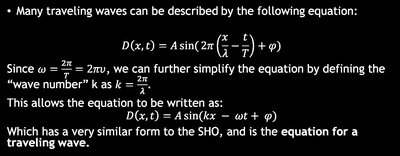
Many traveling waves can be described by a sinusoidal function:
where is the displacement at position and time , is the amplitude, is the wavelength, is the period, and is the phase constant. By defining the angular frequency and the wave number , the equation simplifies to:
Velocity and Acceleration of Particles in a Wave
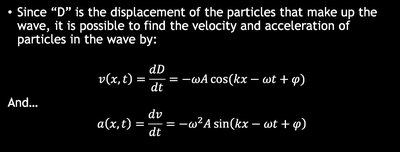
Since represents the displacement of particles in the medium, their velocity and acceleration can be found by differentiation:
Partial Derivatives and the Wave Equation
The velocity above is the velocity of a particle at a specific location and time, not the velocity of the wave itself. The wave function can also be analyzed using partial derivatives:
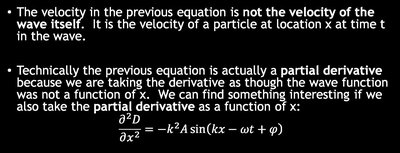
Similarly, the partial derivative with respect to time is:
Comparing these, and using , we find:
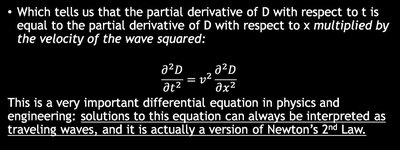
Thus, the wave equation is:
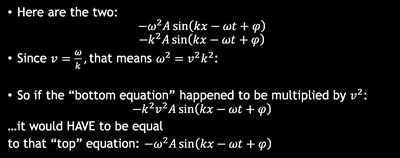
This is a fundamental differential equation in physics, and its solutions describe traveling waves. It is closely related to Newton's Second Law.
Applications of the Wave Equation
Wave on a String
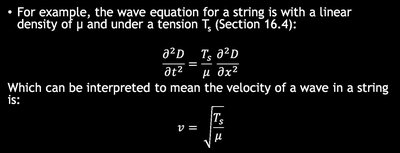
For a string with linear density and under tension , the wave equation becomes:
The velocity of a wave on a string is then:
Sound Waves
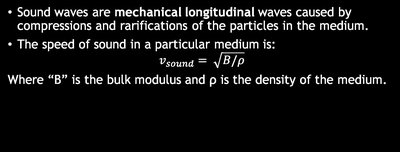
Sound waves are mechanical longitudinal waves caused by compressions and rarefactions in a medium. The speed of sound in a medium is given by:
where is the bulk modulus and is the density of the medium.
Power and Intensity of Waves
Definitions and Relationships
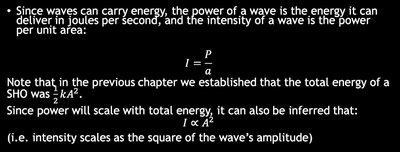
Waves carry energy. The power of a wave is the energy delivered per second, and the intensity is the power per unit area:
For a simple harmonic oscillator (SHO), the total energy is . Since power scales with energy, intensity is proportional to the square of the amplitude:
Intensity of Sound Waves and the Decibel Scale
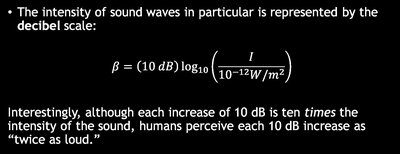
The intensity of sound is often measured in decibels (dB):
Each increase of 10 dB corresponds to a tenfold increase in intensity, but is perceived by humans as "twice as loud."
The Doppler Effect
Frequency and Wavelength Shift
The Doppler Effect describes the change in frequency or wavelength of a wave in relation to an observer moving relative to the source. If the source moves toward a stationary observer, the perceived wavelength shortens:
For an approaching source:
or
For a receding source:
or
If the observer is moving and the source is stationary:
for approach, and for recession.
Example: The Doppler effect explains why the pitch of a siren appears higher as an ambulance approaches and lower as it moves away.
