 Back
BackChapter 16: Traveling Waves – Physics Study Notes
Study Guide - Smart Notes
 Tailored notes based on your materials, expanded with key definitions, examples, and context.
Traveling Waves
Introduction to Waves
Waves are organized disturbances that transfer energy through a medium or space. Unlike particles, which move from one place to another, waves propagate by causing oscillations in the medium, transporting energy without transporting matter.
Wave Model: Describes motion as a disturbance traveling with a well-defined speed.
Essence of Waves: Points in the medium oscillate around equilibrium; energy is transmitted through the medium.
Requirements for a Wave: Stable equilibrium medium, source of disturbance, and propagation mechanism.
Types of Waves
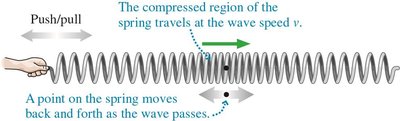
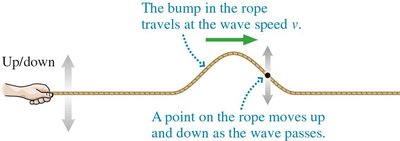
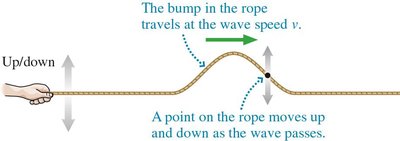
Transverse Waves: Particles move perpendicular to wave direction (e.g., waves on a string).
Longitudinal Waves: Particles move parallel to wave direction (e.g., sound waves in air).
Mechanical Waves: Require a material medium (e.g., water, sound, string).
Electromagnetic Waves: Do not require a medium; include light, radio, microwaves.
Matter Waves: Describe wave-like properties of particles (quantum scale).
Wave Speed and Medium Properties
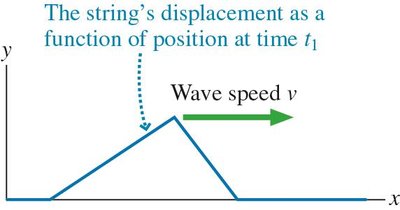
The speed of a wave depends only on the properties of the medium, not on the shape or size of the disturbance.
String Waves: Speed depends on tension (T) and linear density (μ):
Sound Waves in Gases: Speed depends on temperature (T) and molecular mass (m):
Electromagnetic Waves: Speed in vacuum is m/s.
Wave Descriptors and Mathematical Representation
Waves are characterized by several key parameters:
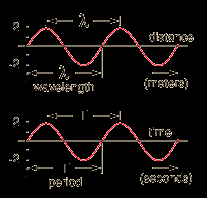
Amplitude (A): Maximum displacement from equilibrium.
Wavelength (λ): Distance between successive crests or troughs.
Frequency (f): Number of cycles per second (Hz).
Period (T): Time for one cycle; .
Wave Speed (v):
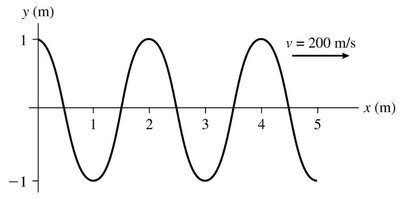
Snapshot and History Graphs
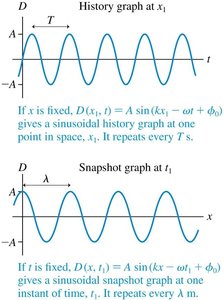
Waves can be analyzed using two types of graphs:
Snapshot Graph: Displacement as a function of position at a fixed time.
History Graph: Displacement of a single point as a function of time.
Sinusoidal Waves
Sinusoidal waves are produced by sources oscillating with simple harmonic motion. The general mathematical form for a traveling sinusoidal wave is:
for a wave traveling in the +x direction
(wave number), (angular frequency)
Sound and Light Waves
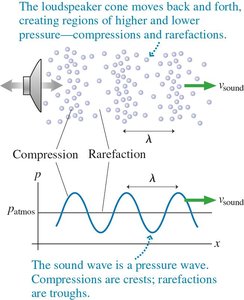
Sound Waves: Longitudinal pressure waves in air, with regions of compression and rarefaction.
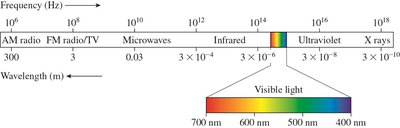
Light Waves: Electromagnetic waves; visible light is a small part of the electromagnetic spectrum.
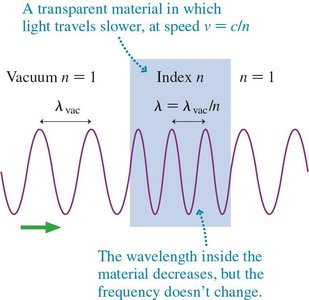
Index of Refraction (n): Describes how light slows in a material:
Wavelength in Material:
Waves in Two and Three Dimensions
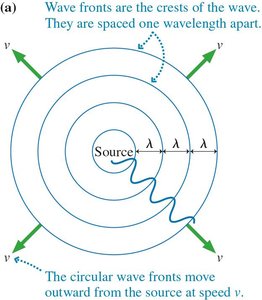
Circular Waves: Spread in two dimensions (e.g., ripples on a pond).
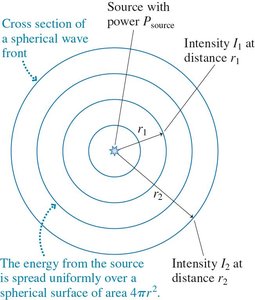
Spherical Waves: Spread in three dimensions (e.g., sound, light).
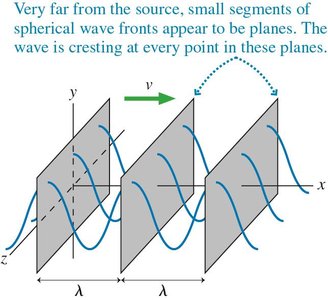
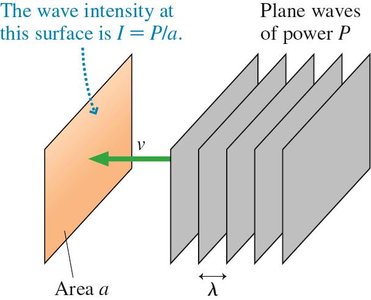
Plane Waves: Far from the source, wave fronts appear flat.
Power, Intensity, and Decibels
Waves transfer energy, and the rate of energy transfer is called power. Intensity is the power per unit area:
For spherical waves:
Sound intensity level (decibels): , where W/m2
The Doppler Effect and Shock Waves
The Doppler effect is the change in observed frequency due to relative motion between the source and observer.
Approaching Source: Observed frequency increases.
Receding Source: Observed frequency decreases.
Formulas:
Source moving:
Observer moving:
Shock Waves: Produced when a source moves faster than the wave speed, resulting in overlapping wave fronts (e.g., sonic boom).
Summary Table: Types of Waves
Type | Medium Required? | Example | Direction of Particle Motion |
|---|---|---|---|
Transverse | Yes | String, water surface | Perpendicular to wave |
Longitudinal | Yes | Sound in air | Parallel to wave |
Electromagnetic | No | Light, radio | N/A (fields oscillate) |
Matter | N/A | Electrons, atoms (quantum) | N/A |
Additional info: These notes synthesize and expand upon the provided lecture slides, including definitions, formulas, and worked examples for clarity and completeness.
