 Back
Chapter 17: Electric Potential and Capacitance – Study Notes
Study Guide - Smart Notes
 Tailored notes based on your materials, expanded with key definitions, examples, and context.
Electric Potential Energy and Potential Difference
Conservative Forces and Potential Energy
Electric force, like gravitational force, is a conservative force. This means the work done by the force depends only on the initial and final positions, not the path taken. The concept of electric potential energy (PE) is analogous to gravitational potential energy.
Electric Potential Energy (PE): The energy a charge has due to its position in an electric field.
Electric Potential (V): The potential energy per unit charge, defined as .
Potential Difference (ΔV): The work done to move a charge between two points, .
The unit of electric potential is the volt (V), where .
Example: Setting the potential at ground to zero () is a common reference.
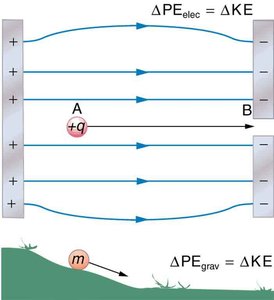
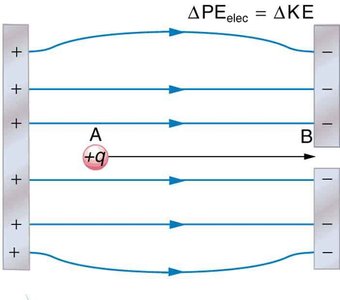
Relationship Between Electric Potential and Electric Field
The change in electric potential energy is related to the work done by the electric force:
for a uniform electric field.
Whether energy increases or decreases depends on the sign of .
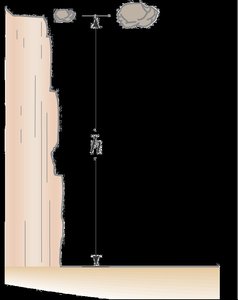
For gravitational potential: ; for electric: .
Electric Potential: Definitions and Units
Electric Potential and Potential Difference
Electric potential is defined as the energy per unit charge. The potential difference between two points is:
(for uniform fields)
Once is known, the change in potential energy is .
Unit: Volt (), where .
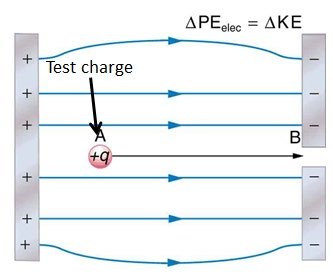
Electric and Gravitational Potential Energy
Both electric and gravitational potential energies depend on the sign of the charge or mass:
For positive , if .
For negative , if .
Electric Field and Potential Difference Between Plates
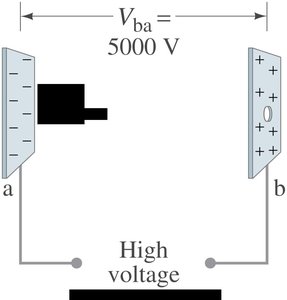
Direction of Electric Field and Forces
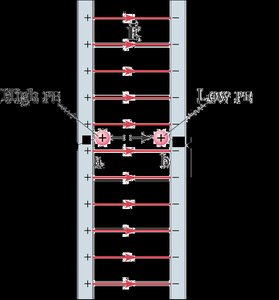
In a parallel plate setup, the electric field points from the plate with higher potential to lower potential. The force on a positive charge is in the direction of the field, while for a negative charge, it is opposite.
Convenient to set at ground.
Potential energy depends on the sign of the charge.
Work, Energy, and Conservation
Conservation of Energy in Electric Fields
When a charge moves in an electric field, its kinetic energy increases as its potential energy decreases:
For an electron released from rest, the final velocity can be calculated using energy conservation.
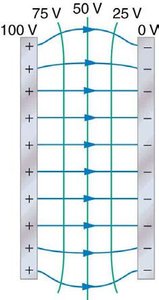
Relation Between Electric Potential and Electric Field
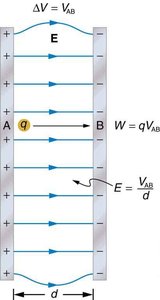
Uniform Electric Field
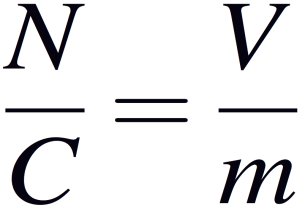
For a uniform electric field, the potential difference is given by:
Example: Voltage across a cell membrane with thickness and field .
The Electron Volt: A Unit of Energy
Definition and Application
The electron volt (eV) is the energy gained by an electron moving through a potential difference of one volt:
Useful for atomic and subatomic processes.
Electric Potential Due to Point Charges
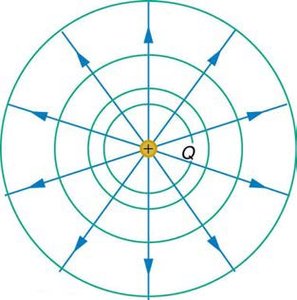
Potential Around a Point Charge
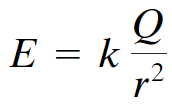
The electric potential at a distance from a point charge is:
For , ; for , .
when .
Potential Due to Multiple Charges
The total potential at a point due to several charges is the algebraic sum of the potentials from each charge:
Equipotential Lines and Surfaces
Definition and Properties
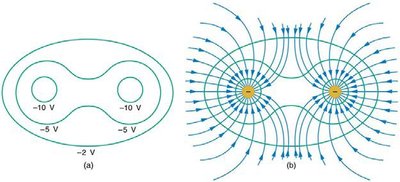
Equipotential surfaces are surfaces where the electric potential is constant. They are always perpendicular to the electric field lines.
No work is done when moving a charge along an equipotential surface.
Metal surfaces are equipotential surfaces.
Capacitance and Capacitors
Definition and Parallel Plate Capacitor
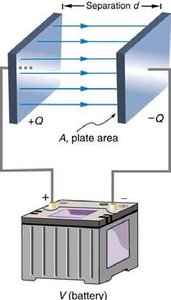
A capacitor is a device that stores electric charge and energy. It consists of two conducting plates separated by an insulating gap.
Capacitance (C):
Unit: Farad (),
Parallel plate capacitor:

Dielectrics
The gap between capacitor plates can be filled with a dielectric material, which increases capacitance by reducing the electric field.
Dielectric constant (κ): Dimensionless factor describing the effect of the material.
Capacitance with dielectric:
Electric field is reduced by a factor of .
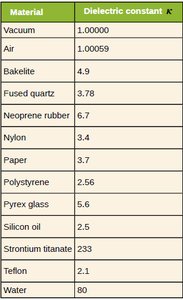
Material | Dielectric constant κ |
|---|---|
Vacuum | 1.00000 |
Air | 1.00059 |
Bakelite | 4.9 |
Fused quartz | 3.78 |
Neoprene rubber | 6.7 |
Nylon | 3.4 |
Paper | 3.7 |
Polystyrene | 2.56 |
Pyrex glass | 5.6 |
Silicon oil | 2.5 |
Strontium titanate | 233 |
Teflon | 2.1 |
Water | 80 |
Capacitors in Series and Parallel
Series and Parallel Configurations
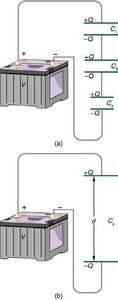
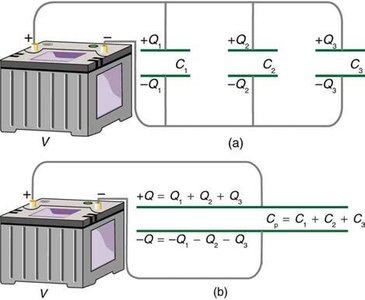
Capacitors can be connected in series or parallel, affecting the total capacitance:
Series:
Parallel:
Energy Storage in Capacitors
Energy Stored and Applications
The energy stored in a capacitor is given by:
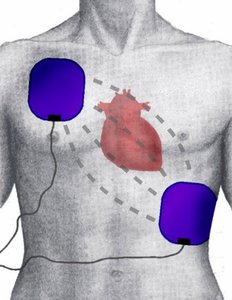
Capacitors are used in devices such as heart defibrillators, where stored energy is released rapidly.

Summary of Key Equations
Electric potential:
Potential difference: (uniform field)
Potential due to point charge:
Capacitance:
Parallel plate capacitor:
Capacitance with dielectric:
Energy stored:
Additional info: Digital electronics and binary numbers are briefly mentioned as applications of electric potential in signal processing, but are not covered in detail in these notes.
