 Back
BackChapter 17: Superposition and Interference of Waves
Study Guide - Smart Notes
 Tailored notes based on your materials, expanded with key definitions, examples, and context.
Superposition of Waves
Principle of Superposition
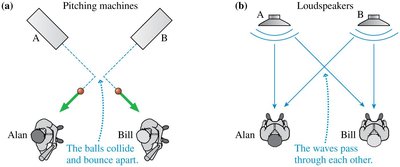
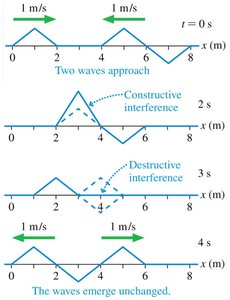
The principle of superposition states that when two or more waves are present at a single point in space, the displacement of the medium at that point is the sum of the displacements due to each individual wave. This property is unique to waves and does not apply to particles, which interact differently when they meet.
Definition: If wave 1 causes a displacement and wave 2 causes at the same point, the net displacement is .
Application: This principle is fundamental to understanding phenomena such as interference, standing waves, and beats.
Example: Two pulses traveling toward each other on a string will pass through each other, and their displacements add where they overlap.

Standing Waves
Formation and Properties
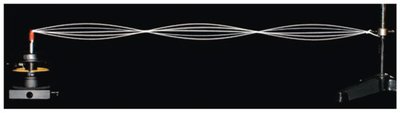
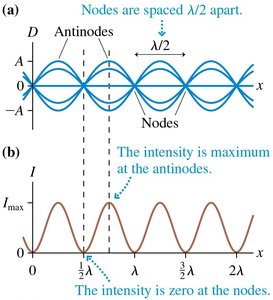
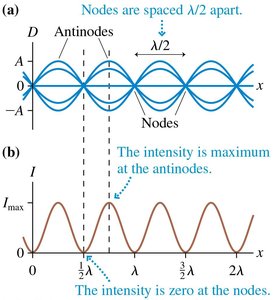
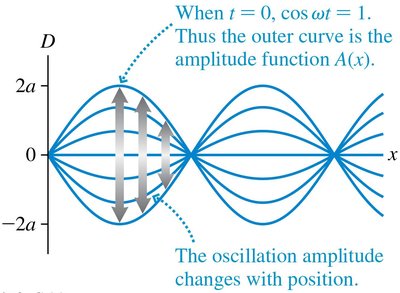
Standing waves are formed when two waves of the same frequency, wavelength, and amplitude travel in opposite directions and interfere. The resulting pattern appears stationary, with fixed points called nodes (no motion) and antinodes (maximum motion).
Nodes: Points that never move; spaced apart.
Antinodes: Points of maximum displacement, located halfway between nodes.
Modes: The specific patterns of standing waves, each with a unique frequency and wavelength.
Intensity: Proportional to the square of the amplitude; maximum at antinodes, zero at nodes.
Mathematics of Standing Waves
A right-traveling wave:
A left-traveling wave:
Superposition yields:
Amplitude function:
Nodes occur at , where is an integer.
Standing Waves on Strings and in Physical Systems
For a string of length fixed at both ends, allowed wavelengths: ,
Allowed frequencies:
Fundamental frequency:
Each mode has antinodes.

Applications and Examples
Musical Instruments: String instruments (guitar, violin) and wind instruments (flute, clarinet) use standing waves to produce notes. Changing the length or tension alters the frequency.
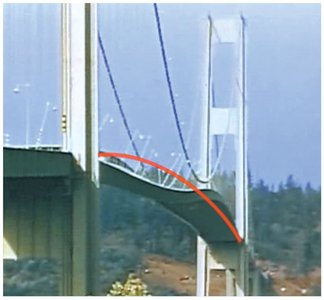
Engineering: Standing waves can cause resonance in structures, as seen in the Tacoma Narrows Bridge collapse.
Interference of Waves
Constructive and Destructive Interference
When two waves overlap, their superposition can lead to interference patterns:
Constructive interference: Occurs when waves are in phase (), resulting in maximum amplitude ().
Destructive interference: Occurs when waves are out of phase (), resulting in zero amplitude ().
General case: The net amplitude is , where is the phase difference.
Beats
Beats occur when two waves of slightly different frequencies interfere, producing a modulation in intensity (loud-soft-loud pattern). The beat frequency is the absolute difference between the two frequencies:
Applications: Music tuning, ultrasonics, telecommunications.

Standing Waves in Air Columns and Musical Instruments
Standing Sound Waves
In tubes (open or closed), standing sound waves form with nodes and antinodes determined by boundary conditions.
Closed-closed or open-open tubes: ,
Open-closed tubes: , , with (only odd harmonics)
Pressure and displacement nodes/antinodes are interchanged.

Examples: Flutes and Clarinets
Flute (open-open):
Clarinet (open-closed):
Next harmonics: Flute has all harmonics, clarinet only odd harmonics.
Interference in Two and Three Dimensions
Path-Length Difference and Interference Patterns
When two sources emit waves, the interference at a point depends on the path-length difference :
Constructive interference:
Destructive interference:
Applies to sound, light, and water waves.

Thin-Film Interference
Optical Coatings
Thin films on glass surfaces (e.g., camera lenses) use interference to reduce reflections. The phase difference between reflected waves depends on the film's thickness , index of refraction , and the wavelength :
Phase difference:
Destructive interference (antireflection): for the thinnest film
Applications: Antireflection coatings, optical devices
Summary Table: Standing Waves in Different Systems
System | Allowed Wavelengths | Allowed Frequencies | Harmonics |
|---|---|---|---|
String fixed at both ends / Open-open tube | All () | ||
Open-closed tube | Odd () |
Key Equations
Superposition:
Standing wave:
Beat frequency:
Interference (general):
Thin-film interference:
