 Back
BackChapter 18: Electric Potential and Capacitance – Study Notes
Study Guide - Smart Notes
 Tailored notes based on your materials, expanded with key definitions, examples, and context.
Electric Potential and Capacitance
Introduction and Daily Life Applications
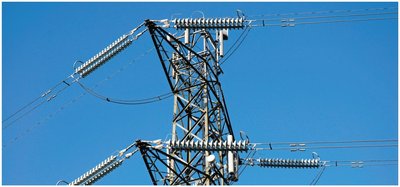
Electric potential and capacitance are fundamental concepts in electromagnetism, with applications ranging from computer circuitry to batteries and electric power transmission. Understanding these concepts allows us to analyze how energy is stored and transferred in electric fields and circuits.
Electric potential is the potential energy per unit charge at a point in an electric field.
Capacitance measures a system's ability to store electric charge and energy.
Applications include power lines, electronic devices, and energy storage systems.
Electric Potential Energy
Gravitational vs. Electric Potential Energy
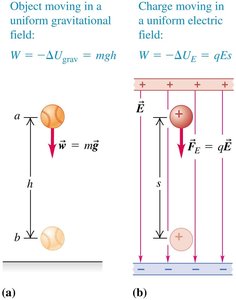
Potential energy is the energy stored due to the position of an object in a force field. The concept applies to both gravitational and electric fields, with analogous equations describing the work done and energy changes.
Gravitational Potential Energy: Work done by gravity is path-independent and can be expressed as:
(Work-Energy Theorem)
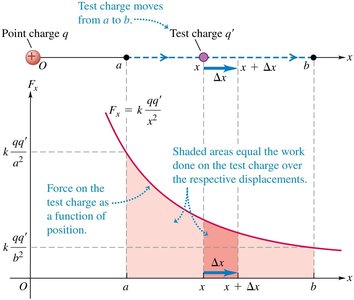
Electric Potential Energy: Similarly, the work done by an electric field on a charge is:
Work Done by Electric Field
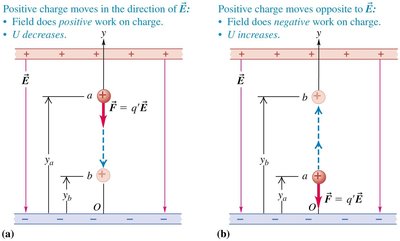
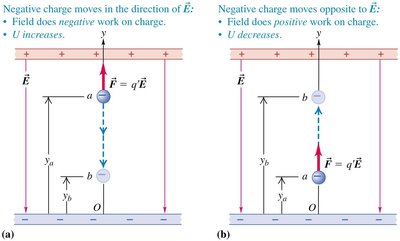
The work done by an electric field can increase or decrease the potential energy of a charged particle, depending on the direction of motion relative to the field.
Charge polarity must be considered in calculations.
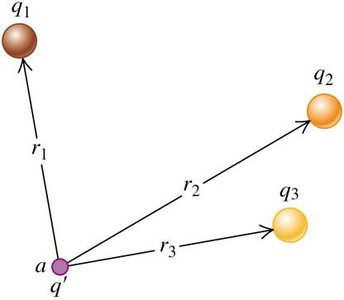
Potential Energy of Point Charges
The potential energy associated with point charges depends on their positions and magnitudes. For a charge at a distance from a point charge :
For multiple charges:
For a system of charges:
Electric Potential (Voltage)
Definition and Calculation
Electric potential at a point is defined as the electric potential energy per unit charge:
or
Unit: Volt (V), where
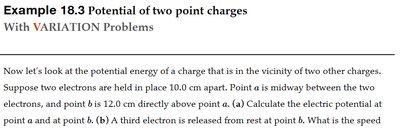
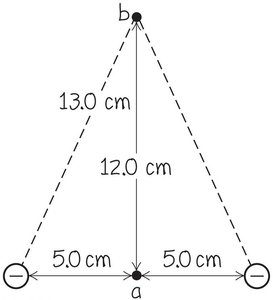
Potential due to a point charge:
Potential due to multiple charges:
Potential in a Uniform Electric Field (Parallel Plates)
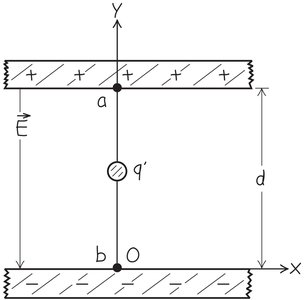
In a region with a uniform electric field (such as between parallel plates), the potential difference between two points separated by distance is:
The potential increases linearly with distance in the direction opposite to the field.
Unit for electric field:
Equipotential Surfaces
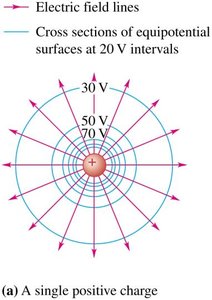
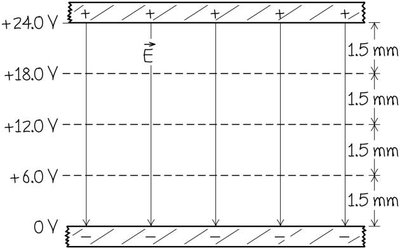
An equipotential surface is a surface on which the electric potential is the same at every point. No work is required to move a charge along an equipotential surface.
Capacitance and Capacitors
Definition and Parallel-Plate Capacitor
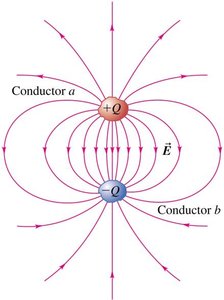
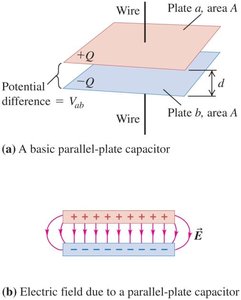
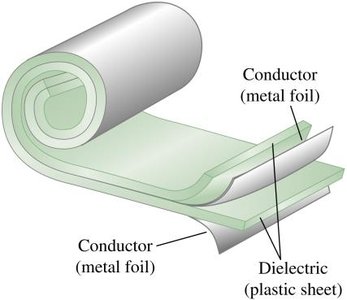
A capacitor is a device that stores electric charge and energy. The capacitance is defined as:
Unit: Farad (F), where
Common subunits: microfarad (F), picofarad (pF)
For a parallel-plate capacitor:
Electric field:
Potential difference:
Capacitance:
Capacitors in Series and Parallel
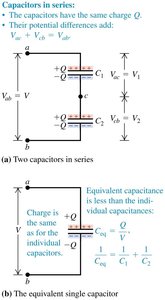
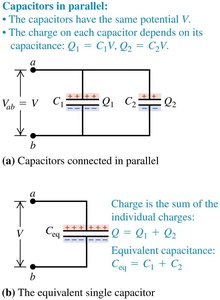
Capacitors can be combined in series or parallel to achieve desired capacitance values in circuits.
Series:
Parallel:
Energy Stored in a Capacitor
Potential Energy and Energy Density
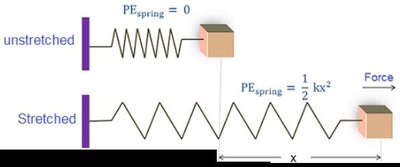
The energy stored in a capacitor is given by:
The energy is stored in the electric field between the plates.
Energy density (energy per unit volume) in the field:
Dielectrics (Overview)
Role and Effect of Dielectrics
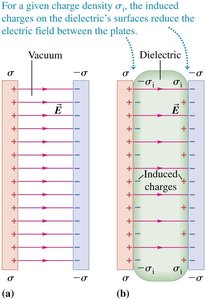
Most capacitors contain a nonconducting material (dielectric) between their plates. Dielectrics:
Increase capacitance by reducing the effective electric field.
Allow capacitors to withstand higher voltages without breakdown.
Dielectric constant is defined as , where is the capacitance with air.
With a dielectric: and
Summary Table: Key Equations and Concepts
Concept | Equation | Unit |
|---|---|---|
Electric Potential Energy (point charges) | Joule (J) | |
Electric Potential (point charge) | Volt (V) | |
Capacitance (parallel plates) | Farad (F) | |
Energy stored in capacitor | Joule (J) | |
Energy density | J/m3 | |
Series capacitance | Farad (F) | |
Parallel capacitance | Farad (F) |
Additional info: Some sections (e.g., detailed derivations, advanced applications, and certain problem solutions) were omitted for brevity but can be found in the full textbook or lecture notes. The above summary covers the essential concepts, equations, and applications relevant to Chapter 18: Electric Potential and Capacitance.
