 Back
BackChapter 19: Current, Resistance, and DC Circuits – Study Notes
Study Guide - Smart Notes
 Tailored notes based on your materials, expanded with key definitions, examples, and context.
Current, Resistance, and DC Circuits
Introduction
This chapter explores the fundamental principles of electric current, resistance, and the behavior of direct current (DC) circuits. These concepts are essential for understanding how electrical devices operate and how energy is transferred in circuits.
Current
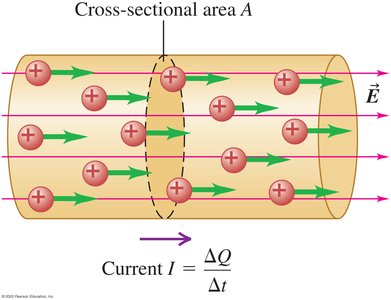
Electric current is the flow of electric charge through a conductor. It is a key concept in understanding how circuits function.
Definition: Current (symbol: I) is the rate at which charge flows through a surface.
SI Unit: The ampere (A), defined as one coulomb per second.
Direction: By convention, current is defined as the direction positive charges would move, even though in most conductors, electrons (negative charges) are the actual charge carriers.
Formula:
Example: If 2 C of charge pass through a wire in 1 s, the current is 2 A.
Resistance and Ohm’s Law
Resistance is a property of materials that opposes the flow of electric current. Ohm’s Law relates the current, voltage, and resistance in a circuit.
Definition: Resistance (symbol: R) quantifies how much a material opposes current flow.
SI Unit: Ohm (Ω).
Formula for Resistance: where is resistivity, is length, and is cross-sectional area.
Ohm’s Law: The relationship between voltage (V), current (I), and resistance (R) is:
Example: A 6 Ω resistor connected to a 24 V battery has a current of:
Resistivity and Material Properties
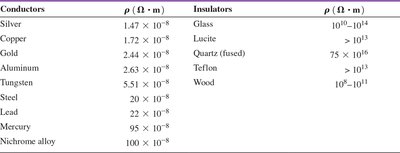
Resistivity is a material-specific property that affects resistance. Conductors have low resistivity, while insulators have high resistivity.
Definition: Resistivity () is a measure of how strongly a material opposes current flow.
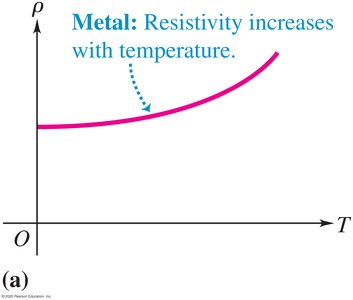
Temperature Dependence: For most metals, resistivity increases with temperature.
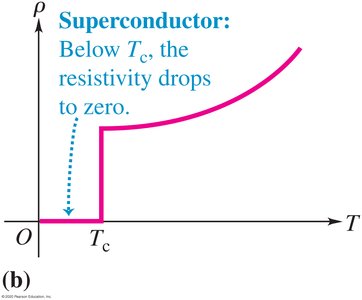
Superconductors: Below a critical temperature (), resistivity drops to zero.
Conductors | () | Insulators | () |
|---|---|---|---|
Silver | Glass | – | |
Copper | Lucite | ||
Gold | Quartz (fused) | ||
Aluminum | Teflon | ||
Tungsten | Wood | – | |
Steel | |||
Lead | |||
Mercury | |||
Nichrome alloy |
Temperature Dependence of Resistance
Resistance of a material changes with temperature, especially for metals.
Formula: where is resistance at reference temperature , is the temperature coefficient.
Example: If a copper wire has at C and C, at C:
Electromotive Force (EMF) and Circuits
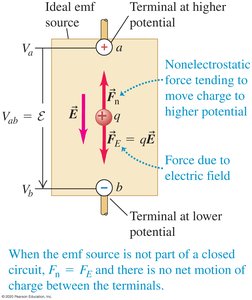
Electromotive force (emf) is the energy per unit charge supplied by a source such as a battery.
Definition: EMF () is the voltage generated by a source.
Units: Volts (V).
Potential Gain: Moving from the negative to the positive terminal of a battery increases potential.
Formula:
Internal Resistance of EMF Sources
Real batteries and emf sources have internal resistance, which causes energy loss.
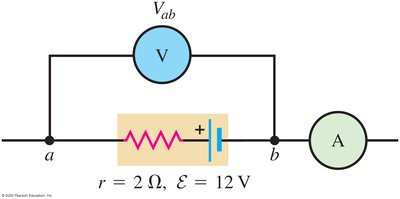
Definition: Internal resistance (r) is the resistance inside the emf source.
Formula for terminal voltage:
Example: For a battery with and , if :
Potential Gain and Loss Around a Circuit
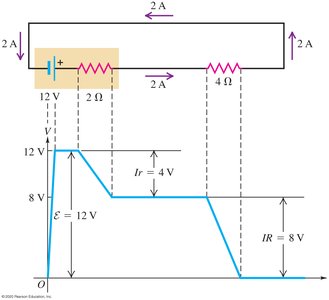
As current flows through a circuit, the potential changes due to emf sources and resistors.
Potential Gain: Occurs across the emf source.
Potential Drop: Occurs across resistors and internal resistance.
Example: In a circuit with , , , and :
Voltage drop across :
Voltage drop across :
Total potential change matches the emf.
Summary Table: Key Equations
Quantity | Symbol | Equation | Units |
|---|---|---|---|
Current | I | A (Ampere) | |
Resistance | R | Ω (Ohm) | |
Ohm's Law | V, I, R | V (Volt) | |
Temperature Dependence | R | Ω (Ohm) | |
EMF | V (Volt) |
