 Back
BackChapter 2: Motion in One Dimension – Study Notes
Study Guide - Smart Notes
 Tailored notes based on your materials, expanded with key definitions, examples, and context.
Motion in One Dimension
Introduction to Linear Motion
Motion in one dimension involves the study of objects moving along a straight line. This chapter introduces the concepts of position, velocity, acceleration, and the mathematical tools used to describe and analyze such motion.
Describing Motion
Position and Coordinate Systems
To analyze motion, we assign a coordinate system:
x-axis: Used for horizontal motion (positive to the right).
y-axis: Used for vertical motion (positive upward).
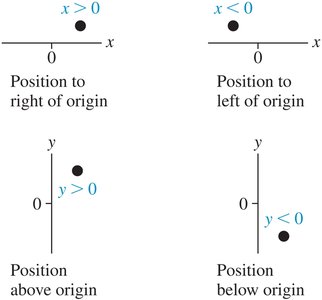
Position is the location of an object relative to an origin. It can be positive or negative depending on the chosen coordinate system.
Motion Diagrams
Motion diagrams represent an object's position at successive times, helping visualize its movement.
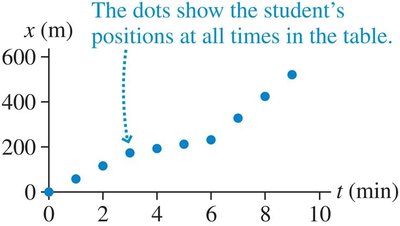

Each dot represents the object's position at a specific time. The spacing between dots indicates speed: equal spacing means constant speed, increasing spacing means acceleration.
Tabular Representation of Motion
Time t (min) | Position x (m) |
|---|---|
0 | 0 |
1 | 60 |
2 | 120 |
3 | 180 |
4 | 200 |
5 | 220 |
6 | 240 |
7 | 340 |
8 | 440 |
9 | 540 |
This table shows how position changes with time for a student walking to school.
Velocity
Average and Instantaneous Velocity
Velocity is the rate of change of position. It is a vector quantity, meaning it has both magnitude and direction.
Average velocity:
Instantaneous velocity: The slope of the position-versus-time graph at a specific point.
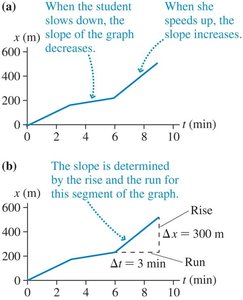
The steeper the slope, the greater the velocity. Positive slope indicates motion in the positive direction; negative slope indicates motion in the negative direction.
Interpreting Position-Time Graphs
Read position at a given time directly from the graph.
Find velocity by calculating the slope at a point.
Direction of motion is given by the sign of the slope.
Velocity-Time Graphs
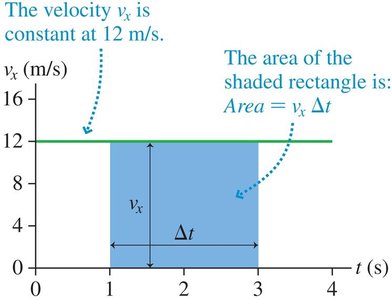
Velocity-time graphs provide another way to represent motion. The area under the velocity-time graph gives the displacement.
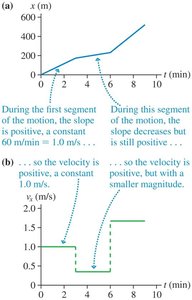
Example: Finding Velocity from Position Graph
Given a position-time graph with segments of different slopes, calculate velocity for each segment:
From to s:
From to s: (no change in position)
From to s:
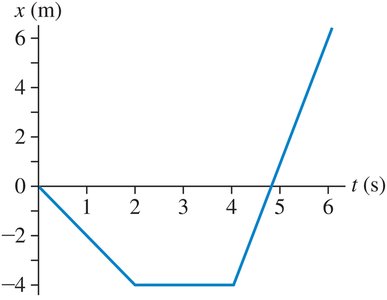
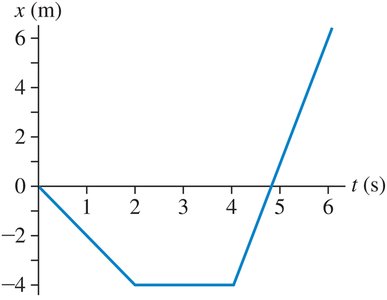
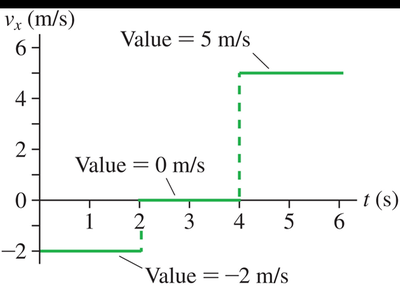
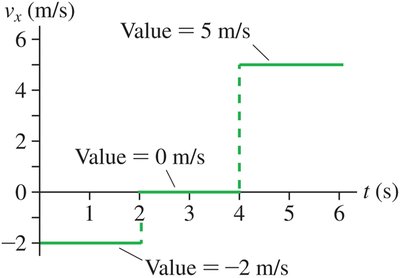
Example: The car moves backward, stops, then moves forward.
Uniform Motion
Definition and Equations
Uniform motion means constant velocity (straight-line motion with equal displacements in equal time intervals).
Position equation:
Displacement:
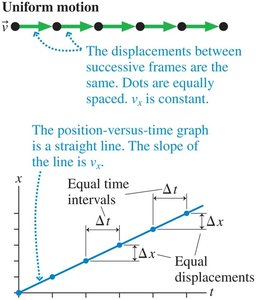
The position-time graph is a straight line for uniform motion.
Proportional Relationships
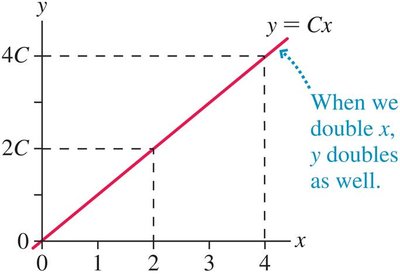
When two quantities are proportional, doubling one doubles the other. For uniform motion, displacement is proportional to time.
Instantaneous Velocity
Definition and Calculation
Instantaneous velocity is the velocity at a specific instant, found as the slope of the tangent to the position-time curve at that point.
If the position graph is curved, zoom in on a small interval to approximate the slope.
Mathematically, (calculus definition).
Displacement from Velocity-Time Graphs
Area Under the Curve
The area under a velocity-time graph represents the object's displacement over a time interval.
Acceleration
Definition and Units
Acceleration is the rate of change of velocity. It is a vector and can be positive or negative depending on the direction of velocity change.
Average acceleration:
SI unit:
An object is speeding up if velocity and acceleration have the same sign; slowing down if they have opposite signs.
Constant Acceleration Equations
Velocity:
Position:
Velocity-Displacement:
Free Fall
Definition and Properties
Free fall is motion under the influence of gravity alone. All objects in free fall near Earth's surface have the same acceleration, downward.
Upward motion:
Downward motion:
At the highest point of a toss, velocity is zero but acceleration is still .
Problem-Solving Strategies
Four-Step Approach
Strategize: Identify the type of problem and relevant principles.
Prepare: Draw diagrams, define variables, and list knowns/unknowns.
Solve: Apply equations and perform calculations.
Assess: Check units, reasonableness, and completeness of the answer.
Pictorial Representation
Sketch the situation, establish axes, define symbols, list knowns and unknowns.
Summary Table: Key Equations for One-Dimensional Motion
Equation | Description |
|---|---|
Average velocity | |
Average acceleration | |
Uniform motion (constant velocity) | |
Velocity with constant acceleration | |
Position with constant acceleration | |
Velocity-displacement relation |
Applications and Examples
Uniform motion: A hockey puck sliding at constant speed.
Constant acceleration: A car accelerating from rest, a ball in free fall.
Free fall: All objects (neglecting air resistance) accelerate downward at .
Additional info: These notes are based on Chapter 2 of a college physics textbook and are suitable for exam preparation and conceptual understanding of one-dimensional motion.
