 Back
BackChapter 2: Motion in One Dimension – Study Notes
Study Guide - Smart Notes
 Tailored notes based on your materials, expanded with key definitions, examples, and context.
Motion in One Dimension
Introduction to Linear Motion
Motion in one dimension refers to the movement of objects along a straight line, either horizontally or vertically. This chapter introduces the fundamental concepts and mathematical tools needed to describe and analyze such motion, including position, velocity, and acceleration.
Describing Motion
Position and Coordinate Systems
To analyze motion, we use a coordinate system:
x-axis for horizontal motion (positive to the right)
y-axis for vertical motion (positive upward)
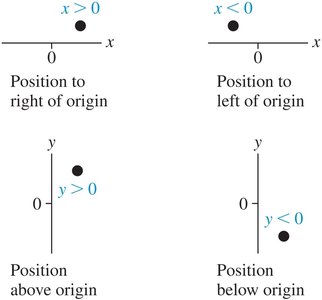
Position is the location of an object relative to an origin. It can be positive or negative depending on the chosen reference point.
Motion Diagrams
Motion diagrams visually represent an object's position at successive times, helping to analyze its movement.

Position vs. Time Graphs
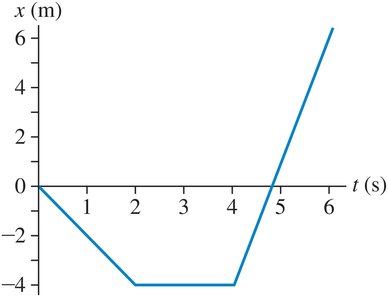
Plotting position (x) versus time (t) provides a graphical representation of motion. The slope of this graph gives information about the object's velocity.
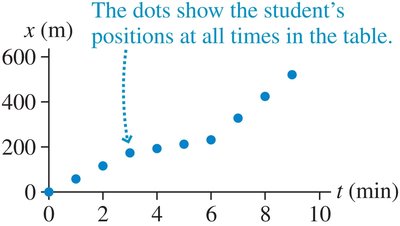

Tabular Representation of Motion
Measured positions at different times can be organized in a table for analysis.
Time t (min) | Position x (m) |
|---|---|
0 | 0 |
1 | 60 |
2 | 120 |
3 | 180 |
4 | 200 |
5 | 220 |
6 | 240 |
7 | 340 |
8 | 440 |
9 | 540 |
Velocity
Average and Instantaneous Velocity
Average velocity is the total displacement divided by the total time interval:
Instantaneous velocity is the velocity at a specific instant, given by the slope of the tangent to the position-time graph at that point.
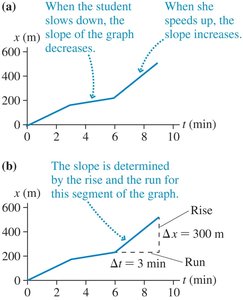
Interpreting Position-Time Graphs
Steeper slopes indicate higher speeds.
Positive slope: motion in the positive direction.
Negative slope: motion in the negative direction.
Velocity-Time Graphs
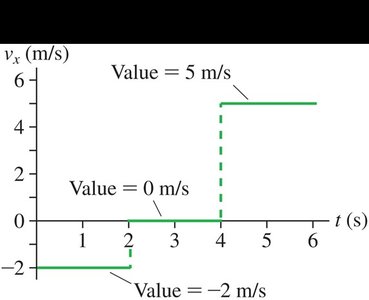
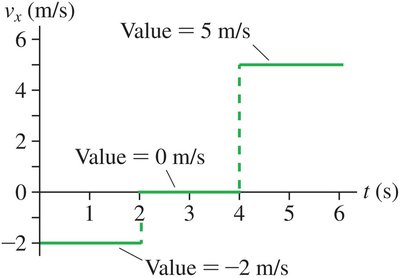
Velocity-time graphs provide another way to represent motion. The area under the curve represents displacement.
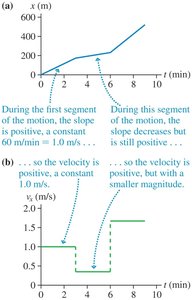
Example: Finding Velocity from Position Graph
Given a position-time graph with segments of different slopes, the velocity in each segment is the slope of that segment.
Uniform Motion
Definition and Equations
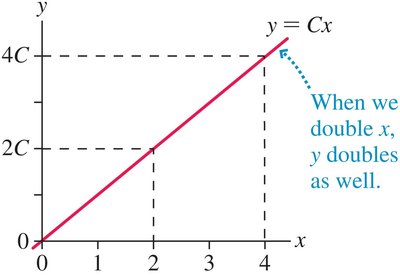
Uniform motion is straight-line motion with constant velocity. The position changes by equal amounts in equal time intervals.
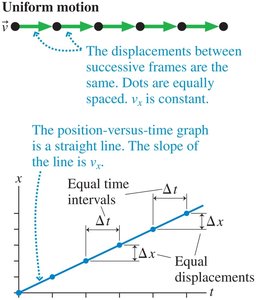
The equation for uniform motion is:
Proportional Relationships
In uniform motion, displacement is proportional to time. If you double the time, the displacement doubles.
Non-Uniform Motion and Acceleration
Acceleration
Acceleration is the rate of change of velocity:
It can be positive (speeding up) or negative (slowing down), depending on the direction of motion and change in velocity.
Velocity and Acceleration Graphs
The slope of a velocity-time graph gives acceleration. The area under a velocity-time graph gives displacement.
Motion with Constant Acceleration
Kinematic Equations
For constant acceleration, the following equations apply:
These equations allow you to solve for unknowns in problems involving constant acceleration.
Quadratic Relationships
When position depends on the square of time (as in constant acceleration), the graph is a parabola.

Free Fall
Definition and Properties
Free fall is motion under the influence of gravity alone. All objects in free fall near Earth's surface have the same acceleration, , directed downward.
Upward motion:
Downward motion:
Air resistance is neglected in introductory problems.
Problem-Solving Strategies
General Approach
Strategize: Identify the type of motion and relevant equations.
Prepare: Draw diagrams, define variables, and list knowns/unknowns.
Solve: Apply equations and solve for the desired quantity.
Assess: Check units, reasonableness, and physical meaning of the answer.
Drawing Pictorial Representations
Sketch the situation, showing initial and final positions.
Establish a coordinate system and define symbols.
List known values and identify unknowns.
Summary of Key Concepts
Velocity:
Acceleration:
Uniform motion:
Constant acceleration: , ,
Free fall: (downward),
