 Back
Chapter 20: Electric Fields and Forces – Study Notes
Study Guide - Smart Notes
 Tailored notes based on your materials, expanded with key definitions, examples, and context.
Electric Fields and Forces
Introduction to Electric Phenomena
Electric phenomena arise from the presence and interaction of electric charges. This chapter introduces the fundamental concepts of charge, electric force, and electric field, which are essential for understanding electricity and magnetism in physics.
Charges and Forces
Nature of Electric Charge
Electric charge is a fundamental property of matter, existing in two types: positive and negative.
Objects become charged by transferring electrons, typically through friction (rubbing).
Like charges repel; opposite charges attract.
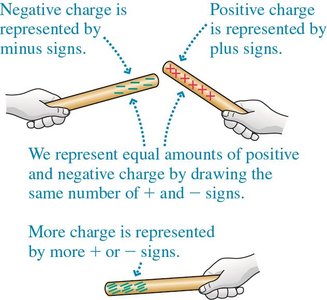
Neutral objects contain equal amounts of positive and negative charge.
Experiments with Charges
Rubbing a plastic rod with wool gives it a negative charge; rubbing glass with silk gives it a positive charge.
Charged rods can attract or repel other objects depending on their charge type.
The force between charged objects decreases with distance and increases with the amount of charge.

Law of Conservation of Charge
Charge is neither created nor destroyed; it is transferred between objects.
When one object gains charge, another loses an equal amount.
Visualizing Charge
Charge diagrams use plus (+) and minus (−) signs to represent positive and negative charges, respectively.
Neutral objects are depicted with equal numbers of + and − signs.
Insulators and Conductors
Definitions and Properties
Conductors: Materials (e.g., metals) in which charge moves freely.
Insulators: Materials (e.g., glass, plastic) in which charge is immobile.
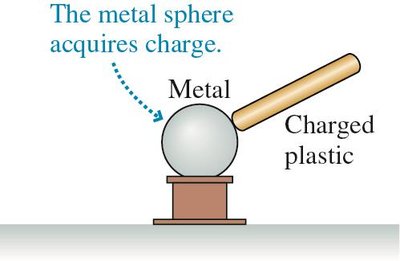
Charge can be transferred by contact; conductors allow charge to spread, while insulators keep it localized.
Electrostatic Equilibrium
In conductors, charges quickly redistribute themselves on the surface until they are at rest (electrostatic equilibrium).
Any excess charge resides on the surface of a conductor.
Polarization
Charge Polarization in Neutral Objects
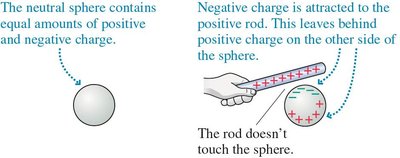
When a charged object is brought near a neutral conductor, charges within the conductor rearrange, creating a slight separation of charge (polarization).
This leads to an attractive force between the charged object and the neutral conductor.
Atomic Structure and Charge
Atoms, Ions, and Molecules
Atoms consist of a positively charged nucleus (protons and neutrons) surrounded by negatively charged electrons.
Objects become positively charged by losing electrons, not by gaining protons.
Ionization is the process of removing or adding electrons to atoms or molecules, creating ions.
Fundamental Charge and Units
The elementary charge, e, is C.
The SI unit of charge is the coulomb (C).
Particle | Mass (kg) | Charge (C) |
|---|---|---|
Proton | ||
Electron |
Coulomb’s Law
Electric Force Between Point Charges
Coulomb’s law quantifies the force between two point charges:
(electrostatic constant)
The force is attractive for opposite charges and repulsive for like charges.
The direction of the force is along the line joining the two charges.
Comparison with Gravitational Force
Both forces are inverse-square laws, but electric forces can be attractive or repulsive, while gravity is always attractive.
The Electric Field
Definition and Properties
The electric field at a point is the force per unit charge experienced by a small positive test charge placed at that point.
Units: newtons per coulomb (N/C).
The electric field is a vector; its direction is the direction of the force on a positive charge.
Electric Field of a Point Charge
Points away from positive charges and toward negative charges.
Superposition Principle
The net electric field due to multiple charges is the vector sum of the fields produced by each charge individually.
Electric Field Lines
Imaginary lines that represent the direction and strength of the electric field.
Field lines start on positive charges and end on negative charges.
Lines are closer where the field is stronger; they never cross.
Uniform Electric Fields and Capacitors
Parallel-Plate Capacitor
Consists of two parallel conducting plates with equal and opposite charges.
The electric field between the plates is uniform and given by:
(permittivity of free space)
The field points from the positive to the negative plate.
Conductors in Electric Fields
Key Properties
The electric field inside a conductor in electrostatic equilibrium is zero.
Any excess charge resides on the surface.
The electric field at the surface is perpendicular to the surface.
Charge density and electric field are highest at sharp points (e.g., lightning rods).
Forces and Torques in Electric Fields
Force on a Charge in an Electric Field
The direction of the force depends on the sign of the charge.
Electric Dipoles
An electric dipole consists of two equal and opposite charges separated by a distance.
In a uniform electric field, a dipole experiences no net force but does experience a torque that aligns it with the field.
Summary Table: Key Equations and Concepts
Concept | Equation | Description |
|---|---|---|
Coulomb’s Law | Force between two point charges | |
Electric Field (point charge) | Field due to a point charge | |
Force in a Field | Force on a charge in an electric field | |
Uniform Field (capacitor) | Field between parallel plates |
Applications and Examples
Electrostatic precipitators use electric fields to remove particles from air.
DNA electrophoresis separates fragments by applying an electric field.
Lightning rods use sharp points to safely dissipate charge and prevent lightning strikes.
Summary of Key Points
Electric charge is quantized and conserved.
Electric forces and fields obey the principle of superposition.
Conductors and insulators behave differently in electric fields.
Electric fields can be visualized with field lines and calculated using Coulomb’s law and superposition.
Uniform electric fields are produced by parallel-plate capacitors.
Dipoles experience torque in electric fields and are important in molecular and biological systems.
