 Back
BackChapter 20: Electric Fields and Forces – Study Notes
Study Guide - Smart Notes
 Tailored notes based on your materials, expanded with key definitions, examples, and context.
Electric Fields and Forces
Vectors and Components
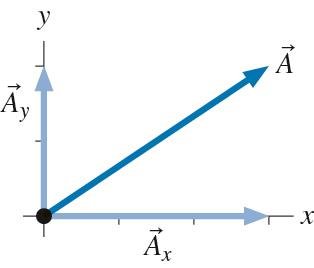
Electric forces and fields are vector quantities, meaning they have both magnitude and direction. Understanding vector components is essential for solving problems involving electric forces and fields.
Vector Representation: Any vector \( \vec{A} \) can be resolved into its x- and y-components: \( \vec{A} = \vec{A}_x + \vec{A}_y \).
Application: Electric force and field calculations often require breaking vectors into components.
Example: The tension in a rope at an angle can be resolved into x and y components using trigonometric functions.
Charges and Forces
Electric phenomena are explained in terms of charges and the forces they exert. When objects are rubbed together, they can acquire electric charge, leading to observable effects such as sparks or attraction/repulsion.
Charge: A fundamental property of matter, either positive or negative.
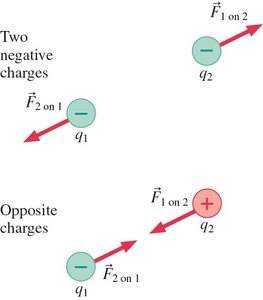
Force: Like charges repel, opposite charges attract.
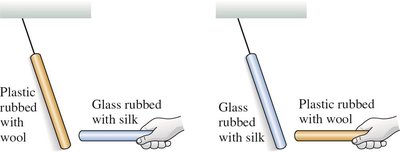
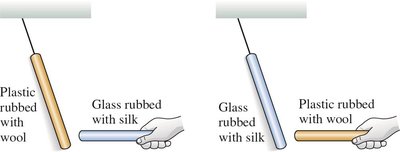
Example: Rubbing a plastic rod with wool and a glass rod with silk demonstrates attraction and repulsion between charged objects.
Visualizing Charge
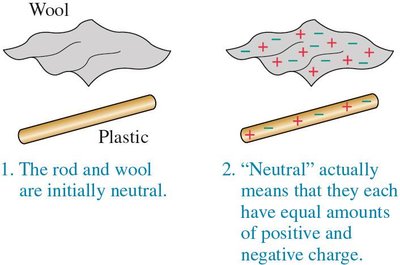
Materials initially neutral contain equal amounts of positive and negative charge. The law of conservation of charge states that charge is neither created nor destroyed, only transferred.
Neutrality: Neutral objects have balanced positive and negative charges.
Conservation: Any transfer of charge must preserve the net charge.
Insulators and Conductors
Materials are classified based on their ability to allow charge movement. Conductors permit easy movement of charge, while insulators do not.
Conductors: Metals; charge distributes quickly over the surface.
Insulators: Glass, plastics; charge remains immobile.
Electrostatic Equilibrium: Condition where charges are at rest on a conductor.
Polarization
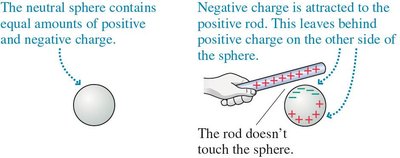
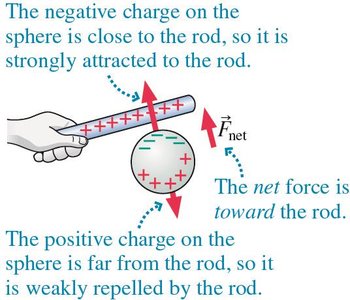
Polarization occurs when a charged object induces a separation of charges in a nearby neutral object, resulting in a net attractive force.
Charge Polarization: Slight separation of positive and negative charges in a neutral object.
Net Force: The closer negative charges are more strongly attracted, leading to a net force toward the charged object.
Atomic Structure and Charge
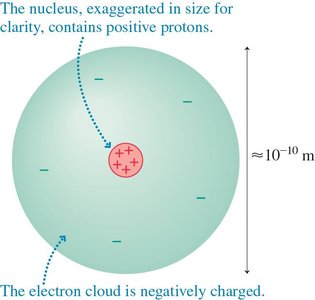
Atoms consist of a positively charged nucleus (protons and neutrons) surrounded by negatively charged electrons. Charge is an inherent property of these particles.
Proton: Mass = \(1.67 \times 10^{-27}\) kg, Charge = \(+1.60 \times 10^{-19}\) C
Electron: Mass = \(9.11 \times 10^{-31}\) kg, Charge = \(-1.60 \times 10^{-19}\) C
Charge Conservation: Symbol \(q\), SI unit: coulomb (C)
Particle | Mass (kg) | Charge (C) |
|---|---|---|
Proton | 1.67 × 10⁻²⁷ | +1.60 × 10⁻¹⁹ |
Electron | 9.11 × 10⁻³¹ | −1.60 × 10⁻¹⁹ |
Coulomb’s Law
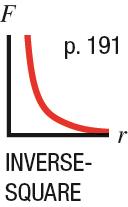
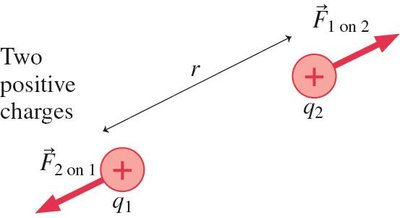
Coulomb’s law describes the force between two point charges. The force is proportional to the product of the charges and inversely proportional to the square of the distance between them.
Formula:
Electrostatic Constant: (rounded to for most calculations)
Direction: Along the line joining the charges; repulsive for like charges, attractive for opposite charges.
Point Charges: Law applies to objects much smaller than their separation.
Superposition of Electric Forces
The net electric force on a charge is the vector sum of the forces exerted by all other charges.
Superposition Principle:
Each force: Calculated using Coulomb’s law.
Electric Field Concept
The electric field is a region of space where a charge experiences a force. It is defined as the force per unit charge.
Definition:
Field of a Point Charge: , directed away from positive and toward negative charges.
Electric Field of Multiple Charges
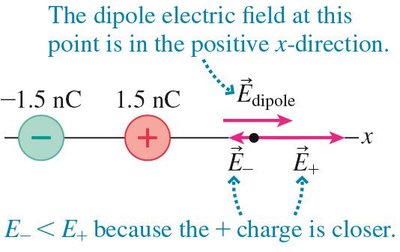
The electric field at a point due to several charges is the vector sum of the fields from each charge.
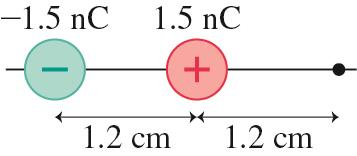
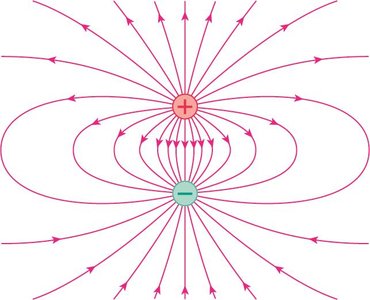
Dipole: A pair of equal and opposite charges separated by a distance creates a characteristic field pattern.
Example: The field near a dipole is calculated by summing the fields from each charge.
Electric Field Lines
Electric field lines visually represent the direction and strength of the field. Lines start on positive charges and end on negative charges.
Field Line Properties: Tangent to field vectors; closer lines indicate stronger fields.
Example: Field lines for a dipole show the pattern of attraction and repulsion.
Electric Fields in Biological Systems
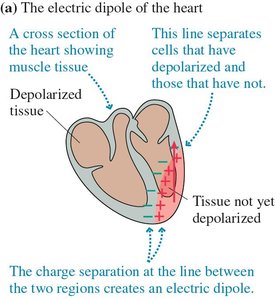
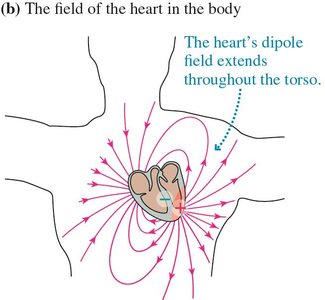
The heart generates an electric field due to the polarization and depolarization of cells. This field can be measured and used for medical diagnostics.
Cell Membrane: Acts as an insulator, enclosing conducting fluid.
Heart Dipole: The heart acts as a large electric dipole, changing orientation and strength during each beat.
Electrocardiogram: Measures the heart’s electric field.
Conductors and Electric Fields
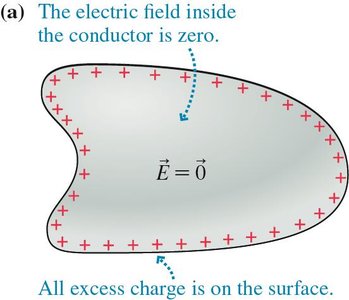
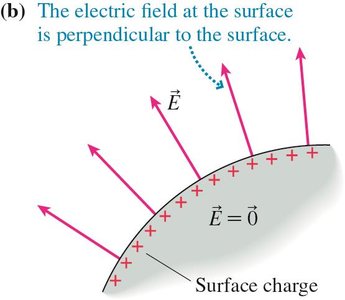
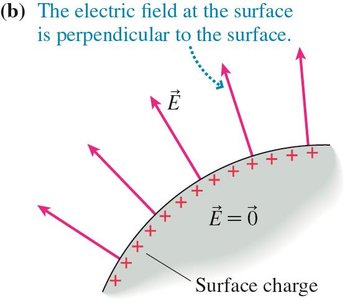
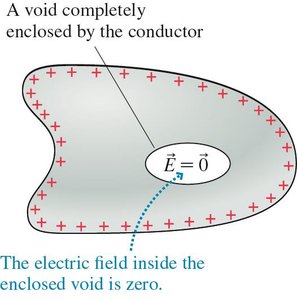
In conductors at electrostatic equilibrium, the electric field inside is zero, and any excess charge resides on the surface. The field at the surface is perpendicular to the surface.
Screening: Conducting enclosures can exclude electric fields from a region (Faraday cage).
Surface Charge: Excess charge moves to the surface due to repulsive forces.
Forces and Torques in Electric Fields
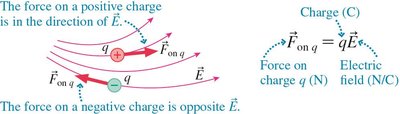
The force on a charge in a known electric field is given by \( \vec{F} = q \vec{E} \). An electric dipole in a uniform field experiences a torque that tends to align it with the field.
Force:
Torque on Dipole: Causes rotation; equilibrium is when dipole moment aligns with field.
Summary Table: Key Concepts
Concept | Definition/Formula | Example/Application |
|---|---|---|
Charge | q (Coulomb) | Proton: +1.60 × 10⁻¹⁹ C |
Coulomb’s Law | Force between two point charges | |
Electric Field | Field around a point charge | |
Superposition | Sum of individual fields/forces | Multiple charges |
Conductors | Field inside = 0 | Faraday cage |
Dipole | Torque in field | Heart’s electric field |
