 Back
BackChapter 23: Electric Potential – Study Notes
Study Guide - Smart Notes
 Tailored notes based on your materials, expanded with key definitions, examples, and context.
Electric Potential and Electric Potential Energy
Introduction to Electric Potential
Electric potential is a fundamental concept in electrostatics, describing the potential energy per unit charge at a point in an electric field. It is a scalar quantity that helps in understanding the energy changes experienced by charges in electric fields.
Electric Potential Energy (U): The energy a charged object possesses due to its position in an external electric field.
Electric Potential (V): The potential energy per unit charge, characteristic of the field itself, independent of any test charge.
Unit: Volt (V), where 1 V = 1 J/C.
Relationship:
Work and Electric Potential
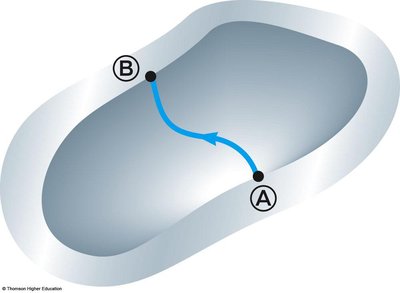
When a charge moves in an electric field, work is done by or against the field, resulting in a change in electric potential energy. The electric field is a conservative force, so the work done is path-independent.
Work Done by the Field:
Potential Difference:
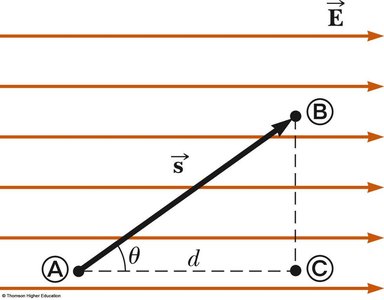
For a uniform field: (where is the displacement parallel to )
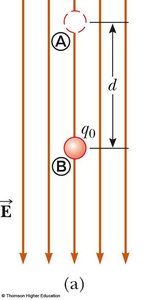
Energy and the Direction of Electric Field
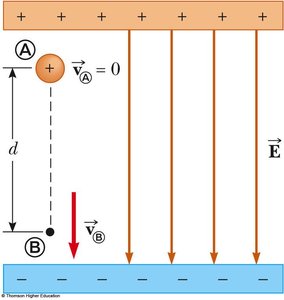
The direction of the electric field determines how the potential energy of a charge changes as it moves. For a positive charge, moving in the direction of the field decreases potential energy; for a negative charge, it increases potential energy.
Conservation of Energy: The loss in potential energy equals the gain in kinetic energy for a charge moving under the influence of the field alone.
Work-Energy Theorem:
Equipotential Surfaces
Equipotential surfaces are surfaces where the electric potential is constant. No work is required to move a charge along an equipotential surface, and the electric field is always perpendicular to these surfaces.
Equipotential Surface: All points have the same potential.
Relation to Field Lines: Equipotentials are perpendicular to electric field lines.
Electric Potential Due to Point Charges and Distributions
Potential Due to a Point Charge
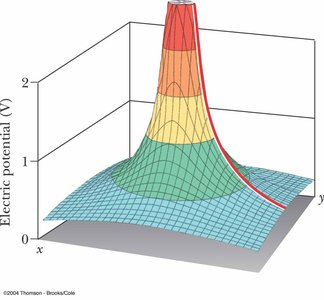
The electric potential at a distance from a point charge is given by:
, where
The reference point is usually taken at infinity ( at ).
Potential Due to Multiple Point Charges
The total electric potential at a point due to several point charges is the algebraic sum of the potentials due to each charge (superposition principle):
Potential is a scalar, so vector addition is not required.
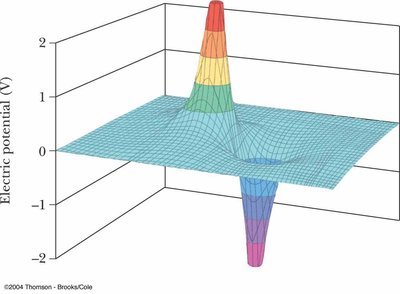
Potential Due to a Dipole
An electric dipole consists of two equal and opposite charges separated by a distance. The potential varies rapidly between the charges and falls off quickly with distance.
Potential for Continuous Charge Distributions
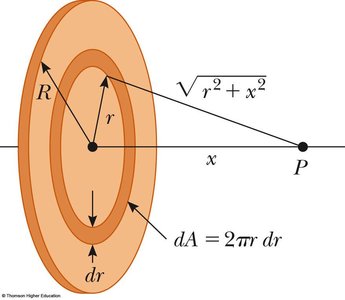
For continuous charge distributions, the potential at a point is found by integrating over the charge distribution:
For a ring, disk, or rod, the integration is performed over the geometry of the object.
Electric Potential Energy of Systems of Charges
Two Point Charges
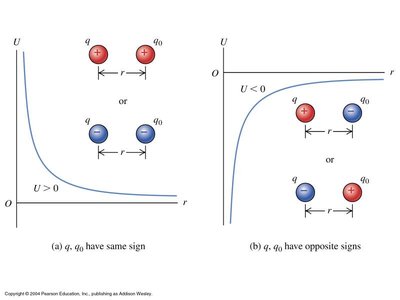
The electric potential energy of a system of two point charges and separated by a distance is:
If the charges have the same sign, (work is required to bring them together); if opposite, (work is required to keep them apart).
Multiple Charges
For more than two charges, the total potential energy is the sum over all unique pairs:
$U = k_e \sum_{i
Electric Field from Electric Potential
Relationship Between E and V
The electric field is related to the spatial rate of change of the electric potential:
In one dimension:
In three dimensions: , ,
Conductors and Equipotential Surfaces
Properties of Conductors in Electrostatic Equilibrium
Conductors exhibit unique properties in electrostatic equilibrium:
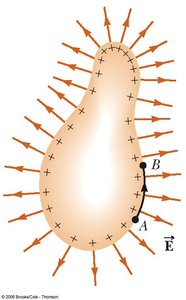
The electric field inside a conductor is zero.
All excess charge resides on the surface.
The electric field just outside the surface is perpendicular to the surface.
The potential is constant everywhere on the surface and inside the conductor.
Cavities in Conductors
A cavity within a conductor, with no internal charges, is a field-free region. The potential is constant throughout the cavity and the conductor.
Applications of Electric Potential
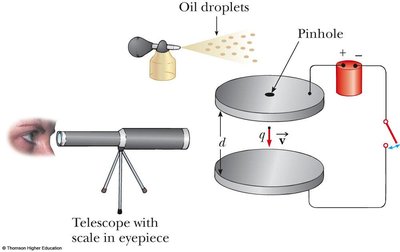
Millikan Oil-Drop Experiment
This classic experiment measured the elementary charge by balancing gravitational and electric forces on tiny charged oil droplets.
Demonstrated the quantization of electric charge:
Measured C
Van de Graaff Generator
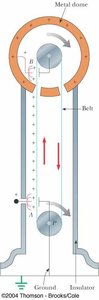
A Van de Graaff generator uses a moving belt to transfer charge to a high-potential electrode, generating large voltages for particle acceleration and other applications.
Electrostatic Precipitator
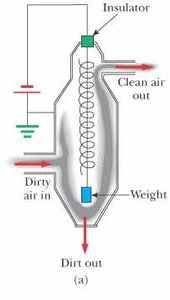
Electrostatic precipitators use electric fields to remove particulate matter from gases, commonly used in industrial air cleaning.
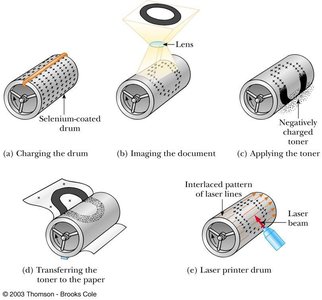
Xerographic Copiers and Laser Printers
These devices use the principles of electric potential and photoconductivity to transfer toner to paper, forming images and text.
Summary Table: Key Equations and Concepts
Concept | Equation | Description |
|---|---|---|
Electric Potential (point charge) | Potential at distance from charge | |
Potential Difference (uniform field) | Between two points separated by | |
Potential Energy (two charges) | Energy of two point charges | |
Work and Potential | Work to move from to | |
Electric Field from Potential | Field as gradient of potential | |
Electron Volt | Energy gained by through |
