 Back
BackChapter 23: Electric Potential – Study Notes
Study Guide - Smart Notes
 Tailored notes based on your materials, expanded with key definitions, examples, and context.
Electric Potential
Introduction to Electric Potential
Electric potential is a fundamental concept in electromagnetism, describing the potential energy per unit charge at a point in an electric field. It is crucial for understanding how charges interact and how energy is transferred in electrical systems.
Electric potential energy is the energy a charge possesses due to its position in an electric field.
The electric potential (V) at a point is the electric potential energy per unit charge at that point.
Electric potential is a scalar quantity measured in volts (V), where 1 V = 1 J/C.

Electric Potential Energy
Work and Potential Energy in Electric Fields
For conservative forces, such as the electrostatic force, the work done is path-independent. The change in electric potential energy (U) is the negative of the work done by the electric field (We) as the system changes configuration:
Reference Point: Electric potential energy is defined to be zero when all charges are infinitely far apart.
Significance of Work: If the electric field does positive work, the potential energy decreases (U < 0); if it does negative work, the potential energy increases (U > 0).
The change in electric potential energy is given by:
Constant Electric Field
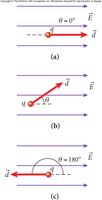
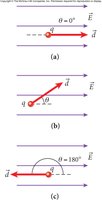
When a charge moves in a constant electric field, the work done by the field is:
where is the charge, is the electric field, is the displacement, and is the angle between the field and displacement.
Special Cases for Constant Electric Field
If the displacement is in the same direction as the electric field, a positive charge loses potential energy.
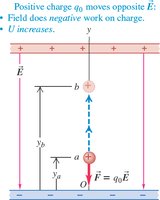
If the displacement is opposite to the electric field, a positive charge gains potential energy.
Analogy with Gravity
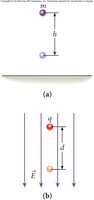
The behavior of electric potential energy is analogous to gravitational potential energy. For a mass m in a gravitational field g, the change in potential energy is . Similarly, for a charge in an electric field, the change in potential energy depends on the direction of movement relative to the field.
Positive and Negative Charges in Uniform Fields
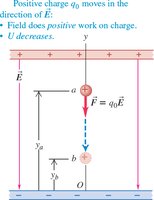
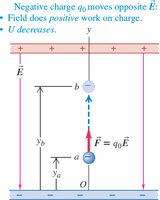
For a positive charge moving in the direction of the field, the field does positive work and potential energy decreases.
For a positive charge moving opposite the field, the field does negative work and potential energy increases.
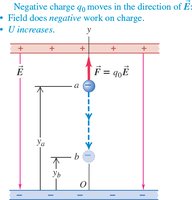
For a negative charge moving in the direction of the field, the field does negative work and potential energy increases.
For a negative charge moving opposite the field, the field does positive work and potential energy decreases.
Path Independence in Uniform Fields
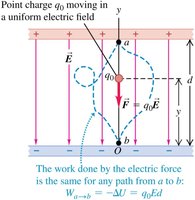
In a uniform electric field, the work done by the field on a charge is independent of the path taken between two points.
Electric Dipole in a Constant Electric Field
Potential Energy of a Dipole
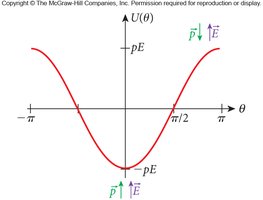
An electric dipole consists of two equal and opposite charges separated by a distance. In a constant electric field, the dipole experiences a torque and can store potential energy depending on its orientation:
Where is the dipole moment, is the electric field, and is the angle between them.
Definition of Electric Potential
Electric Potential (V)
The electric potential at a point is defined as the electric potential energy per unit charge:
Electric potential is a scalar quantity.
Unit: Volt (V), where .
Electric Potential Difference
The potential difference between two points is related to the work done by the electric field:
The Volt
The volt is the SI unit of electric potential, named after Alessandro Volta. The electric field can be expressed in units of V/m.
Applications and Examples
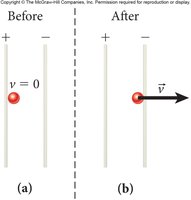
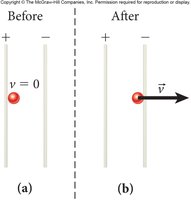
Energy Gain of a Proton
When a proton moves through a potential difference, the change in its kinetic energy equals the change in electric potential energy:
Equipotential Surfaces and Lines
Equipotential Surfaces
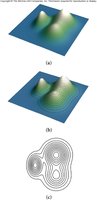
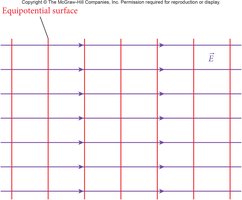
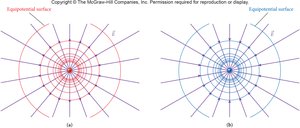
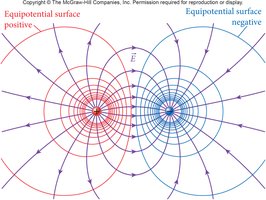
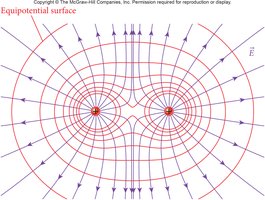
Equipotential surfaces are surfaces where the electric potential is constant. No work is required to move a charge along an equipotential surface. The electric field is always perpendicular to these surfaces.
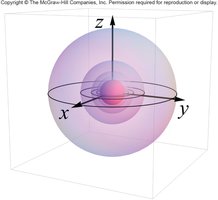
Equipotential Surfaces for Different Charge Distributions
For a constant electric field, equipotential surfaces are parallel planes.
For a point charge, equipotential surfaces are concentric spheres.
For two opposite charges, equipotential lines are more complex but always perpendicular to field lines.
Calculating Electric Potential
From Electric Field
The electric potential difference between two points is the negative integral of the electric field along the path:
For a Point Charge
The electric potential due to a point charge is:

For Multiple Point Charges
The electric potential at a point due to a collection of point charges is the algebraic sum of the potentials due to each charge:

Continuous Charge Distributions
For continuous charge distributions, the potential is found by integrating over the charge distribution:
Electric Potential and Electric Field
Relationship Between E and V
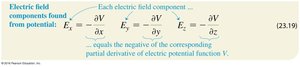
The electric field is the negative gradient of the electric potential:
In Cartesian coordinates: , ,
Electric Potential Energy for Systems of Charges
Two Point Charges
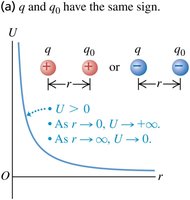
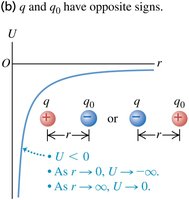
The electric potential energy of two point charges separated by a distance r is:
If charges have the same sign, U is positive (repulsive interaction).
If charges have opposite signs, U is negative (attractive interaction).
Many Charges
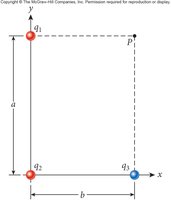
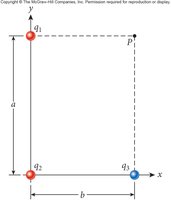
For a system of n charges, the total electric potential energy is the sum over all pairs:
$U = \frac{1}{4\pi\varepsilon_0} \sum_{i
Superposition Principle
The total electric potential at a point due to multiple charges is the algebraic sum of the potentials due to each charge. This principle greatly simplifies calculations compared to vector addition for electric fields.
Special Units and Applications
Electron Volt (eV)
The electron volt is a unit of energy commonly used in atomic and nuclear physics. One electron volt is the energy gained by an electron moving through a potential difference of 1 V:
Applications: Cancer Radiotherapy
High-energy electrons (in the MeV range) are used in radiotherapy to treat superficial tumors, transferring energy to cancerous tissue through collisions.

Conductors and Equipotentials
Charged Conductors
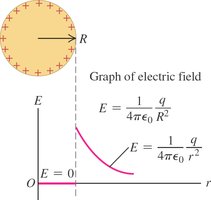
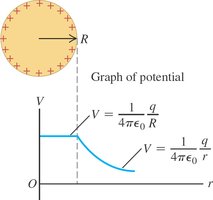
The electric field inside a conductor is zero.
The potential is constant throughout the conductor and equal to its value at the surface.
Dielectric Breakdown and Corona Discharge
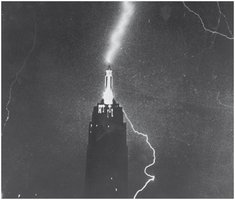
When the electric field at the surface of a conductor exceeds the dielectric strength of air, ionization occurs, leading to corona discharge. The maximum potential is for a sphere of radius R.
Summary Table: Key Equations
Quantity | Equation | Description |
|---|---|---|
Electric Potential (point charge) | Potential at distance r from charge q | |
Electric Potential (multiple charges) | Sum over all charges | |
Electric Field from Potential | Field is negative gradient of potential | |
Potential Energy (two charges) | Energy of two charges separated by r | |
Potential Energy (system) | $U = \frac{1}{4\pi\varepsilon_0} \sum_{i | Sum over all pairs |
Concept Checks and Problem-Solving
Work done by the electric field is path-independent for conservative fields.
Equipotential lines are always perpendicular to electric field lines.
The electric field points in the direction of decreasing potential.
Potential energy is positive for like charges and negative for opposite charges.
Example: What is the electric potential 45.5 cm away from a point charge of 12.5 pC?
Use with C and m.
Additional info: These notes cover the main concepts, equations, and applications of electric potential as presented in a standard university physics curriculum, with illustrative images and tables for clarity.
