 Back
BackChapter 23: The Electric Field – Structured Study Notes
Study Guide - Smart Notes
 Tailored notes based on your materials, expanded with key definitions, examples, and context.
Chapter 23: The Electric Field
23.1 Electric Field Models
The concept of the electric field is fundamental in physics, describing the region around charged objects where other charges experience a force. Electric fields are responsible for phenomena such as electric currents in circuits and biological systems, and the alignment of molecules in LCDs. The chapter goal is to learn how to calculate and use the electric field.
Definition: The electric field \( \vec{E} \) at a point is the force per unit charge experienced by a small test charge placed at that point.
Permittivity constant: \( \varepsilon_0 = 8.85 \times 10^{-12} \ \text{C}^2/\text{N} \cdot \text{m}^2 \)
Four widely used models:
Point charge
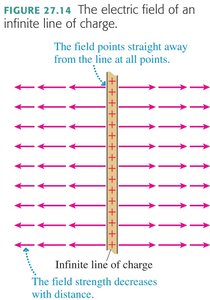
Infinitely long charged wire
Infinitely wide charged plane
Charged sphere
23.2 The Electric Field of Point Charges
The electric field produced by a point charge is a classic model in electrostatics. The field is radially outward for positive charges and radially inward for negative charges.
Formula: The electric field due to a point charge \( q \) at distance \( r \) is: where \( K = \frac{1}{4\pi\varepsilon_0} \).
Superposition Principle: The net electric field at a point due to multiple charges is the vector sum of the fields from each charge:

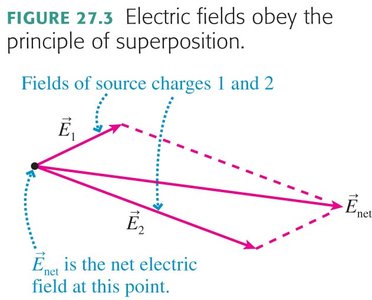
Component Form:
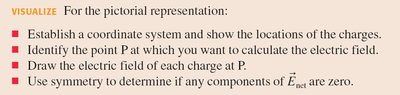
Problem-Solving Strategy:
Model charged objects as point charges.
Establish a coordinate system and show charge locations.
Identify the point of interest.
Draw the electric field vectors and use symmetry.
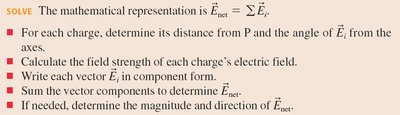
Calculate field strengths and sum components.

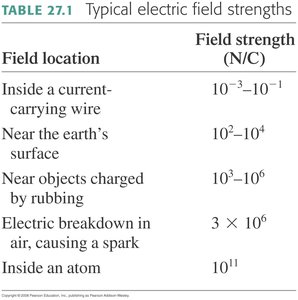
Typical Field Strengths:
Field location
Field strength (N/C)
Inside a current-carrying wire
\( 10^{-3} - 10^{-1} \)
Near the earth's surface
\( 10^2 - 10^4 \)
Near objects charged by rubbing
\( 10^3 - 10^6 \)
Electric breakdown in air
\( 3 \times 10^6 \)
Inside an atom
\( 10^{11} \)
Electric Field Lines:
Lines point in the direction of the electric field vector.
Lines begin on positive charges and end on negative charges.
The number of lines is proportional to the magnitude of the charge.
No two field lines cross.
Field strength is indicated by line density.
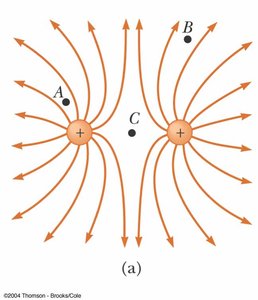
Example: Calculating the electric field at a point due to multiple charges, both in component form and magnitude/direction.


23.3 The Electric Field of a Continuous Charge Distribution
When charges are distributed over a line, surface, or volume, the electric field is calculated by integrating over the distribution. This approach is used when the distance between individual charges is small compared to the distance to the point of interest.
Charge Densities:
Volume charge density: \( \rho = \frac{Q}{V} \)
Surface charge density: \( \sigma = \eta = \frac{Q}{A} \)
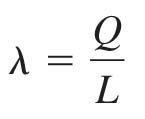
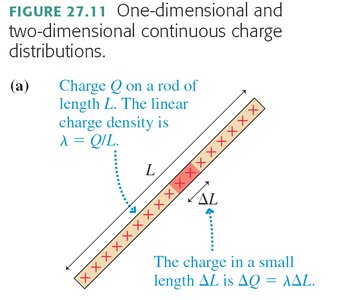
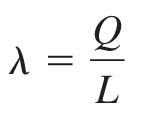
Line charge density: \( \lambda = \frac{Q}{L} $
 $
$
Field Calculation:
For continuous distributions:
For non-uniform distributions: , ,
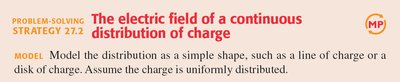
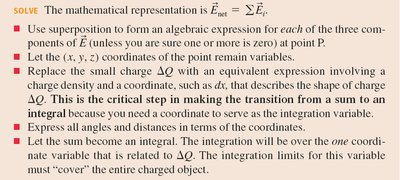
Problem-Solving Strategy:
Model the distribution as a simple shape.
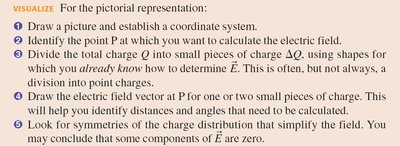
Divide the total charge into small pieces.
Draw the electric field vectors for each piece.
Use symmetry to simplify calculations.
Example: Linear charge density and calculation for a rod.

23.4 The Electric Fields of Rings, Disks, Planes, and Spheres
Special geometries allow for simplified calculations of electric fields. These include rings, disks, planes, and spheres, each with characteristic field equations.
Ring: Charge distributed along a semicircular rod.
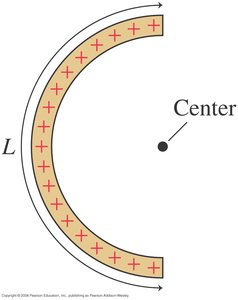
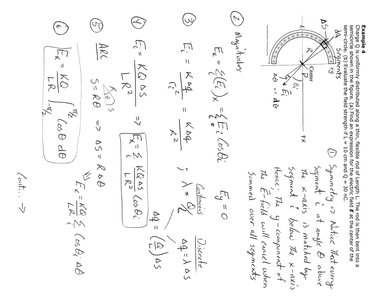
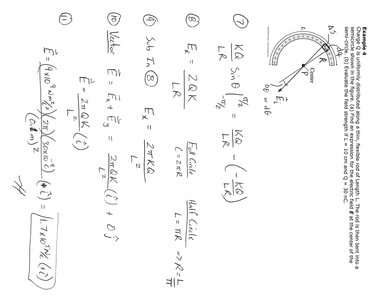
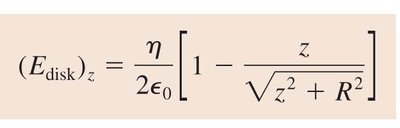
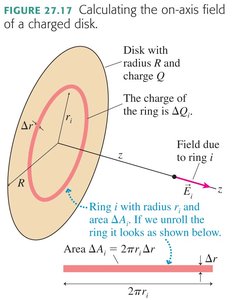
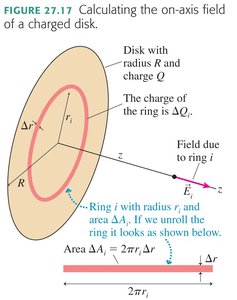
Disk: The on-axis electric field of a charged disk:
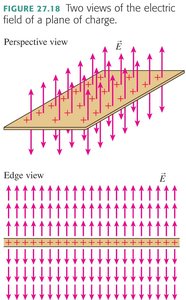
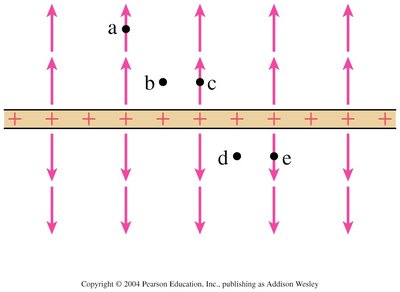
Plane: The electric field of an infinite plane:
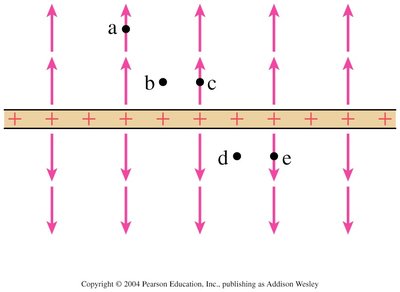
Sphere: The field outside a uniformly charged sphere is identical to that of a point charge at its center.
23.5 The Parallel-Plate Capacitor
A parallel-plate capacitor consists of two electrodes with equal and opposite charges, separated by a distance. It produces a uniform electric field between the plates, which is essential in many electronic circuits.
Diagram:
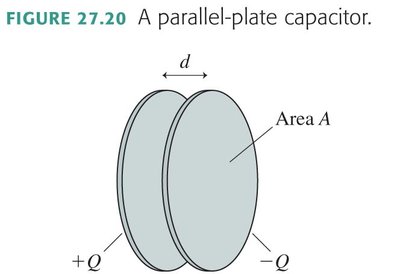
Field inside a capacitor:
Uniform Field: The field is uniform between the plates and zero outside.
Example: Calculating the diameter of disks in a parallel-plate capacitor given charge and field strength.
23.6 Motion of a Charged Particle in an Electric Field
Charged particles experience a force in an electric field, leading to acceleration. The direction and magnitude of acceleration depend on the charge and mass of the particle.
Force on a charge:
Acceleration:
Uniform field: Acceleration is constant; positive charges accelerate in the direction of the field, negative charges in the opposite direction.
Non-uniform field: Acceleration varies; can lead to circular motion (e.g., classical hydrogen atom model).
23.7 Motion of a Dipole in an Electric Field
An electric dipole consists of two equal and opposite charges separated by a small distance. The dipole moment determines the field strength and the response to external fields.
Dipole moment: SI units: C·m
Torque on a dipole: Maximum torque: When \( \vec{p} \perp \vec{E} \); zero when \( \vec{p} \parallel \vec{E} \).
Dipole in a uniform field: Experiences no net force but a torque that aligns it with the field.
Additional Example: Sphere of Charge
The electric field outside a uniformly charged sphere or spherical shell is equivalent to that of a point charge located at the center of the sphere.
Formula: (for \( r \) outside the sphere)
