 Back
BackChapter 23: The Electric Field – Study Notes
Study Guide - Smart Notes
 Tailored notes based on your materials, expanded with key definitions, examples, and context.
The Electric Field
Definition and Properties
The electric field is a fundamental concept in electromagnetism, describing the region of space around charged objects where other charges experience a force. The electric field at a point is defined as the force per unit charge exerted on a test charge placed at that point.
Mathematical Definition: , where is the electric force on a test charge .
SI Units: Newtons per Coulomb (N/C).
Typical Field Strengths: Vary from N/C inside a wire to N/C inside an atom.
Field Location | Field Strength (N/C) |
|---|---|
Inside a current-carrying wire | – |
Near Earth's surface | – |
Near objects charged by rubbing | – |
Electric breakdown in air | |
Inside an atom |
Electric Field of a Point Charge
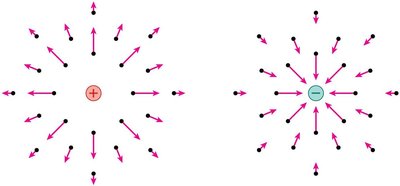
The electric field produced by a single point charge is radially symmetric and decreases with the square of the distance from the charge.
Formula:
Direction: Away from positive charges, toward negative charges.
Example: Lightning is a natural example of strong electric fields.

Electric Field of Multiple Point Charges
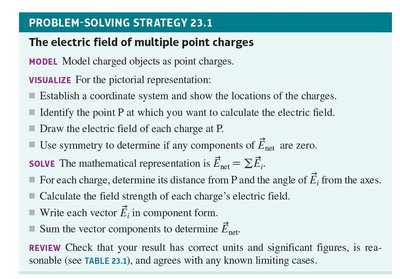
When several point charges are present, the net electric field at any point is the vector sum of the fields produced by each charge. This is known as the principle of superposition.
Formula:
Steps for Calculation:
Establish a coordinate system and locate the charges.
Identify the point of interest.
Draw the electric field vectors for each charge at that point.
Use symmetry to simplify calculations.
Calculate the magnitude and direction of each field.
Sum the vector components to find .
Electric Dipoles
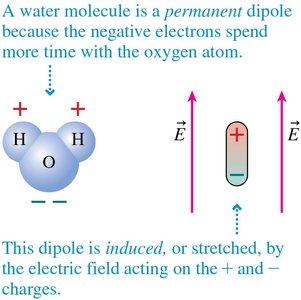
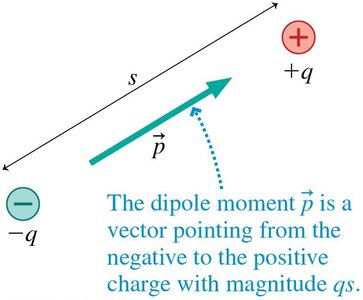
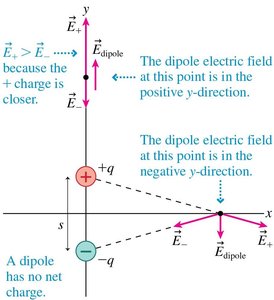
An electric dipole consists of two equal and opposite charges separated by a small distance. Dipoles are important in molecular physics and electromagnetism.
Dipole Moment: , a vector from the negative to the positive charge.
SI Units: Coulomb-meter (C·m).
Example: Water molecules have a permanent dipole moment.
Electric Field of a Dipole
The electric field produced by a dipole varies depending on the location relative to the dipole axis.
On the axis:
In the bisecting plane:
The field is opposite to the dipole direction and half as strong in the bisecting plane compared to the axis.
Electric Field Lines
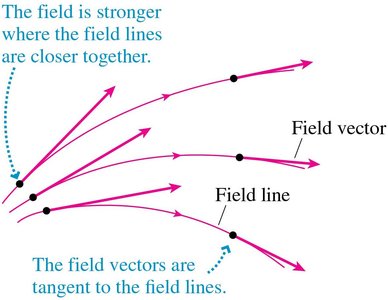
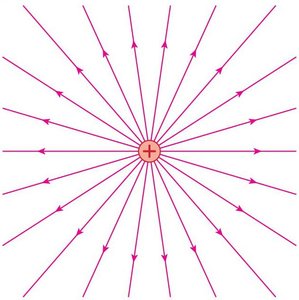
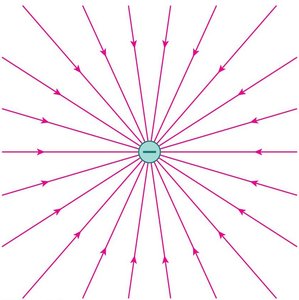
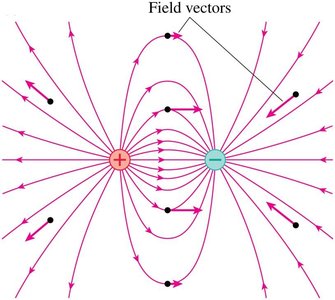
Electric field lines are a visual representation of the electric field. They indicate the direction and strength of the field.
Field lines are tangent to the electric field vectors.
Closer spacing indicates stronger fields.
Field lines start on positive charges and end on negative charges.
Field lines never cross.
The Parallel-Plate Capacitor
Structure and Field
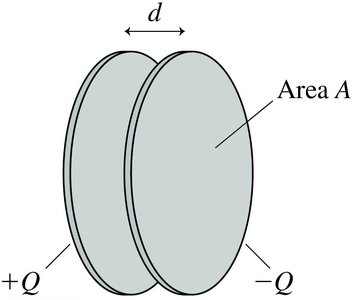
A parallel-plate capacitor consists of two electrodes with equal and opposite charges, separated by a distance . Capacitors are essential components in electric circuits.
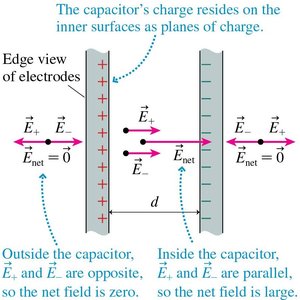
Charge resides on the inner surfaces of the plates.
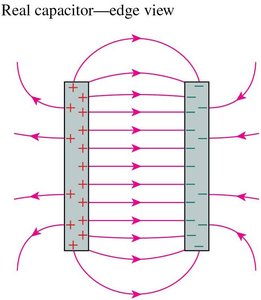
Inside the capacitor, the net field points from the positive to the negative plate.
Outside the capacitor, the net field is zero.
Electric Field of a Capacitor
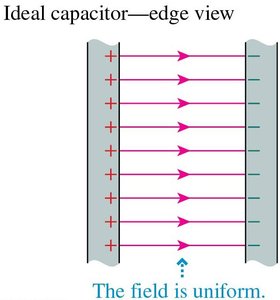
The electric field inside a parallel-plate capacitor is uniform and given by:
Formula: (inside), $0$ (outside)
is the surface area of each electrode.
Field is uniform as long as plate separation is much smaller than plate size.
Ideal vs. Real Capacitors
An ideal capacitor assumes infinite plates and uniform field. Real capacitors have edge effects (fringe fields) that slightly distort the field near the edges.
For most calculations, assume inside the capacitor.
Edge effects are negligible if plate size.
Uniform Electric Fields
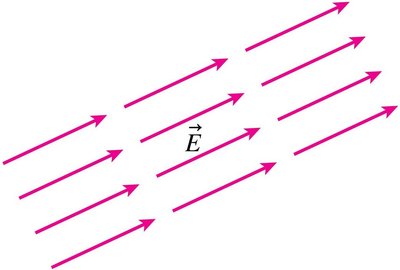
A uniform electric field has the same strength and direction at every point in a region. Parallel-plate capacitors are the easiest way to produce such fields.
Motion of Charged Particles in Electric Fields
Force and Acceleration
A charged particle in an electric field experiences a force and, if unopposed, accelerates.
Force:
Acceleration:
In a uniform field, acceleration is constant.
Applications: Gel Electrophoresis
Gel electrophoresis uses a uniform electric field to separate DNA fragments by size, as the fragments migrate at speeds inversely proportional to their size due to drag forces in the gel.

Trajectory of Charged Particles
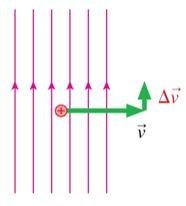
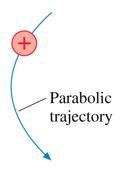
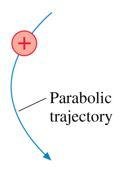
Charged particles in a uniform electric field follow predictable trajectories, often parabolic if the field is perpendicular to the initial velocity.
Example: A proton moving in a vertical electric field will accelerate vertically, altering its velocity.


Summary Table: Key Equations
Situation | Electric Field Equation |
|---|---|
Point charge | |
Multiple charges | |
Dipole (axis) | |
Dipole (bisecting plane) | |
Parallel-plate capacitor | |
Force on charge | |
Acceleration |
Additional info: Academic context and examples were expanded for clarity and completeness. All images included are directly relevant to the adjacent explanations.
