 Back
BackChapter 25: Electric Potential Energy – Structured Study Notes
Study Guide - Smart Notes
 Tailored notes based on your materials, expanded with key definitions, examples, and context.
Electric Potential Energy
Concept and Conservation
Electric potential energy is the energy stored due to the position of charged particles in an electric field. It is a key concept in understanding how energy is transferred and conserved in systems involving electric forces.
Conservation of Mechanical Energy: For particles interacting via conservative forces, the total mechanical energy is conserved.
Work-Energy Principle: The work done by electric forces is related to changes in kinetic and potential energy: .
Formula: for conservative systems.
Charges in an Electric Field
Behavior of Positive and Negative Charges
Charged particles respond differently to electric fields depending on their sign. The direction of force and energy change is determined by the charge's polarity.
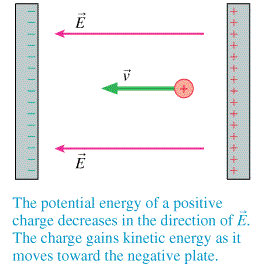
Force Direction: The electric field points in the direction a positive charge would feel force ().
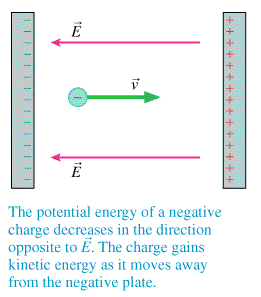
Work Done: Moving a negative charge perpendicular to the field results in zero work; moving against the field results in negative work.
Potential Energy Change: For negative charges, potential energy increases when moved against the field.

Conservation of Energy in a Capacitor
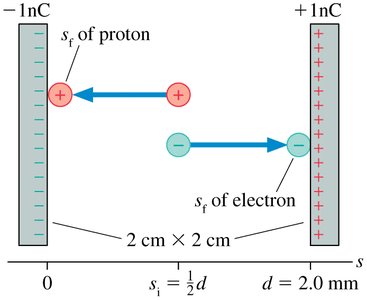
Example: Proton and Electron in a Parallel Plate Capacitor
Charged particles released in a capacitor experience changes in electric potential energy and kinetic energy as they move toward the plates.
Energy Change:
Kinetic Energy:
Application: Both protons and electrons gain kinetic energy as their potential energy decreases, but the direction depends on their charge.

Potential Energy of Point Charges
Interaction Between Two Charges
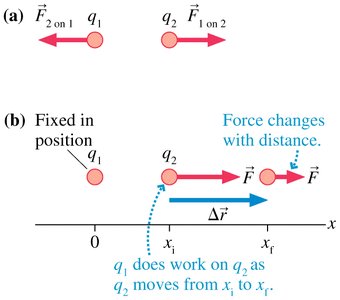
The potential energy between two point charges depends on their separation and the amount of charge.
Formula:
Work Done: The work by one charge on another as it moves from to is .
Energy Change:

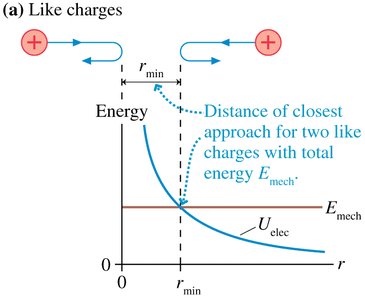
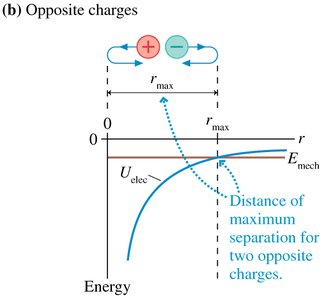
The Potential Energy of Like and Unlike Charge Pairs
Energy Characteristics
The sign and magnitude of potential energy depend on whether the charges are like or unlike.
Like Charges: System energy is positive and decreases with separation.
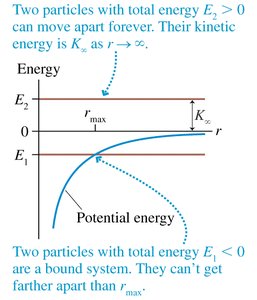
Unlike Charges: System energy is negative and increases (approaches zero) with separation; the system is typically bound.

The Zero of Potential Energy
Reference Point Selection
The zero point of potential energy is arbitrary and chosen for convenience. Only changes in potential energy have physical consequences.
Common Choices: at or at Earth ground.
Physical Meaning: The choice does not affect the physics, as only matters.

Example: Approaching a Charged Sphere
Energy Conservation Application
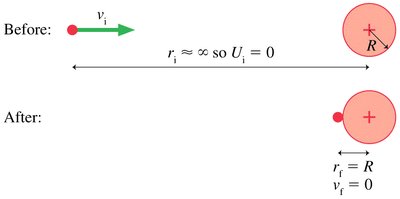
When a charged particle approaches a charged sphere, its initial kinetic energy must be sufficient to overcome the electric potential energy barrier.
Conservation of Energy:
Initial Condition: at
Final Condition: at (surface of sphere)

Example: Escape Velocity
Minimum Speed for Separation
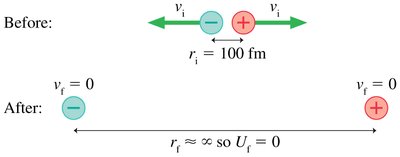
To escape the mutual attraction of two opposite charges, each must have a minimum speed corresponding to the total energy required to reach infinite separation.
Initial Condition: fm, calculated at this separation.
Final Condition: ,
Energy Conservation:

Multiple Point Charges: Potential Energy
Superposition Principle
The total potential energy for a system of multiple point charges is the sum of the potential energies for each unique pair.
Formula: $U_{total} = \sum_{i
Counting Pairs: Avoid double-counting and self-interactions by summing only over .

Work Done to Assemble Charges
Calculation and Significance
Assembling a set of charges requires work, which is stored as electric potential energy. The sign of the work depends on the nature of the charges.
Positive Charges: Work is positive due to repulsion.
Negative Charges: Work is still positive, as likes repel.
Formula: for three charges.

Electric Dipole in a Constant Electric Field
Energy Storage and Torque
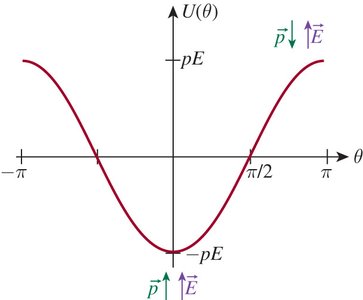
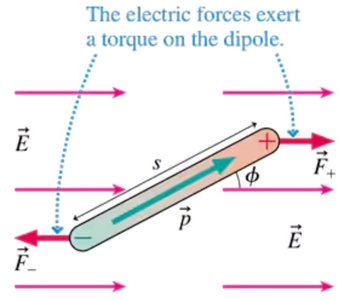
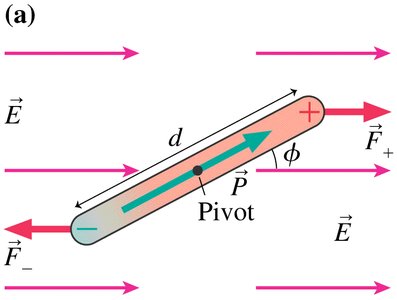
An electric dipole in a constant electric field experiences a torque and can store energy depending on its orientation.
Potential Energy:
Torque:
Work Done:


Example: Rotating a Molecule
Energy Required for Rotation
Rotating a molecule with a permanent dipole moment in an electric field requires energy, calculated from the change in potential energy.
Formula:
Application: Used to determine energy needed to rotate water molecules in a field.

Electric Potential
Definition and Units
Electric potential is a scalar quantity representing the potential energy per unit charge at a point in space. It is measured in volts (V).
Formula:
Units: 1 V = 1 J/C; kV = V; mV = V; V = V.

The Electric Potential V
Relation to Electric Field
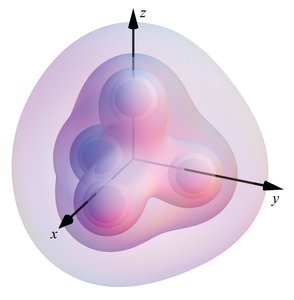
The electric potential is related to the electric field as a normalized potential energy. It is useful because it is a scalar and depends only on the source charges and their geometry.
Formula: ,
Physical Meaning: The potential exists throughout space, regardless of the presence of a test charge.

Why do we need the Electric Potential?
Advantages and Applications
Electric potential simplifies calculations by being a scalar and allows easy determination of potential energy for any charge entering a region.
Scalar Quantity: Easier to work with than vector fields.
Potential Energy: for any charge .

Electric Potential of a Point Charge
Mathematical Relationship
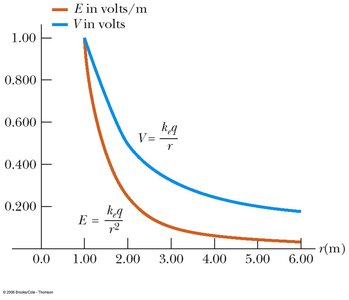
The electric potential due to a point charge decreases with distance and is proportional to .
Formula:
Comparison: Electric field , potential .

Equipotential Surfaces
Definition and Properties
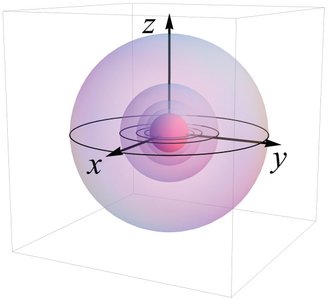
Equipotential surfaces are surfaces where all points have the same electric potential. They are important for understanding electric fields and energy transfer.
No Work Required: Moving a charge along an equipotential surface requires no work.
Field Perpendicularity: Electric field is perpendicular to equipotential surfaces.
For Point Charges: Equipotential surfaces are spheres centered on the charge.

Equipotential Surfaces and Lines
Conductors and Representation
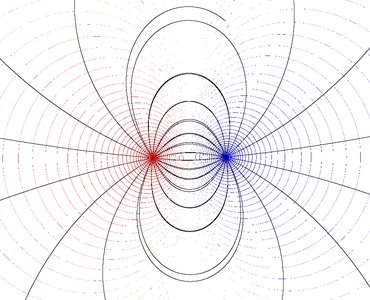
The surface of a conductor is an equipotential surface, and the electric field inside a conductor is zero. Equipotential lines are used for visualization in two dimensions.
Conductor Surface: Entire volume at same potential.
Equipotential Lines: Used to represent surfaces in 2D diagrams.

Rules for Equipotentials
Key Properties
Equipotential surfaces follow specific rules that help in understanding electric fields and potentials.
No Intersection: Equipotentials never intersect.
Conductor Surface: Always an equipotential.
Field Lines: Cross equipotentials at right angles.
Spacing: Close equipotentials indicate strong fields.
Far Field: Equipotentials become spheres at large distances for net charge systems.

Example: Moving Through a Potential Difference
Energy Transformation
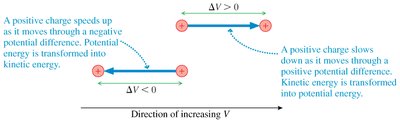
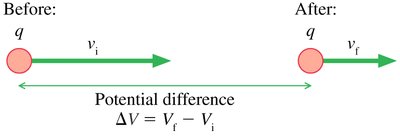
When a charge moves through a potential difference, its kinetic and potential energies are interconverted.
Formula:
Work-Energy:
Application: Used to calculate final speed of a charge after moving through a potential difference.

Quiz Example: Electric Potential Comparison
Potential at a Point
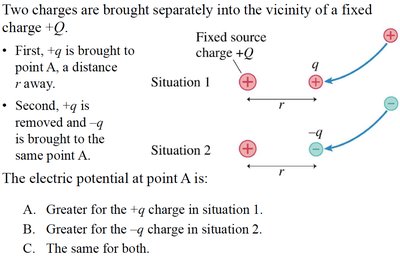
Bringing charges to a fixed point near a source charge demonstrates the independence of electric potential from the sign of the test charge.
Key Point: The electric potential at a point depends only on the source charge and distance, not on the test charge.

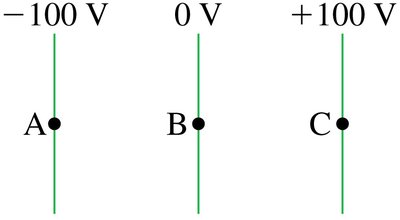
Quiz Example: Potential at Different Points
Potential Difference Visualization
Potential at points A, B, and C is visualized to understand how charges move in response to potential differences.
Key Point: Charges move from high to low potential energy.

Defibrillator Example: Energy and Electric Field
Application of Electric Potential Energy
A portable defibrillator uses stored electric potential energy to deliver a charge across the heart, demonstrating practical use of electric potential difference.
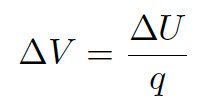
Energy Change:
Electric Field Strength: , where is the distance between paddles.
Given: ,




Additional info: These notes expand on brief points and examples to provide a comprehensive, exam-ready summary of Chapter 25: Electric Potential Energy, including definitions, formulas, applications, and visual aids.
