 Back
BackChapter 25: The Electric Potential – Study Notes
Study Guide - Smart Notes
 Tailored notes based on your materials, expanded with key definitions, examples, and context.
Electric Potential and Electric Potential Energy
Introduction to Electric Potential Energy
Electric potential energy is the energy stored due to the position of charged particles in an electric field. It is analogous to gravitational potential energy, where the interaction energy arises from the electric force between charges.
Potential Energy (U): The interaction energy of a system of charges.
Change in Potential Energy (ΔU): For conservative forces, ΔU is minus the work done by the interaction forces.
Conservation of Energy: If only conservative forces act, the total mechanical energy (K + U) is conserved.
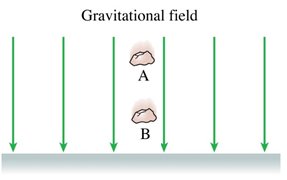
Work and Potential Energy in Electric and Gravitational Fields
Both gravitational and electric fields are conservative, meaning the work done depends only on the initial and final positions, not the path taken. The change in potential energy is given by the product of the property (mass or charge), the field strength, and the displacement.
Gravitational Potential Energy:
Electric Potential Energy (Uniform Field):
Electric Potential (V)
Definition and Properties
The electric potential (V) is a scalar quantity defined at every point in space due to source charges. It determines the potential energy of a charge placed at that point and is measured in volts (V), where 1 V = 1 J/C.
Electric Potential (V):
Potential Energy:
Scalar Field: Unlike the electric field, potential is a scalar and easier to sum for multiple sources.
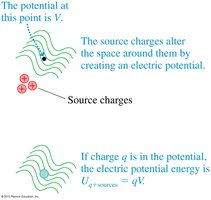
Equipotential Surfaces
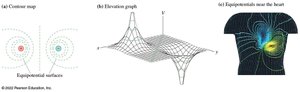
Equipotential surfaces are imaginary surfaces where the electric potential is constant. They help visualize how potential varies in space and are always perpendicular to electric field lines.
Calculating Electric Potential
Potential Due to Point Charges
The electric potential at a distance r from a point charge q is:
The potential decreases as 1/r with distance from the charge.
Potential Due to Multiple Point Charges
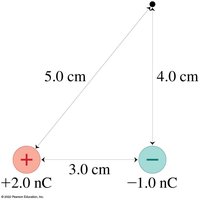
The total electric potential at a point due to several point charges is the algebraic sum of the potentials from each charge:
Superposition principle applies; add as scalars, not vectors.
Potential of a Charged Sphere
Outside a uniformly charged sphere (radius R, charge Q), the potential is identical to that of a point charge at the center:
for
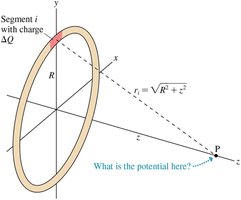
Potential of a Ring of Charge
For a thin ring of radius R and total charge Q, the potential at a point on the axis a distance z from the center is:
Electric Potential Energy of Point Charges
Two Point Charges
The potential energy of two point charges q1 and q2 separated by distance r is:
Positive for like charges (repulsion), negative for unlike charges (attraction).
Multiple Point Charges
The total potential energy for a system of point charges is the sum over all unique pairs:
$U = \sum_{i
Energy Conservation and Motion in Electric Fields
Charged Particle Motion
When a charged particle moves through a potential difference, its kinetic and potential energies change, but the total mechanical energy is conserved:
For a charge q moving through a potential difference ΔV:
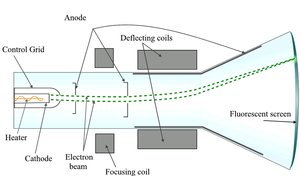
Example: Cathode Ray Tube
Electrons are accelerated through a large potential difference, gaining kinetic energy:
Final speed can be found using
Electric Potential in a Parallel-Plate Capacitor
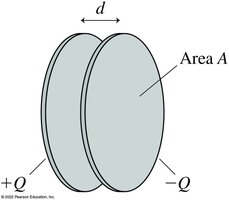
Potential Difference and Field
Inside a parallel-plate capacitor, the electric field is uniform and the potential difference between plates is:
Electric field units: V/m (equivalent to N/C)
Potential at a Point Between Plates
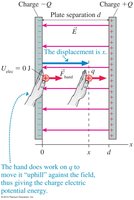
If the negative plate is defined as V = 0, the potential at a distance s from the negative plate is:
Equipotential Surfaces and the Human Heart
Equipotential Maps and Applications
Equipotential lines and surfaces are useful for visualizing electric potential in space. In biological systems, such as the human heart, equipotential lines can be measured on the skin to monitor electrical activity.
Summary Table: Key Equations and Concepts
Concept | Equation | Description |
|---|---|---|
Electric Potential (point charge) | Potential at distance r from charge q | |
Potential Energy (two charges) | Energy of two charges separated by r | |
Potential Difference (capacitor) | Potential difference across plates | |
Energy Conservation | Total mechanical energy is conserved | |
Electron-Volt | Energy gained by electron through 1 V |
Additional info:
Alessandro Volta invented the first electric battery, leading to the unit "volt" for electric potential.
Potential energy and electric potential are related but distinct: potential energy depends on both the charge and the potential, while potential is a property of the field created by source charges.
