 Back
BackChapter 26: Potential and Field – Study Notes
Study Guide - Smart Notes
 Tailored notes based on your materials, expanded with key definitions, examples, and context.
Potential and Field: Fundamental Concepts
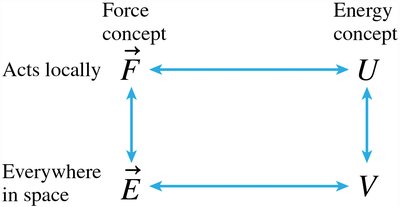
Connecting Force and Energy Concepts
The relationship between force and energy in electrostatics is central to understanding electric fields and potentials. Force acts locally on charges, while energy concepts such as potential and potential energy describe the system's state everywhere in space.
Force Concept: Describes how charges interact locally via forces (\( \vec{F} \)).
Energy Concept: Describes the potential energy (U) and electric potential (V) at every point in space.
Electric Field (\( \vec{E} \)): The field that mediates the force between charges and is related to the spatial variation of the potential.
Electric Potential Due to Point Charges
Finding the Potential of a Point Charge
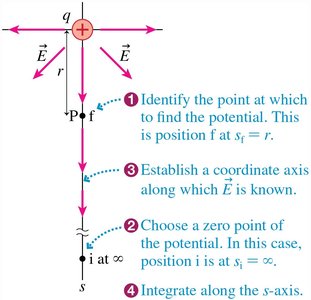
To determine the electric potential at a point due to a point charge, follow a systematic approach:
Step 1: Identify the point where the potential is to be found (position f at sf = r).
Step 2: Choose a zero point for the potential, often at infinity (si = ∞).
Step 3: Establish a coordinate axis along which the electric field \( \vec{E} \) is known.
Step 4: Integrate the electric field along the chosen axis to find the potential difference.
The potential at a distance r from a point charge q is given by:
Work and Electric Potential
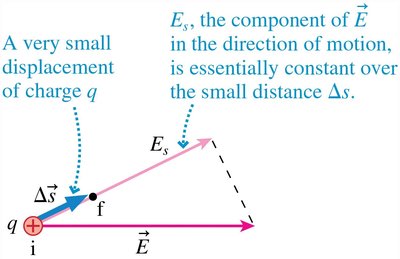
When a charge moves in an electric field, the work done by the field relates to the change in electric potential:
Work Done:
Potential Difference:
Electric Field from Electric Potential
Relationship Between Field and Potential
The electric field is the negative gradient of the electric potential. In one dimension:
In three dimensions:
Example: Potential and Field of a Point Charge
For a point charge, the potential is spherically symmetric, and the electric field points radially:
Interpreting Potential Graphs and Particle Motion
Potential Graphs and Particle Behavior
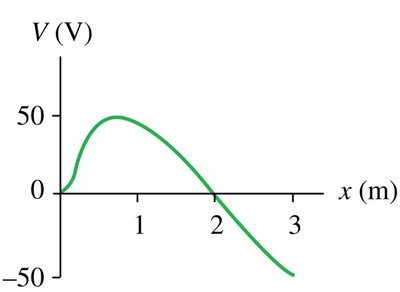
The motion of a charged particle in a potential field can be predicted by analyzing the slope of the potential graph:
Negative Slope: Indicates a positive electric field direction.
Electron Motion: Since electrons are negatively charged, they move opposite to the electric field direction.
Equipotential Surfaces and Electric Field Geometry
Equipotential Contours
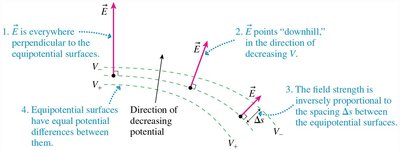
Equipotential surfaces are regions where the electric potential is constant. The electric field has the following properties relative to these surfaces:
Always perpendicular to equipotential surfaces.
Points in the direction of decreasing potential.
Field strength is inversely proportional to the spacing between equipotentials.
Equipotential surfaces have equal potential differences between them.
Kirchhoff’s Loop Law and Path Independence
Kirchhoff’s Loop Law
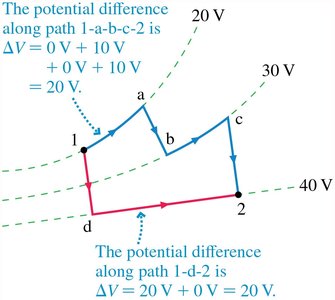
In any closed loop, the sum of all potential differences is zero:
This law reflects the conservative nature of electrostatic fields: the potential difference between two points is independent of the path taken.
Conductors in Electrostatic Equilibrium
Properties of Conductors
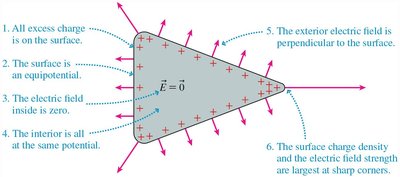
When a conductor is in electrostatic equilibrium:
All excess charge resides on the surface.
The surface is an equipotential.
The electric field inside the conductor is zero.
The electric field just outside the surface is perpendicular to the surface.
The field is strongest at sharp corners.

Equipotentials Near Conductors
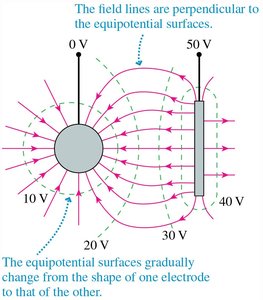
Equipotential surfaces near conductors conform to the shape of the conductor. Field lines are always perpendicular to these surfaces.
Capacitance and Capacitors
Definition and Properties of Capacitance
Capacitance is the ability of a system to store charge per unit potential difference. For a parallel-plate capacitor:
SI Unit: Farad (F), where 1 F = 1 C/V.
Charge-Voltage Relationship:
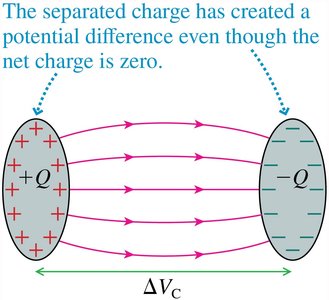
Charging a Capacitor
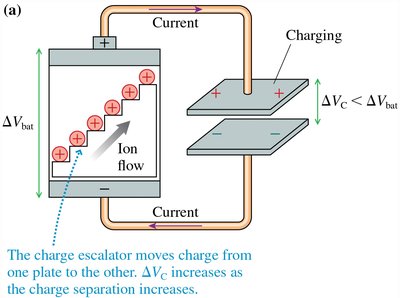
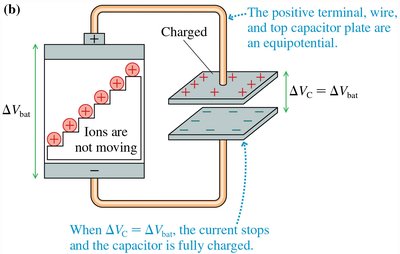
When a capacitor is connected to a battery, charge accumulates on the plates until the potential difference across the capacitor equals the battery voltage.
Combinations of Capacitors
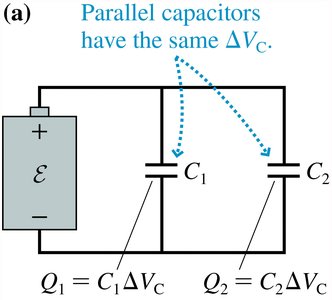
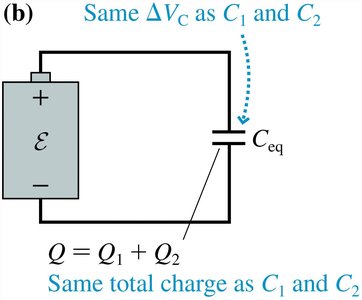
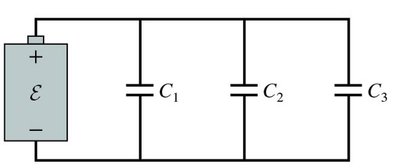
Parallel Capacitors
When capacitors are connected in parallel, the total (equivalent) capacitance is the sum of the individual capacitances:
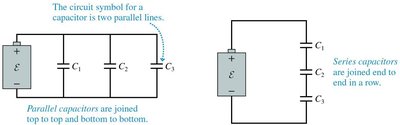
Series Capacitors
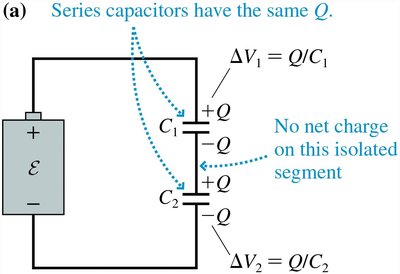
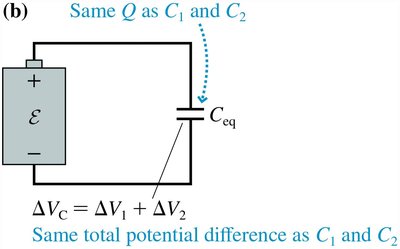
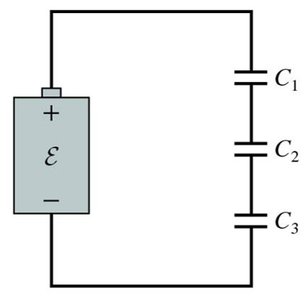
When capacitors are connected in series, the reciprocal of the equivalent capacitance is the sum of the reciprocals of the individual capacitances:
Batteries and Potential Difference
Charge Escalator Model of a Battery
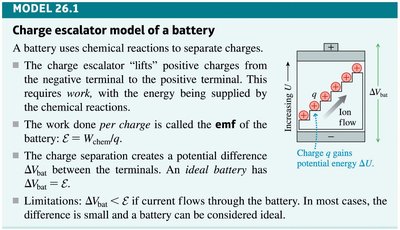
A battery uses chemical reactions to separate charges, creating a potential difference (emf) between its terminals. The work done per charge is the emf:
Batteries in Series
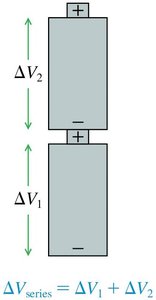
When batteries are connected in series, their voltages add:
Summary Table: Capacitor Combinations
Configuration | Equivalent Capacitance | Voltage Across Each | Charge on Each |
|---|---|---|---|
Parallel | Same for all: | ||
Series | Same for all: |
Additional info: These notes cover all major concepts from Chapter 26: Potential and Field, including the mathematical relationships, physical interpretations, and practical applications relevant to college-level physics.
