 Back
BackChapter 26: Properties of Light – Study Notes
Study Guide - Smart Notes
 Tailored notes based on your materials, expanded with key definitions, examples, and context.
Properties of Light
Electromagnetic Waves
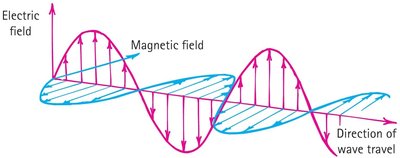
Light is a form of energy that we can see, originating from the accelerated motion of electric charges. It is an electromagnetic phenomenon, meaning it consists of oscillating electric and magnetic fields that propagate through space.
Electromagnetic waves are made up of vibrating electric and magnetic fields at right angles to each other and to the direction of wave travel.
These waves do not require a medium and can travel through a vacuum at the speed of light, m/s.
Light is produced when charges (such as electrons) accelerate, creating oscillations in the electromagnetic field.
Key Equation:
The Electromagnetic Spectrum
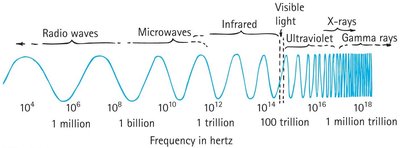
The electromagnetic spectrum is the classification of electromagnetic waves according to their frequency or wavelength. It includes a wide range of waves, from radio waves to gamma rays.
Visible light is only a small part of the spectrum, ranging from red (lowest frequency) to violet (highest frequency).
Beyond visible light, higher frequencies include ultraviolet, X-rays, and gamma rays, while lower frequencies include infrared, microwaves, and radio waves.
There are no sharp boundaries between regions of the spectrum.
Key Equation:
= speed of the wave
= frequency
= wavelength
Transparent Materials
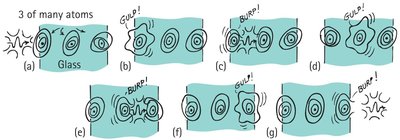
Transparent materials, such as glass and water, allow light to pass through them by a process of absorption and re-emission at the atomic level.
When light enters a transparent material, its energy is absorbed by electrons, which then re-emit the energy as new photons or transfer it as heat.
This process causes a time delay, resulting in a lower average speed of light in the material compared to a vacuum.
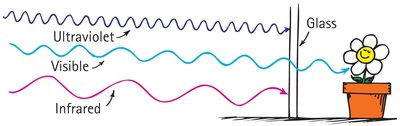
Glass is transparent to visible light but not to ultraviolet or infrared light, which are absorbed and converted to heat.
Average Speed of Light in Different Materials:
Vacuum: m/s
Air: slightly less than
Water:
Glass: (varies with type)
Diamond:
Opaque Materials
Opaque materials do not transmit light; instead, they absorb it and convert it into internal energy (heat).
Examples: books, desks, metals, and people.
In metals, free electrons vibrate and re-emit light as reflection, making metals shiny.
On dry surfaces, light bounces directly to the eye; on wet surfaces, light is absorbed and appears darker.
Shadows and Eclipses
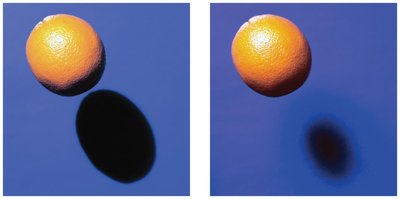
Shadows are regions where light is blocked by an object. The nature of the shadow depends on the size and distance of the light source.
A ray is a thin beam of light.
A shadow consists of two parts:
Umbra: total shadow, where all light is blocked.
Penumbra: partial shadow, where some light is blocked and some passes through.
Sharp shadows are produced by small or distant light sources; blurry shadows by large or nearby sources.

During eclipses:
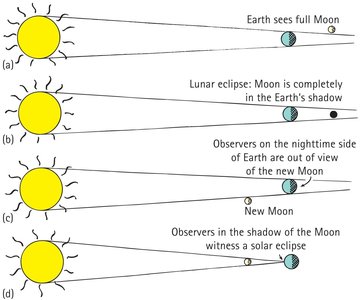
Solar eclipse: The Moon casts a shadow on Earth, creating regions of umbra (total eclipse) and penumbra (partial eclipse).
Lunar eclipse: The Moon passes into Earth's shadow.
Seeing Light – The Eye
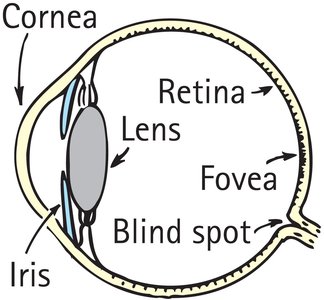
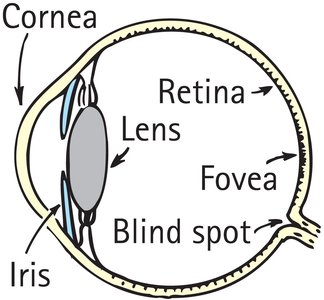
The human eye is a complex optical instrument that detects light and forms images.
Light enters through the cornea, which bends the light.
It passes through the pupil (opening in the iris) and is further focused by the lens.
The vitreous humor (gelatinous fluid) helps maintain the eye's shape and allows light to pass to the retina.
The retina contains photoreceptor cells (rods and cones) that convert light into electrical signals sent to the brain via the optic nerve.
The fovea is the region of sharpest vision; the blind spot is where the optic nerve exits the eye and contains no photoreceptors.
Photoreceptors: Rods and Cones
Rods: Sensitive to low light, responsible for night vision, located mainly at the periphery of the retina.
Cones: Responsible for color vision and detail, concentrated in the fovea. There are three types, each sensitive to different frequencies (colors) of light.
Although peripheral vision is less sharp, it is more sensitive to movement.
