 Back
BackChapter 28: Photons, Electrons, and Atoms – Study Notes
Study Guide - Smart Notes
 Tailored notes based on your materials, expanded with key definitions, examples, and context.
Photons, Electrons, and Atoms
Introduction to Photons, Electrons, and Atoms
This chapter explores the dual nature of light, focusing on its particle-like behavior and its implications for atomic structure and spectra. While previous chapters emphasized the wave nature of light, here we examine phenomena that require a particle description, such as the photoelectric effect and atomic emission spectra.
Wave-Particle Duality: Light exhibits both wave-like and particle-like properties, depending on the experiment.
Photoelectric Effect: Demonstrates that light can eject electrons from a material, explained only if light consists of discrete packets called photons.
Applications: Solar panels and digital cameras rely on the particle nature of light to function.
Topics Covered:
The photoelectric effect and work function
Line spectra and atomic energy levels
The Bohr model of the atom
X-ray production and scattering
The wave nature of particles
Line Spectra and Energy Levels
Atoms emit or absorb light at specific wavelengths, producing line spectra. These spectra provide evidence for quantized energy levels within atoms.
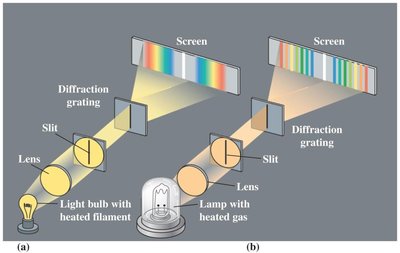
Continuous Spectrum: Produced by hot solids or liquids; contains all wavelengths.
Line Spectrum: Produced by excited gases; contains only specific wavelengths as sharp lines.
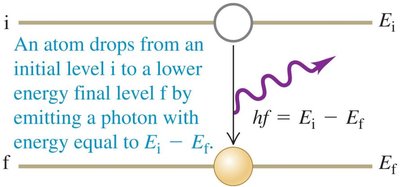
Bohr’s Hypothesis: The energy of a photon emitted or absorbed during a transition between energy levels is given by:
Where h is Planck’s constant (), f is the frequency, and , are the initial and final energies.
For absorption:
Energy differences are often measured in electron volts (eV):
Hydrogen Spectrum
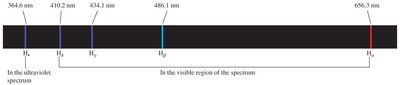
The hydrogen atom, being the simplest atom, has a well-studied emission spectrum. Under certain conditions, it emits light at specific wavelengths, forming the Balmer series in the visible region.
Balmer Series: Four visible lines, labeled , , etc.
Balmer’s Formula: The wavelengths of these lines are given by:
Where is the wavelength, is the Rydberg constant (), and
Energy Levels in the Hydrogen Atom
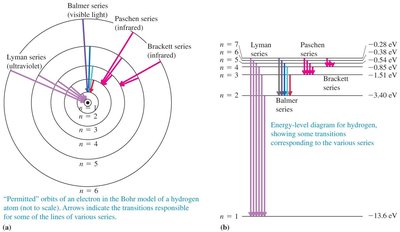
The observed spectral lines correspond to transitions between quantized energy levels in the atom. The Bohr model provides a formula for these energy levels:
Energy Levels: , where
With , so:
Ground State: The lowest energy level (); higher values are excited states.
Photon Emission: Occurs when an atom transitions from a higher to a lower energy state; the photon's energy equals the difference between the two levels.
Worked Example: Discrete Energy Levels
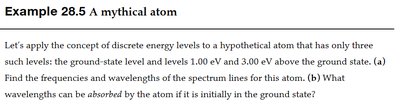
This example applies the concept of discrete energy levels to a hypothetical atom with three levels: ground state, 1.00 eV, and 3.00 eV above ground. It asks for the frequencies and wavelengths of possible spectral lines and the wavelengths that can be absorbed from the ground state.
Practice Problems
Sample problems include calculating the energy required to ionize a hydrogen atom from an excited state and determining the wavelength of photons emitted during specific transitions.

Summary Table: Hydrogen Atom Energy Levels and Series
Series Name | Transition (to n=) | Region | Example Wavelengths (nm) |
|---|---|---|---|
Lyman | 1 | Ultraviolet | 121.6, ... |
Balmer | 2 | Visible | 656.3, 486.1, 434.1, 410.2 |
Paschen | 3 | Infrared | 1875, ... |
Brackett | 4 | Infrared | 4050, ... |
Additional info: Table constructed to summarize the main hydrogen spectral series and their properties for quick reference.
