 Back
BackChapter 29: Light Waves – Huygens’ Principle, Diffraction, Interference, Polarization, and Holography
Study Guide - Smart Notes
 Tailored notes based on your materials, expanded with key definitions, examples, and context.
Light Waves
Introduction
This chapter explores the wave nature of light, focusing on Huygens’ Principle, diffraction, superposition and interference, polarization, and holography. These concepts are fundamental to understanding the behavior of light and its applications in modern physics and technology.
Huygens’ Principle
Definition and Explanation
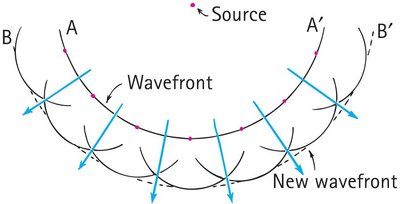
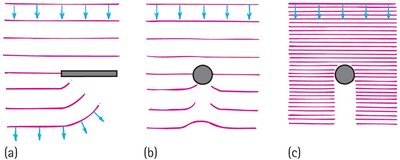
Huygens’ Principle states that every point on a wavefront acts as a source of tiny secondary wavelets that spread out in all directions at the same speed as the original wave. The new position of the wavefront at a later time is the surface tangent to these secondary wavelets.
Wavefront: The locus of points having the same phase in a wave, such as the crest of a water wave.
Huygens’ Principle helps explain how waves propagate, bend, and interact with obstacles.
It applies to all types of waves, including light, sound, and water waves.
Applications and Examples
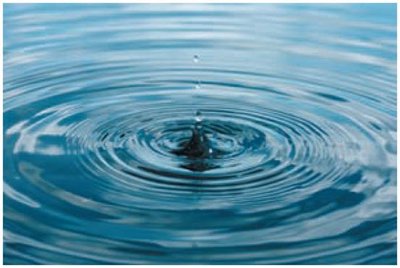
Throwing a rock into a pond creates circular wavefronts, illustrating secondary wavelets.
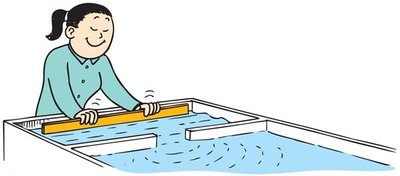
Plane waves can be generated by moving a straightedge in water, showing how wavefronts are constructed from secondary sources.
Diffraction
Definition and Properties
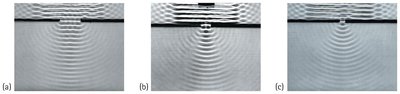
Diffraction is the bending of waves around obstacles or through openings, other than by reflection or refraction. It is a property of all wave types and is especially noticeable when the size of the obstacle or opening is comparable to the wavelength of the wave.
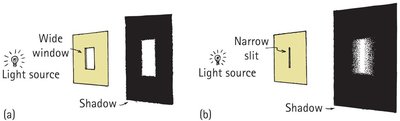
Diffraction explains why shadows have fuzzy edges and why waves can bend around corners.
The amount of diffraction increases as the size of the opening decreases relative to the wavelength.
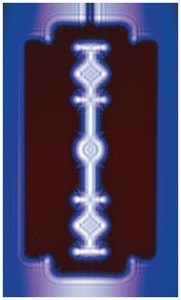
Dependence on Wavelength and Opening Size
When the opening is much larger than the wavelength, the shadow is sharp with slight fuzziness at the edges.
When the opening is narrow (comparable to the wavelength), diffraction is more pronounced, and the shadow is much fuzzier.
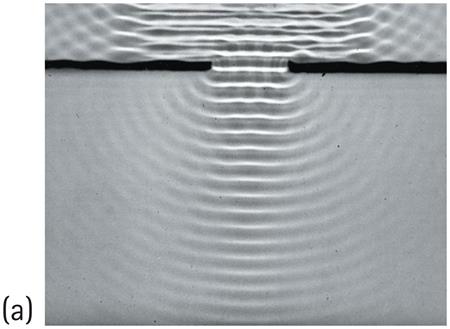
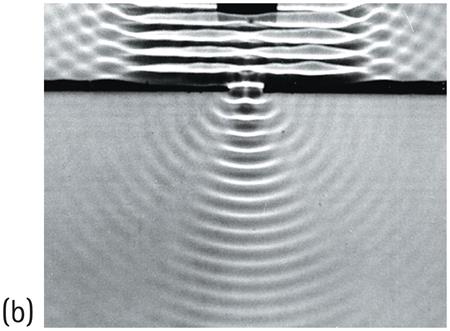
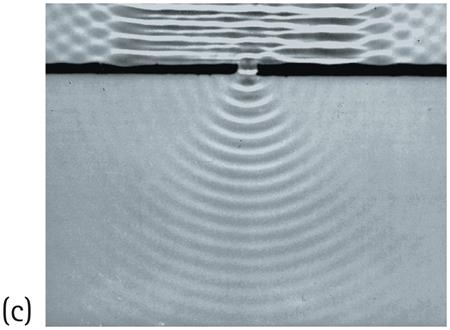
Applications and Limitations
Diffraction limits the resolution of optical instruments (e.g., microscopes, telescopes).
Electron microscopes use shorter wavelengths to overcome diffraction limits and resolve smaller details.
Longer radio waves diffract better around obstacles, improving reception.
Dolphins use ultrasound (shorter wavelengths) for detailed echolocation.
Superposition and Interference
Superposition Principle
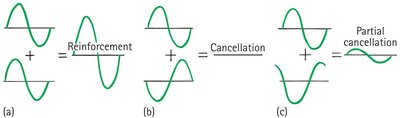
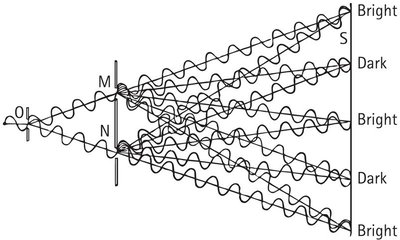
The superposition principle states that when two or more waves overlap, the resulting wave displacement at any point is the sum of the displacements of the individual waves at that point.
Constructive interference: Waves reinforce each other, producing a larger amplitude (bright regions).
Destructive interference: Waves cancel each other, producing a smaller or zero amplitude (dark regions).
Interference Patterns
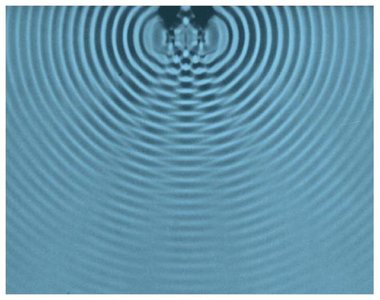
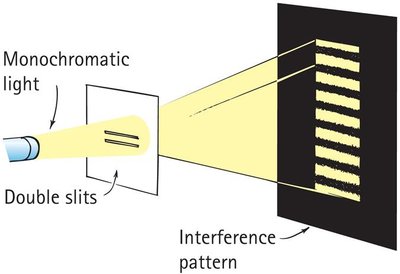
When waves from two sources overlap, they create an interference pattern of alternating bright and dark regions due to constructive and destructive interference.
Double-slit experiments with light demonstrate interference patterns, confirming the wave nature of light.

Thin-Film Interference
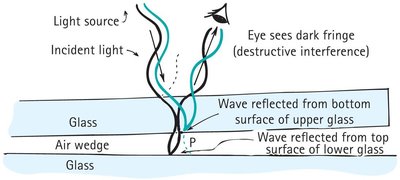
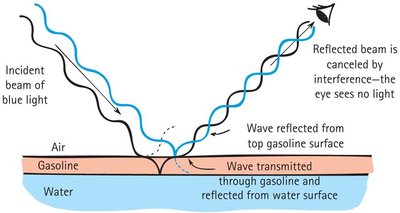
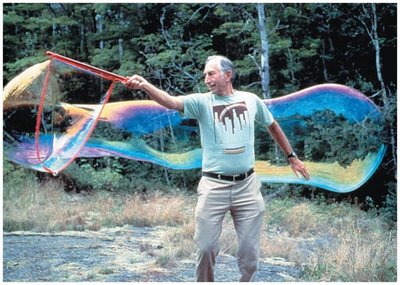
Thin films (such as oil on water or soap bubbles) produce colorful patterns due to interference between light reflected from the upper and lower surfaces of the film.
The color observed depends on the thickness of the film and the wavelength of light.
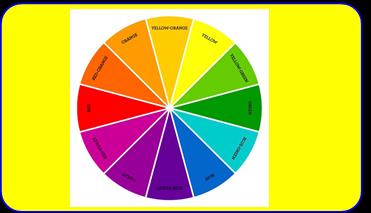
Destructive interference cancels certain wavelengths, resulting in the appearance of complementary colors.
Diffraction Grating
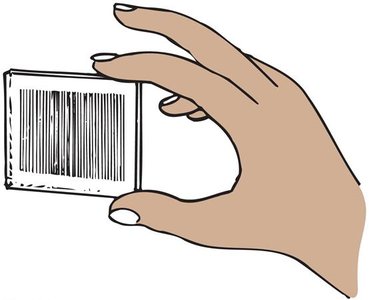
A diffraction grating consists of many closely spaced slits that disperse light into its component colors, producing a spectrum. It is used in spectrometers to analyze light sources.
Polarization
Unpolarized and Polarized Light
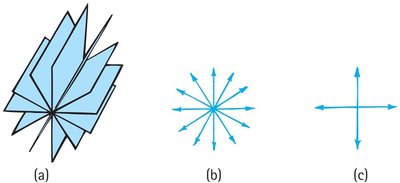
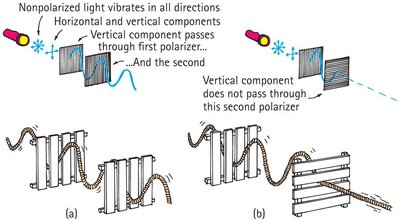
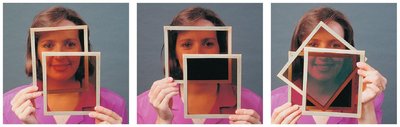
Unpolarized light consists of waves vibrating in random directions perpendicular to the direction of propagation. Polarized light consists of waves vibrating in a single plane.
Common sources of unpolarized light: incandescent lamps, fluorescent lamps, candle flames.
Polarization can be achieved by passing light through a polarizing filter, which only transmits waves vibrating in a specific direction.
Properties and Applications
Only transverse waves (such as light) can be polarized; longitudinal waves (such as sound) cannot.
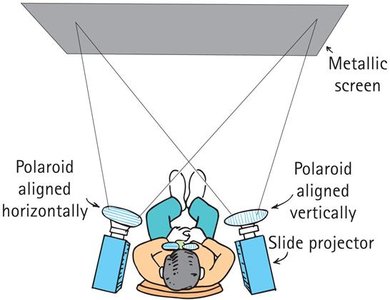
Polarization is used in sunglasses, photography, LCD screens, and 3D movie technology.
Three-Dimensional Viewing
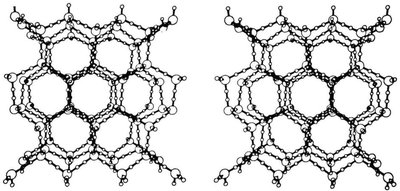
3D vision relies on each eye receiving a slightly different image. Polarized glasses and projectors can be used to deliver separate images to each eye, creating a stereoscopic effect.
Holography
Definition and Principles
Holography is a technique for creating three-dimensional images (holograms) using the interference of coherent light, typically from a laser. Each point on the object reflects light to the entire photographic plate, so every part of the plate contains information about the whole object.
Holograms require coherent light (single frequency, in phase) for accurate 3D reconstruction.
Applications include data storage, security, and advanced imaging.
