 Back
Chapter 29: Magnetic Fields – Physics with Calculus Study Notes
Study Guide - Smart Notes
 Tailored notes based on your materials, expanded with key definitions, examples, and context.
Magnetism and Magnetic Fields
What is Magnetism?
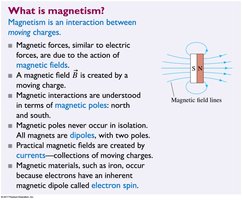
Magnetism is a fundamental interaction arising from moving electric charges. It is closely related to electricity but distinct in its effects and properties. Magnetic forces are due to the action of magnetic fields, and these fields are created by moving charges.
Magnetic field (\(\vec{B}\)): Created by moving charges, such as electric currents.
Magnetic poles: All magnets have two poles, north and south, which never occur in isolation.
Dipoles: All magnets are dipoles, possessing both north and south poles.
Electron spin: Magnetic materials like iron are magnetic because electrons have an inherent magnetic dipole called electron spin.
Why is Magnetism Important?
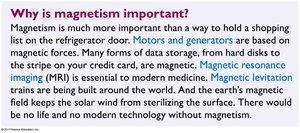
Magnetism is essential in many aspects of modern technology and natural phenomena. It is the basis for motors, generators, data storage, medical imaging, and even the protection of life on Earth.
Motors and generators: Operate using magnetic forces.
Data storage: Hard disks and credit card stripes use magnetic materials.
Magnetic resonance imaging (MRI): Critical for medical diagnostics.
Magnetic levitation trains: Use magnetic fields for frictionless travel.
Earth's magnetic field: Shields the planet from solar wind.
Properties and Behavior of Magnets
Magnetic Poles and Forces
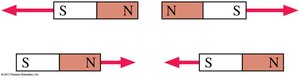
Magnets have two poles: north and south. Like poles repel, and opposite poles attract. This behavior is analogous to electric charges but with important differences.
Repulsion: North-north and south-south poles repel each other.
Attraction: North-south poles attract each other.
Compass Needles and Bar Magnets
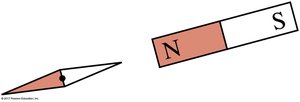
A compass needle is itself a small bar magnet. The north pole of a bar magnet attracts one end of the compass needle and repels the other, demonstrating the dipole nature of magnets.
Compass: Used to identify the poles of a magnet.
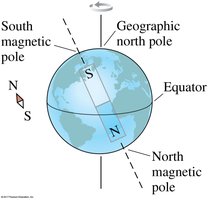
Alignment: The north pole of a compass points toward the geographic north, which is actually a south magnetic pole.
Cutting a Bar Magnet
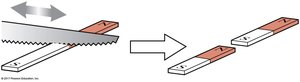
When a bar magnet is cut in half, each piece becomes a complete magnet with both a north and a south pole. This property persists even at microscopic scales.
Indivisibility of poles: Magnetic poles always come in pairs.
Microscopic magnets: Even tiny fragments retain both poles.
Magnetic Materials
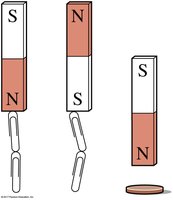
Magnets attract certain materials, such as iron and steel, but not others like copper, aluminum, glass, or plastic. Materials attracted to magnets are called magnetic materials.
Iron and steel: Common magnetic materials.
Non-magnetic materials: Copper, aluminum, glass, and plastic are unaffected by magnets.
Magnetism vs. Electricity
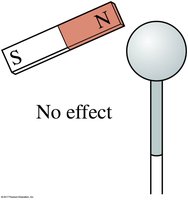
Magnetism is not the same as electricity. While both are long-range forces, magnetic poles are not equivalent to electric charges. Charges have no direct effect on magnets except through polarization forces.
Polarization force: Weak attractive force from a charged rod, similar to effects on non-magnetic metals.
Distinct nature: Magnetism arises from moving charges, not static ones.
Earth's Magnetism and Compasses
Geomagnetism
The Earth acts as a giant magnet due to currents in its molten iron core. The magnetic poles are offset from the geographic poles, and the geographic north pole is actually a south magnetic pole.
Earth's magnetic field: Protects the planet from solar wind.
Compass alignment: Compasses align with Earth's magnetic field.
Magnetic Force on a Compass
A compass needle in a magnetic field experiences forces on its poles, resulting in a torque that aligns the needle with the field. The force on the north pole is parallel to the field, while the force on the south pole is opposite.
Torque: Rotates the needle to align with the magnetic field.
Field direction: The needle points in the direction of the field.

Magnetic Field Models
Important Magnetic Field Configurations
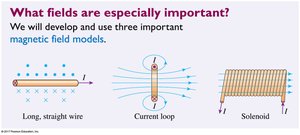
Three key magnetic field models are commonly studied: the field around a long, straight wire, a current loop, and a solenoid. Each configuration produces a distinct pattern of magnetic field lines.
Long, straight wire: Magnetic field forms concentric circles around the wire.
Current loop: Field lines pass through the loop and return outside.
Solenoid: Produces a uniform magnetic field inside the coil.
Magnetic Field Notation and Right-Hand Rule
Notation for Vectors and Currents Perpendicular to the Page
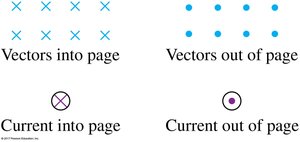
Special notation is used to represent vectors and currents perpendicular to the page. An 'X' denotes a vector into the page, while a dot denotes a vector out of the page.
X: Vector or current into the page.
Dot: Vector or current out of the page.
Right-Hand Rule for Magnetic Fields
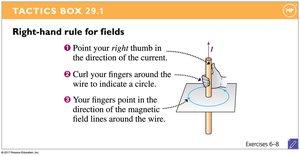
The right-hand rule is used to determine the direction of the magnetic field around a current-carrying wire. Point your right thumb in the direction of the current, and your fingers curl in the direction of the magnetic field lines.
Thumb: Points in the direction of current.
Fingers: Curl in the direction of the magnetic field lines.
Magnetic Forces and Motion
How Charges Respond to Magnetic Fields
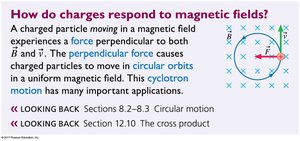
A charged particle moving in a magnetic field experiences a force perpendicular to both the magnetic field (\(\vec{B}\)) and its velocity (\(\vec{v}\)). This force causes the particle to move in circular orbits, a phenomenon known as cyclotron motion.
Perpendicular force: Given by the equation
Circular motion: The force causes charged particles to move in circles in a uniform magnetic field.
Applications: Cyclotron motion is used in particle accelerators and mass spectrometers.
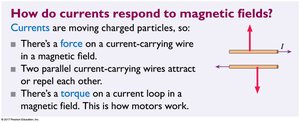
How Currents Respond to Magnetic Fields
Since currents are moving charged particles, they also experience forces in magnetic fields. These forces can cause wires to attract or repel each other, and can exert a torque on current loops, which is the principle behind electric motors.
Force on wire: A current-carrying wire in a magnetic field experiences a force.
Attraction/repulsion: Two parallel current-carrying wires can attract or repel each other.
Torque on loop: A current loop in a magnetic field experiences a torque.
Summary Table: Comparison of Magnetism and Electricity
Property | Magnetism | Electricity |
|---|---|---|
Source | Moving charges (currents) | Static or moving charges |
Poles/Charges | Always dipoles (north & south) | Can be monopoles (positive or negative) |
Force Direction | Perpendicular to velocity and field | Along the line joining charges |
Field Lines | Closed loops | Begin and end on charges |
Additional info: Table inferred for academic completeness, summarizing key differences between magnetism and electricity.
